





 +91 88949 00142
 +1 (307) 435-9605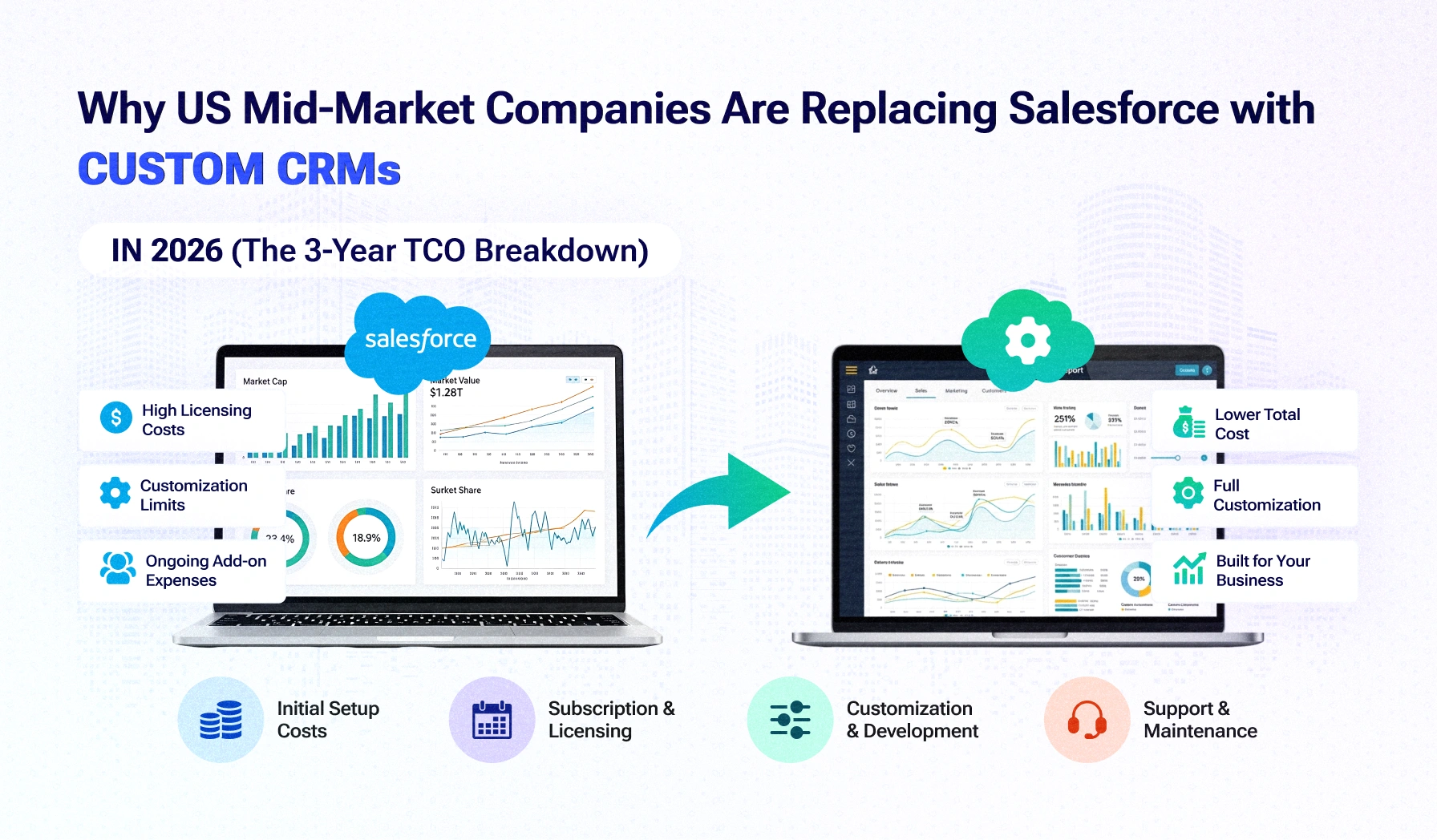
- The "Seat Tax" Tipping Point : Commercial SaaS platforms charge roughly $150–$300 per user per month. For a 50-seat team, that is $285,000+ in licensing over three years with zero asset equity.
- The Custom Build Economic Advantage : A bespoke custom CRM built on modern open-source stacks (Laravel, React, PostgreSQL) requires a one-time development investment of $45,000 to $65,000, with annual hosting and maintenance costs of roughly $6,000/year.
-
3-Year Net Savings
: Companies that migrate from Salesforce to a custom CRM save over 70% ($200,000+) while eliminating artificial seat limits for future hiring.
- Native AI Ownership : Commercial platforms charge steep add-on fees for basic AI copilots. A custom CRM allows businesses to embed private, fine-tuned LLMs directly into lead-scoring and automated follow-up workflows with zero per-user surcharges.
The 2026 Enterprise SaaS Crisis: Why “Seat Taxes” Are Crushing Mid-Market Margins
Across the United States, mid-market enterprise leaders are confronting a financial reality: software subscription sprawl has become a tax on company growth.
When an organization scales from 25 to 75 sales reps, account managers, and field technicians, commercial CRM vendors reward that expansion not with volume discounts, but with escalating annual renewal quotes. Every new employee requires an additional software license, mandatory support tier, and API quota upgrade.
Furthermore, commercial systems force companies into rigid workflows. Sales teams find themselves performing excessive manual data entry into bloated, slow-loading interfaces just to satisfy vendor database structures. As a result, software designed to increase sales velocity often decelerates day-to-day operations.
For growing businesses, custom software development is no longer an experimental luxury—it has become a necessary capital reallocation strategy.
The 3-Year TCO Breakdown: Salesforce Enterprise vs. Custom Built CRM
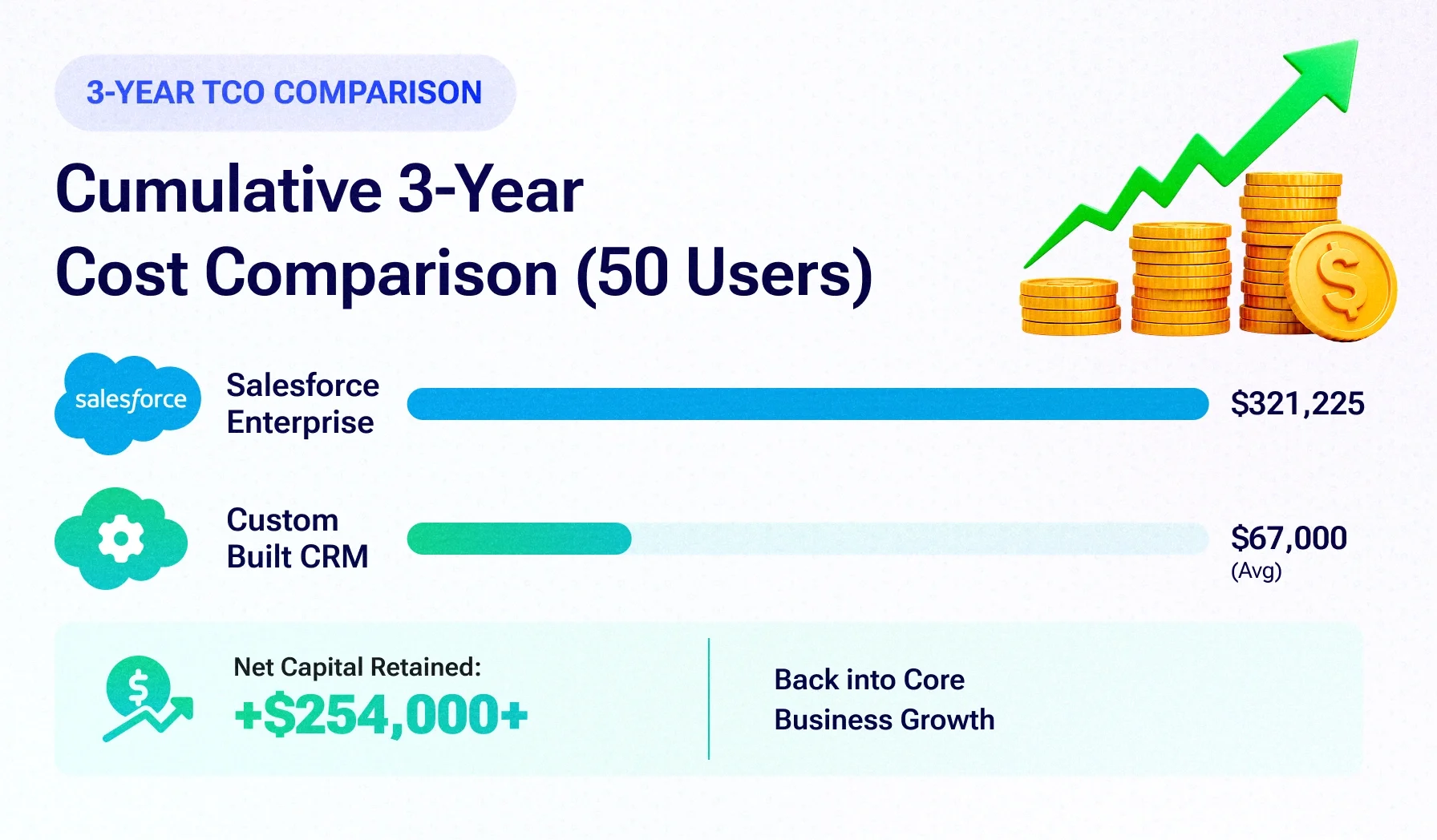
To understand the financial case, consider the three-year Total Cost of Ownership (TCO) for a standard US business operating 50 active CRM seats:
| Financial & Technical Dimension | Salesforce Enterprise (50 Users) | Suave Creators Custom CRM (Client-Owned) |
|---|---|---|
| Year 1 Base Licensing Fees | $90,000 ($150/user/mo billed annually) | $0 (Zero recurring seat fees) |
| Year 1 Onboarding & Customization | $25,000 (Third-party certified consultant setup) | $45,000 – $65,000 (Complete discovery, UI/UX, and production build) |
| Year 2 Base Licensing (5% Renewal Hike) | $94,500 | $0 |
| Year 2 Infrastructure & Maintenance | $5,000 (Add-on storage and API overages) | $6,000 (Dedicated AWS/GCP cloud hosting, database backups & patches) |
| Year 3 Base Licensing (Compounded) | $99,225 | $0 |
| Year 3 Infrastructure & Maintenance | $7,500 (Tier adjustments) | $6,000 (Dedicated cloud infrastructure & routine maintenance) |
| 3-Year Cumulative Capital Spend | $321,225 (Pure operational expense; zero equity) | $57,000 – $77,000 (Balance-sheet company asset) |
| Net 3-Year Capital Savings | Baseline | $244,225 – $264,225 (>75% savings) |
| Cost per Additional Hire | +$1,800 to +$3,600 / year | $0 / year (Unlimited users) |
| Data & Pipeline Ownership | Vendor-hosted proprietary cloud | 100% client sovereignty (private cloud) |
5 Operational Breaking Points: When It’s Time to Build a Custom CRM
Cost alone is rarely the sole trigger. Companies reach an operational breaking point where generic platforms actively inhibit commercial velocity.
1.Your Workflow Deviates from Standard SaaS Templates
If your business operates in specialized verticals—such as freight forwarding, bespoke manufacturing, or multi-clinic healthcare—off-the-shelf CRM fields break down. Teams end up maintaining secondary "shadow spreadsheets" in Excel or Google Sheets to track real operational milestones. A custom CRM maps directly to your operational schema.
2.You Want Native AI Automation Without Per-Token Markup
Commercial CRM providers charge steep add-on premiums for proprietary AI assistants. When you build a custom CRM with a partner like Suave Creators, our architects integrate native Large Language Model (LLM) pipelines directly into your application. Your system can perform automated lead qualification, call sentiment analysis, and context-aware email drafting without sharing customer data with public models.
3. High-Turnover Roles Inflate Inactive License Cost
In businesses that employ seasonal sales reps, contracted SDRs, or external brokers, managing license de-provisioning in Salesforce is an administrative burden. Paying full enterprise seat fees for part-time or low-touch users drains operational capital. A custom CRM allows you to configure granular role-based permissions (RBAC) for thousands of users at zero marginal licensing cost.
4. Disconnected Internal Systems and API Rate Limits
Off-the-shelf software imposes strict daily API call governors. When attempting to synchronize high-volume customer telemetry, billing records from Stripe, or inventory data from an internal ERP, commercial platforms trigger overage penalties. A custom CRM features unrestricted internal database queries and custom GraphQL or REST endpoints.
5. Data Privacy, Compliance & Single-Tenant Requirements
Sharing a multi-tenant cloud environment with thousands of other corporations can complicate compliance audits for US businesses subject to strict HIPAA, SOC 2, or FINRA oversight. A custom CRM gives you an isolated single-tenant database deployed on your private AWS or Google Cloud account with AES-256 bit encryption at rest and in transit.
Technical Architecture: How an Enterprise-Grade Custom CRM Is Built in 2026
Modern custom CRM engineering does not mean reinventing basic web infrastructure. By leveraging battle-tested frameworks, senior teams deliver enterprise-grade performance in 8 to 16 weeks.
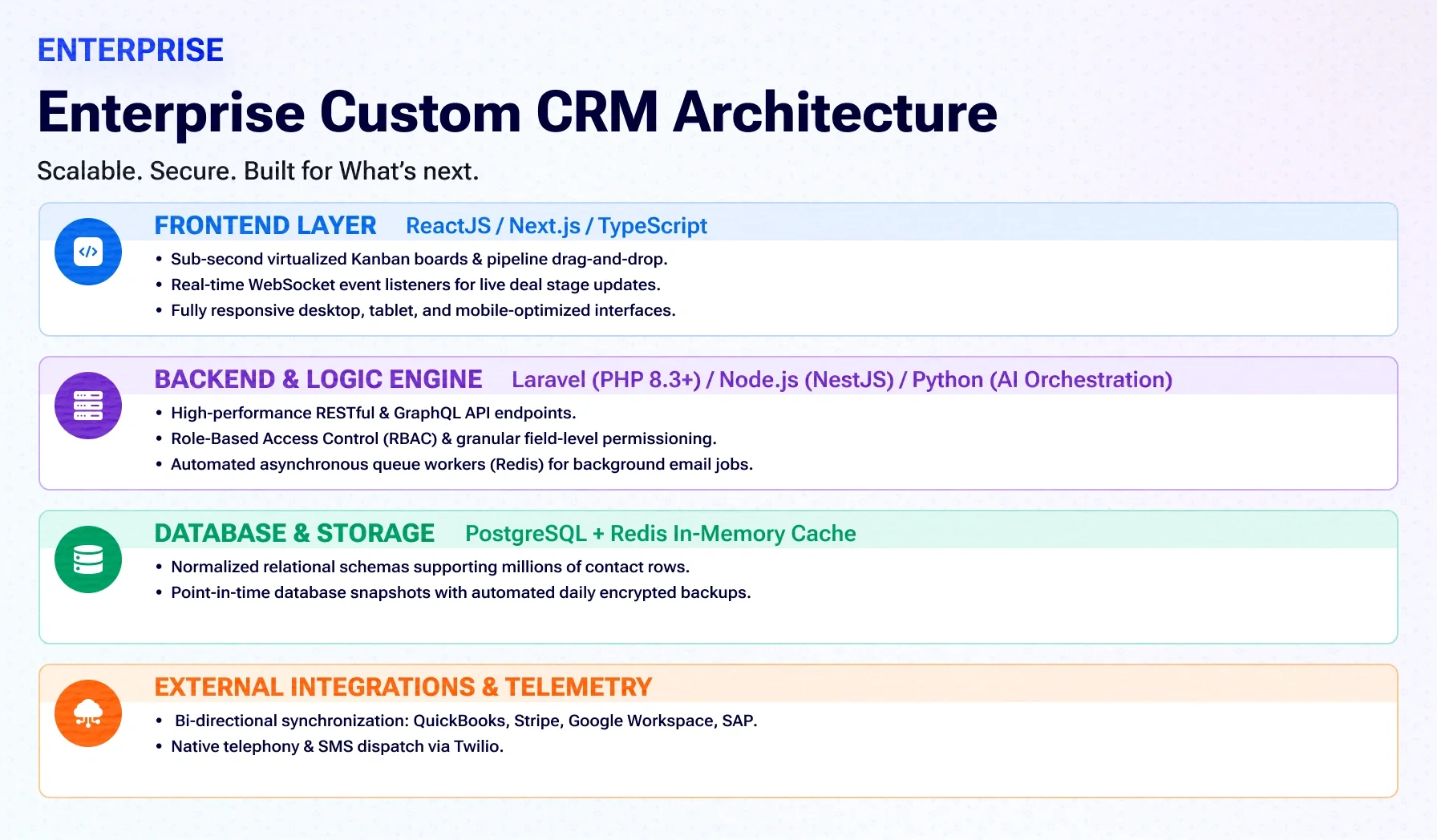
| Layer | Stack & Capabilities |
|---|---|
| Frontend Layer | React / Next.js / TypeScript — Sub-second virtualized Kanban boards & pipeline drag-and-drop — Real-time WebSocket event listeners for live deal stage updates — Fully responsive desktop, tablet, and mobile-optimized interfaces |
| Backend & logic Engine | Laravel (PHP 8.3+) / Node.js (NestJS) / Python (AI orchestration) — High-performance RESTful & GraphQL API endpoints — Role-Based Access Control (RBAC) & granular field-level permissioning — Automated asynchronous queue workers (Redis) for background email jobs |
| Database & storage | PostgreSQL + Redis In-Memory cache — Normalized relational schemas supporting millions of contact rows — Point-in-time database snapshots with automated daily encrypted backups |
| Integrations & telemetry | Bi-directional sync with QuickBooks, Stripe, Google Workspace, and SAP
— Native telephony & SMS dispatch via Twilio |
Explore the full capability set on our Custom CRM Builder & Development Services hub, or review how we approach broader engineering services for mid-market teams.
The Salesforce/HubSpot Data Migration Playbook
One of the most common executive concerns is: “How do we move years of historical records without disrupting our sales team?”
At Suave Creators, we follow a strict 5-phase zero-downtime migration framework:
5-phase zero-downtime migration
- Schema Auditing & Sanitization: We catalog all standard and custom objects (Leads, Contacts, Accounts, Opportunities, Notes, and Activity Histories). Duplicate records and obsolete custom fields are cleaned before migration.
- Relational Field Mapping: We map legacy relationships into normalized PostgreSQL tables, preserving historical creation timestamps, sales rep attribution, and conversation notes.
- Staging Dry Runs & Data Validation: We execute complete test migrations on an isolated staging server. Stakeholders verify record counts, account hierarchies, and pipeline values against the production Salesforce database.
- Delta Synchronization: Over a scheduled weekend cutover window, we run an automated differential script that captures all delta changes made during the testing phase.
- Zero-Downtime Production Cutover: The sales team signs off on the new, intuitive interface on Monday morning with zero lost pipeline context.
Real-World Proof: How We Cut Sales Administrative Time by 35%
In our work engineering a custom pipeline for high-velocity B2B sales teams, Suave Creators replaced disconnected subscription software with an integrated sales workspace.
As documented in our B2B CRM Outbound Sales Case Study:
-
Eliminated Multi-Tool Chaos: Combined prospect discovery, cold email outreach sequencing, and deal stage management into a single tab
-
+35% Administrative Efficiency: Streamlined prospecting workflows from twelve disconnected manual steps down to four automated actions
-
$0 in Per-Seat Fees: The company scaled its outbound team by 40% without incurring additional SaaS subscription expenses.
- Complete Data Ownership: Historical pipeline data remains stored inside the organization's private cloud rather than a third-party vendor database.
Similarly, in our logistics engineering engagement for Turbo Trans Corporation, our custom software platform automated real-time dispatch and quote calculations that standard commercial software could not support.
Stop Paying the “Seat Tax” on Your Sales Team’s Growth
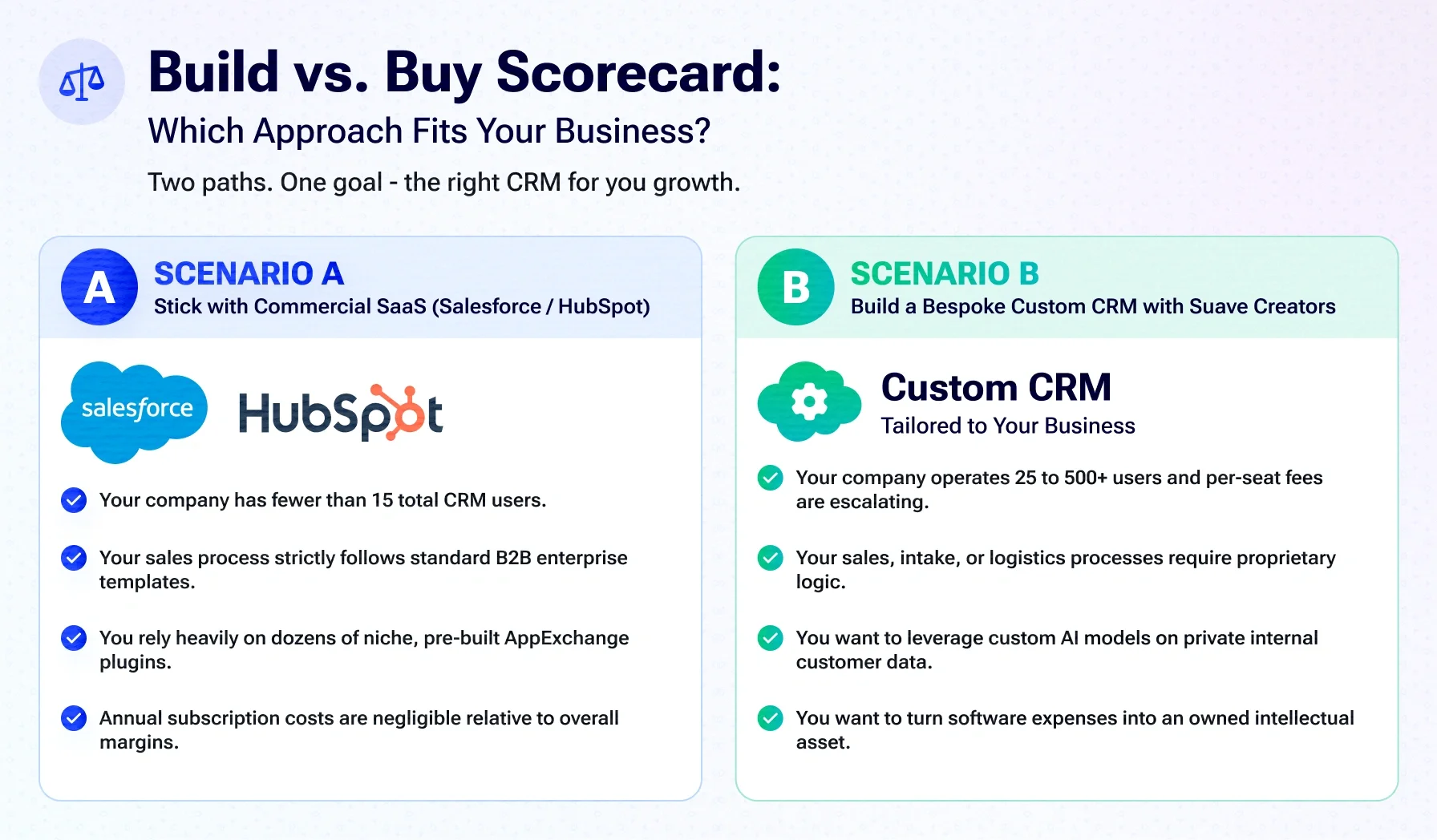
Your CRM should be a competitive asset that accelerates your sales team—not an escalating operational expense that penalizes hiring.
Ready to explore what a custom CRM architecture looks like for your business?
-
Explore Our Engineering Capabilities: Visit our dedicated Custom CRM Builder & Development Services hub.
- Calculate Your Exact Savings: Schedule a Free CRM Discovery Consultation with a senior software architect today.
- Learn who we are :Read more About Suave Creatorsand how we partner with US mid-market teams.