

Technology stack

Technologies & Development Stack for Web, Mobile and E-commerce Applications

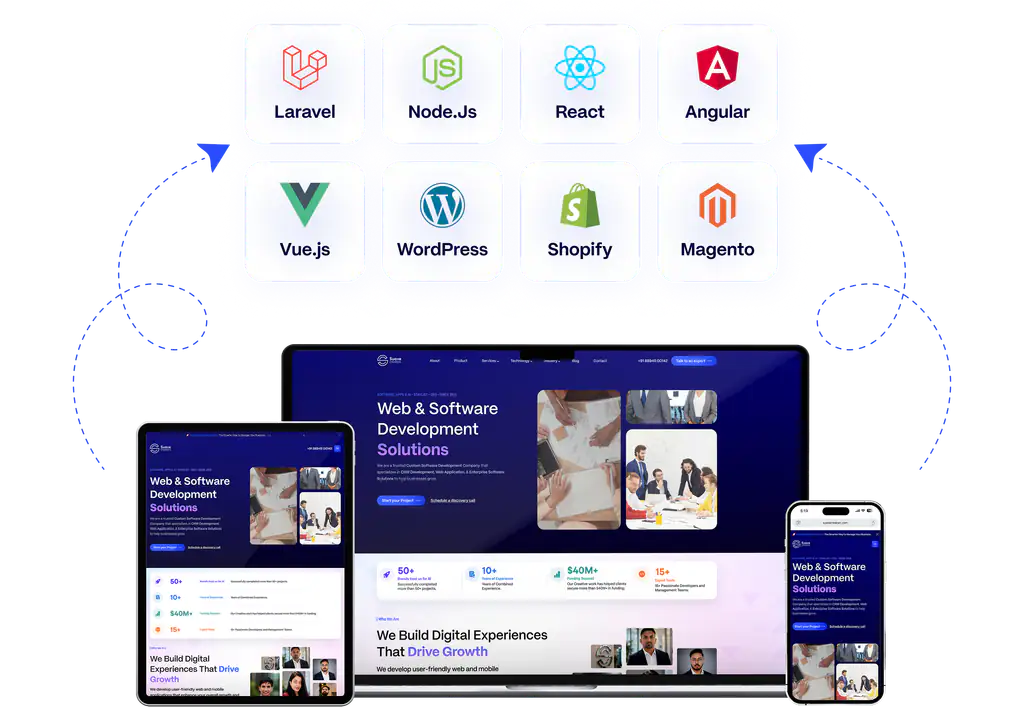
Suave Creators builds custom web applications, mobile apps, enterprise systems, content platforms and e-commerce stores on eight proven technologies: Laravel (PHP), Node.js, React & React Native, Angular, Vue.js, WordPress & Headless CMS, Shopify Plus and Magento (Adobe Commerce). We choose the stack during discovery, based on your data, integrations, traffic and who will maintain the system after launch.

Get a Scoped Estimate
  • 100% code and
    IP ownership
  • Direct senior
    architect access
  • Transparent
    2-week sprints
Laravel React and ecommerce technology logos with web software development previews

Full stack

Our Technology Stack

Suave Creators uses Laravel and Node.js for back-end development, React, Angular and Vue.js for web front ends, React Native for cross-platform mobile apps, WordPress and headless CMS setups for content platforms, and Shopify Plus and Magento (Adobe Commerce) for e-commerce. Laravel is our primary back-end framework.

  • Laravel (PHP)

    Back end

    Typical use: Secure APIs, CRM and ERP platforms, database-heavy business applications

  • Node.js

    Back end

    Typical use: Real-time features, WebSockets, microservices, streaming APIs

  • React

    Front end

    Typical use: Interactive web interfaces, dashboards, single-page applications

  • React Native

    Mobile

    Typical use: iOS and Android apps from one codebase

  • Angular

    Front end

    Typical use: Enterprise administration portals, large structured front ends

  • Vue.js

    Front end

    Typical use: Lightweight reactive interfaces, progressive single-page applications

  • Typical use: Marketing sites, publishing, decoupled content delivery

  • Shopify Plus

    E-commerce

    Typical use: High-volume stores, custom themes, headless storefronts

  • Typical use: B2B commerce, multi-store and multi-currency catalogs

Back end

Backend Development: Laravel and Node.js

The back end holds your business rules, data and integrations. We use Laravel for most business applications, and Node.js where the workload is dominated by many simultaneous connections or real-time events.

Laravel (PHP)

Laravel is an open-source PHP web framework built on the model-view-controller (MVC) pattern. It ships with routing, the Eloquent ORM, database migrations, queues, authentication and testing tools, so teams spend their time on business logic instead of plumbing. It is Suave Creators' primary back-end framework.

What we build

  • REST APIs that serve web front ends and mobile apps
  • Custom CRM and ERP platforms with roles, permissions, workflows and reporting
  • Enterprise web applications and customer portals
  • Database-driven systems with complex relationships, versioned migrations and background jobs
  • Integrations with third-party tools through APIs and webhooks

Why businesses choose it

Laravel suits applications with a lot of business logic and relational data. Its conventions make a codebase predictable for the next developer, migrations keep database changes versioned with the code, and queues move slow work such as imports, emails and AI calls out of the user's request. PHP hosting and PHP developers are widely available, which keeps long-term maintenance practical.

Consider a different fit when

The core of the product is thousands of long-lived real-time connections, such as live chat or vehicle tracking. A common pattern is a Laravel core with a separate Node.js service for the real-time layer.

Works with

React, Vue.js or Angular front ends · React Native apps through Laravel APIs · Node.js services for real-time features

Node.js

Node.js is an open-source JavaScript runtime built on Google's V8 engine. Its event-driven, non-blocking I/O model lets one process handle many simultaneous connections efficiently, which makes it a strong fit for real-time and I/O-heavy workloads.

What we build

  • Real-time features over WebSockets: live dashboards, notifications, chat and tracking
  • Microservices that split a large system into independently deployable parts
  • Lightweight and streaming API back ends, including streamed responses from AI models
  • Integration and webhook-processing services

Why businesses choose it

One language, JavaScript or TypeScript, across front end and back end; efficient handling of high concurrency; and the npm ecosystem, which covers almost every integration.

Consider a different fit when

The work is CPU-heavy, such as large report generation or image processing. Long computations block Node's event loop, so they belong in worker threads, a queue or a separate service.

Works with

React, Vue.js and Angular front ends · Laravel back ends · React Native apps

Laravel or Node.js?

If your application…

Start with

Is heavy on business rules and relational data (CRM, ERP, portals)

Laravel

Holds many live connections (chat, tracking, live dashboards)

Node.js

Needs both

Laravel Node.js Laravel core + Node.js real-time service

Front end

Frontend and Web Application Development: React, Angular and Vue.js

All three build fast, component-based interfaces. The right one depends on the size of the application, how many teams will work on it, and how much built-in structure you want.

React

React is an open-source JavaScript library, maintained by Meta, for building user interfaces from reusable components. It re-renders only the parts of a page whose data changed, which keeps complex interfaces responsive.

What we build

  • Responsive web application front ends and single-page applications
  • Dashboards and data-heavy admin screens
  • Customer portals
  • Front ends for headless CMS and headless commerce builds

Why businesses choose it

The largest ecosystem and hiring pool of the three; it pairs with any API back end; and its component logic carries over to mobile apps through React Native, part of the same React & React Native practice.

Works with

Laravel or Node.js APIs · React Native · headless WordPress · Shopify's Hydrogen framework, which is built on React

Angular

Angular is an open-source, TypeScript-based front-end framework maintained by Google. Unlike React, it is a complete framework: routing, forms, an HTTP client and built-in dependency injection come as standard, which gives large teams one consistent structure.

What we build

  • Complex administration portals
  • Internal enterprise tools with many forms, roles and workflows
  • Long-lived front ends maintained by several teams

Why businesses choose it

Enforced structure and TypeScript typing reduce drift in large codebases, and modular dependency injection keeps parts testable and replaceable.

Consider a different fit when

You are building a small interactive site or marketing pages. Angular's structure adds overhead there; React or Vue.js is lighter.

Vue.js

Vue.js is an open-source progressive JavaScript framework for building user interfaces. "Progressive" means it can enhance one part of an existing page or scale up to a full single-page application.

What we build

  • Lightweight reactive interfaces
  • Progressive single-page applications
  • Interactive components added to existing server-rendered applications, such as Laravel pages

Why businesses choose it

A gentle learning curve, reactive data binding and single-file components. Vue.js also has a long-standing pairing with Laravel; Laravel's official starter kits include a Vue option.

Comparison React Angular Vue.js
Type React UI library Angular Full framework Vue.js Progressive framework
Language React JavaScript or TypeScript Angular TypeScript Vue.js JavaScript or TypeScript
Built-in structure React Flexible; you choose routing and state tools Angular Opinionated; routing, forms and dependency injection included Vue.js Moderate; official router and state tools
Best fit React Interactive apps, dashboards, shared web and mobile code Angular Large enterprise portals, multi-team codebases Vue.js Lightweight apps, adding interactivity to existing pages
Mobile path React React Native Angular — Vue.js —

Mobile app

Mobile Application Development with React Native

React Native

React Native is an open-source framework, created by Meta, for building native iOS and Android apps with React and JavaScript or TypeScript. It renders real native interface components rather than a web page in a wrapper, and most business logic is shared between both platforms.

React Native is the mobile half of our React & React Native practice: the same component patterns, state management and API layer can serve both your web app and your mobile app.

  • Cross-platform apps for customers, field teams and sales teams
  • Mobile companions to web platforms and CRMs
  • Apps that consume Laravel or Node.js APIs
  • iOS and Android notification icon for Suave Creators mobile app development

    iOS + Android

    One codebase targets both platforms natively

  • Shared logic share icon for Suave Creators React Native development

    Shared logic

    Business logic shared with your React web app

  • Native UI code icon for Suave Creators mobile app development

    Native UI

    Real native components, not a web view wrapper

  • API-first link icon for Suave Creators mobile backend development

    API-first

    Connects to any Laravel or Node.js back end

Why businesses choose it

One codebase for two platforms reduces build and maintenance effort, and native modules can be added when a feature needs direct device access.

Consider a different fit when

The app is dominated by heavy 3D graphics or deep platform-specific hardware features; fully native development may justify its extra cost there.

Content platforms

CMS and Content Platforms: WordPress & Headless CMS

WordPress

WordPress is an open-source content management system written in PHP. It lets marketing and content teams publish and update pages without developer involvement.

What we build

  • Custom theme engineering for fast, maintainable sites
  • Marketing and corporate websites
  • Secure enterprise content setups with editorial roles and hardened configuration

Why businesses choose it

A familiar editor for non-technical teams, a large plugin ecosystem, and a PHP base that fits alongside Laravel systems.

Watch-out

Plugin sprawl is the main source of WordPress security and speed problems. Keep plugins few, maintained and updated.

Headless CMS

A headless CMS stores and manages content but delivers it through an API instead of rendering web pages itself. The front end is a separate application, for example in React or Vue.js. This decoupled architecture lets one content source feed a website, a mobile app and other channels. WordPress can run headless through its REST API, so editors keep the familiar dashboard while the public site is built as a modern front end.

Go headless when

The same content must reach several channels, the front end needs full design and performance freedom, or you want the editing system separated from the public site.

Stay traditional when

It is a straightforward marketing site managed by a small team; classic WordPress is simpler and cheaper to run.

E-commerce

E-commerce Platforms: Shopify Plus and Magento (Adobe Commerce)

Shopify Plus

Shopify Plus is Shopify's enterprise plan for high-volume merchants. Shopify hosts, secures and scales the platform, so your team focuses on the storefront, checkout and integrations rather than servers.

What we build

  • Custom Shopify themes
  • Custom app integrations with ERP, CRM and inventory systems (Shopify now calls the older "private apps" custom apps)
  • Headless storefronts built on the Storefront API, including React-based front ends

Why businesses choose it

No infrastructure to manage, enterprise features for checkout customisation and automation, and a fast path to launch.

Consider a different fit when

Catalog, pricing and B2B rules are unusually complex, or you need full control of hosting and code. Magento (Adobe Commerce) or a custom platform may fit better.

Magento (Adobe Commerce)

Magento is an open-source e-commerce platform written in PHP; Adobe Commerce is its commercial edition from Adobe, and Magento Open Source remains the free edition. One installation can run several websites, stores and store views, each with its own currency, language and pricing.

What we build

  • Enterprise B2B commerce with company accounts and shared catalogs
  • Complex multi-store catalogs
  • Multi-currency global retail platforms
  • Integrations with ERP and product data systems

Why businesses choose it

Full code-level customisation, a native multi-store structure and extensive B2B features.

Consider a different fit when

You want minimal hosting and maintenance. Magento needs experienced developers and managed infrastructure; Shopify Plus shifts that work to Shopify.

Shopify Plus vs Magento (Adobe Commerce)

Comparison Shopify Plus Magento (Adobe Commerce)
Hosting Shopify Plus Fully hosted by Shopify Magento (Adobe Commerce) Self-hosted, or Adobe's cloud for Adobe Commerce
Customisation Shopify Plus Themes, apps, checkout extensions, headless Magento (Adobe Commerce) Full code access to every layer
B2B Shopify Plus Native B2B features Magento (Adobe Commerce) Extensive B2B features in Adobe Commerce
Multi-store Shopify Plus Additional stores under one plan Magento (Adobe Commerce) Websites → stores → store views in one installation
Best fit Shopify Plus High-volume brands that want speed and low maintenance Magento (Adobe Commerce) Complex catalogs, B2B buying and global multi-store setups

Stack combinations

How These Technologies Work Together

Most products use more than one of these technologies. These are common combinations and where each leads on our site.

Business need Typical stack Related page
Business need Custom CRM or ERP Build scalable systems with complex data, roles and workflows. Typical stack Laravel API + React or Vue.js Related page Custom CRM development
Business need Enterprise administration portal Run internal tools for roles, approvals and day-to-day operations. Typical stack Laravel API or Node.js + Angular Related page Enterprise software solutions
Business need Real-time tracking or live dashboard Show live status, alerts and tracking on one dashboard. Typical stack Laravel + Node.js + React Related page Logistics and supply chain software
Business need Marketing website your team edits Publish and update campaign pages without a developer. Typical stack WordPress Related page Web application development
Business need Content across web and mobile Serve the same content on the website and the mobile app. Typical stack Headless CMS + React + React Native Related page UI/UX design services
Business need High-volume online store Sell at high volume with a storefront your team can run. Typical stack Shopify Plus or React Related page E-commerce development
Business need B2B or multi-store catalog Manage complex catalogs, B2B buying and ERP-connected stores. Typical stack Magento Related page E-commerce development
Business need AI features in an existing product Add model-backed features to a product you already run. Typical stack Laravel or Node.js Related page AI solutions

Stack selection

How We Choose a Technology Stack

We choose the stack in the discovery phase, before any production code is written. We map your workflows, data model and technical constraints, then recommend the technologies that fit, with the trade-offs written down.

Discovery

  • Your goals
  • Workflows
  • Data model
  • Constraints

Recommended stack

  • Laravel logo for Suave Creators technology stack selection
  • Node.js logo for Suave Creators technology stack selection
  • React logo for Suave Creators technology stack selection
  • Angular logo for Suave Creators technology stack selection
  • Vue.js logo for Suave Creators technology stack selection
  • WordPress logo for Suave Creators technology stack selection
  • Shopify logo for Suave Creators technology stack selection
  • Magento logo for Suave Creators technology stack selection

Right stack. Real results.

  • 01

    Data and business logic.

    Relational, rule-heavy systems favour Laravel; event-heavy systems favour Node.js.

  • 02

    Real-time and concurrency needs.

    Live updates and many open connections point to a Node.js layer.

  • 03

    Who edits content.

    If non-technical teams publish daily, WordPress or a headless CMS belongs in the stack.

  • 04

    Integrations.

    ERP, CRM, payment and inventory systems shape the API design and the commerce platform.

  • 05

    Ownership after launch.

    We favour widely used technologies so your in-house team can hire for and maintain the code you own.

  • 06

    Total cost of ownership.

    Hosting, platform licences and maintenance effort are compared over several years, not just the build.

Why us

Build With Suave Creators

  • In-house software developers code gear icon for Suave Creators

    Full-time in-house developers

    Specialising in Laravel, React, Angular and Node.js, led by senior solution architects.

  • Code and IP ownership security icon for Suave Creators clients

    100% code and IP ownership

    Repositories and intellectual property belong to you.

  • Two-week sprint calendar icon for Suave Creators delivery

    Transparent 2-week sprints

    Direct access to the architect and lead developer.

  • Documented stack decisions document icon for Suave Creators

    Documented stack decisions

    Stack decisions documented during discovery, so the reasoning outlives the project.

Frequently Asked Questions

Technology FAQs

Suave Creators builds with eight core technologies: Laravel (PHP) and Node.js for back ends, React, Angular and Vue.js for web front ends, React Native for cross-platform mobile apps, WordPress and headless CMS setups for content platforms, and Shopify Plus and Magento (Adobe Commerce) for e-commerce. Laravel is our primary back-end framework.

Get started

Discuss Your Technology Stack With a Solution Architect

Tell us what you're building and what you run today. A solution architect will recommend a stack, explain the trade-offs and give you a scoped estimate, whether you need a full project team or developers who join yours.

Get a Scoped Estimate
Suave Creators software developer ready for a project consultation
Suave Creators product specialist available for consultation
Suave Creators technology leader for web development consultation
Suave Creators project lead for CRM and software consulting
Suave Creators UI UX designer for product consultation
Suave Creators software consultant ready for a digital project discussion

Our Partnerships & Growth Stack

  • VerySoul logo partner of Suave Creators software development
  • RedSixity logo partner of Suave Creators digital solutions
  • DAJJ Logistics logo partner of Suave Creators web development
  • Ematrics logo partner of Suave Creators custom software
  • BioAssay Systems logo partner of Suave Creators technology services