





 +91 88949 00142
 +1 (307) 435-9605
In today's fast-paced business landscape, agility is key. Companies need to adapt quickly, and traditional software development can be a bottleneck. Enter low-code development—a game-changing approach that allows you to build applications with minimal coding effort.
Low-code development is revolutionizing how businesses create applications. This post explores its benefits, key features, and why adopting low-code solutions can drastically enhance your operational efficiency and speed up your time to market.
Low-code platforms empower teams to develop, test, and deploy applications faster than ever before. This not only saves valuable time and resources but also promotes collaboration between IT and business units.
The Rise of Low-Code: What You Need to Know🔗
Low-code development is not just a trend; it's becoming a necessity. Here are a few reasons why:
Accelerated Development Times: With pre-built templates and drag-and-drop interfaces, developers can create applications in a fraction of the time.
Empowerment of Non-Technical Users: Business analysts and other non-technical staff can contribute to app development, reducing reliance on IT.
Cost Efficiency: By streamlining development, businesses can significantly cut down on labor costs and time-to-market.
Enhanced Collaboration: Low-code platforms foster closer collaboration between IT and business teams, leading to more relevant solutions.
Key Features of Low-Code Platforms🔗
When exploring low-code options, consider these essential features:
Visual Development Tools: Simplifies the design process, allowing users to see their changes in real time.
Integration Capabilities: Seamlessly connects with existing systems and third-party services, enhancing functionality.
Scalability: Allows businesses to start small and expand their applications as needs grow.
Robust Security Features: Ensures that applications comply with industry standards and protect sensitive data.
Challenges and Considerations🔗
While low-code development offers numerous advantages, it's essential to be aware of potential challenges:
Vendor Lock-In: Some platforms may tie you to their ecosystem, making future changes difficult.
Limited Customization: Complex applications may still require traditional coding for specific functionalities.
Quality Control: Ensuring that non-developers create high-quality applications can be challenging.
How to Get Started with Low-Code Development🔗
Ready to dive into low-code? Here’s how you can begin:
Assess Your Needs: Identify areas in your business where low-code can provide the most value.
Choose the Right Platform: Evaluate different low-code solutions based on features, usability, and integration options.
Train Your Team: Provide training for both technical and non-technical staff to maximize the platform's potential.
Start Small: Begin with a pilot project to test the waters before scaling up.
Real Business Use Cases of Low-Code Development🔗
Low-code development is helping organizations across industries build applications faster, automate processes, and improve operational efficiency. By reducing development time and enabling rapid innovation, businesses can respond quickly to changing market demands while minimizing costs. Here are some common ways organizations are leveraging low-code platforms:
Workflow Automation: Streamline repetitive business processes such as approvals, leave requests, expense management, and document routing.
Customer Relationship Management (CRM): Develop customized CRM systems to manage customer interactions, sales pipelines, and support requests.
Employee Portals: Create centralized portals for onboarding, HR services, training, and internal communication.
Inventory and Supply Chain Management: Build applications to track inventory levels, manage warehouse operations, and monitor shipments in real time.
Project and Task Management: Design collaborative dashboards that help teams manage projects, assign tasks, and track progress efficiently.
Customer Self-Service Portals: Enable customers to submit requests, track orders, access documents, and receive support without manual intervention.
Healthcare and Insurance Applications: Develop patient management systems, appointment scheduling platforms, claims processing solutions, and secure document management tools.
Business Reporting and Dashboards: Build interactive dashboards that consolidate data from multiple systems, providing real-time insights for informed decision-making.
These real-world applications demonstrate how low-code development empowers businesses to solve operational challenges, improve productivity, and deliver better experiences for both employees and customers—all while significantly reducing development time compared to traditional software development.
Industries Benefiting from Low-Code Development🔗
Low-code development is transforming the way organizations across industries build and deploy business applications. Its ability to accelerate development, automate workflows, and simplify digital transformation makes it a valuable solution for businesses of all sizes. From streamlining internal operations to improving customer experiences, low-code platforms are helping organizations innovate faster and respond more effectively to evolving market demands.
Some of the industries benefiting from low-code development include:
Healthcare: Develop patient portals, appointment scheduling systems, electronic health record (EHR) solutions, and healthcare workflow automation.
Banking and Financial Services: Build secure customer portals, loan processing systems, compliance workflows, and financial reporting applications.
Insurance: Automate policy management, claims processing, customer onboarding, and document management.
Retail and E-commerce: Create inventory management systems, order tracking applications, customer loyalty programs, and personalized shopping experiences.
Manufacturing: Streamline production workflows, quality inspections, equipment maintenance tracking, and supply chain operations.
Logistics and Supply Chain: Develop shipment tracking platforms, warehouse management systems, fleet management applications, and logistics dashboards.
Education: Build student portals, learning management systems, admission workflows, and online assessment platforms.
Real Estate: Simplify property management, client communication, document approvals, and lease management processes.
Government and Public Sector: Digitize citizen services, automate administrative workflows, and improve document processing and approvals.
Information Technology: Accelerate internal tool development, service request management, DevOps dashboards, and business process automation.
As digital transformation continues to reshape industries, low-code development provides organizations with the flexibility to rapidly build scalable, secure, and cost-effective applications that address evolving business needs.
Low-Code vs. Traditional Development🔗
Low-code development and traditional software development each have their own strengths, and the right choice depends on your business requirements. Traditional development relies on extensive hand-written code and is ideal for building highly customized, complex applications with unique functionality. While it offers greater flexibility and control, it often requires longer development cycles, higher costs, and a team of experienced developers.
In contrast, low-code development uses visual interfaces, drag-and-drop components, and pre-built modules to accelerate the application development process. This enables organizations to build, test, and deploy applications much faster while reducing development costs and encouraging collaboration between IT teams and business users. Low-code is particularly well suited for workflow automation, internal business applications, customer portals, and rapid prototyping.
Rather than replacing traditional development, low-code complements it. Many organizations adopt a hybrid approach—using low-code platforms to quickly deliver business applications and automate processes, while relying on traditional development for complex, highly customized, or mission-critical systems. By selecting the right approach for each project, businesses can achieve greater agility, improve efficiency, and accelerate their digital transformation initiatives.
Which Approach Is Right for Your Business?🔗
Low-code development is an excellent choice for organizations that need to build applications quickly, automate business processes, and respond rapidly to changing market demands. Traditional development remains the preferred option for highly specialized applications that require extensive customization, advanced functionality, or unique system architectures.
In many cases, businesses achieve the best results by combining both approaches—using low-code platforms for rapid application development and workflow automation while relying on traditional development for highly complex or mission-critical systems.
Common Myths About Low-Code Development🔗
As low-code platforms become increasingly popular, several misconceptions continue to surround their capabilities. Understanding the facts can help businesses make informed decisions and confidently adopt low-code solutions.
Myth 1: Low-Code Is Only for Simple Applications🔗
Reality: Modern low-code platforms are capable of building sophisticated, enterprise-grade applications. Many organizations use low-code for customer portals, workflow automation, CRM systems, and other mission-critical business solutions.
Myth 2: Low-Code Will Replace Software Developers🔗
Reality: Low-code is designed to enhance developer productivity, not replace developers. While business users can build basic applications, experienced developers remain essential for complex integrations, custom functionality, security, and application architecture.
Myth 3: Low-Code Applications Are Not Scalable🔗
Reality: Leading low-code platforms are built to support growing businesses. They offer scalable architectures, cloud deployment, and enterprise-grade capabilities that allow applications to grow alongside organizational needs.
Myth 4: Low-Code Compromises Security🔗
Reality: Reputable low-code platforms include robust security features such as role-based access control, encryption, compliance support, and regular security updates. When implemented correctly, they can meet enterprise security and regulatory requirements.
Myth 5: Low-Code Offers Limited Customization🔗
Reality: Although low-code emphasizes visual development, most platforms also allow developers to extend applications with custom code, APIs, and third-party integrations when advanced functionality is required.
Myth 6: Low-Code Is Only Suitable for Large Enterprises🔗
Reality: Businesses of all sizes can benefit from low-code development. Whether you're a startup, a small business, or a large enterprise, low-code platforms provide a cost-effective way to build applications, automate workflows, and accelerate digital transformation.
By separating myths from reality, organizations can better understand the true potential of low-code development and make confident decisions about adopting solutions that drive innovation, efficiency, and long-term business growth.
Common Mistakes to Avoid When Adopting Low-Code Development🔗
While low-code development can significantly accelerate application delivery and digital transformation, successful implementation requires careful planning. Avoiding these common mistakes can help businesses maximize the value of their low-code initiatives.
1. Choosing the Wrong Platform🔗
Not all low-code platforms offer the same features, scalability, or integration capabilities. Evaluate platforms based on your business requirements, security needs, budget, and long-term growth plans before making a decision.
2. Ignoring Governance and Security🔗
Failing to establish governance policies can lead to inconsistent development practices and security risks. Define clear guidelines for user access, data management, compliance, and application lifecycle management.
3. Starting Without Clear Business Objectives🔗
Implementing low-code without identifying specific business challenges or measurable goals can result in applications that deliver limited value. Begin with well-defined use cases that align with your organization's objectives.
4. Overlooking System Integration🔗
Business applications often need to connect with existing software such as ERP, CRM, HR, or accounting systems. Ensure your chosen platform supports seamless integration to avoid data silos and workflow disruptions.
5. Skipping User Training🔗
Even though low-code platforms are user-friendly, employees still need proper training to use them effectively. Investing in training helps improve adoption, productivity, and application quality.
6. Trying to Build Everything at Once🔗
Attempting to digitize every business process simultaneously can increase complexity and delay results. Start with a pilot project, validate its success, and then expand gradually to other departments and workflows.
7. Neglecting Ongoing Maintenance and Optimization🔗
Applications require regular updates, performance monitoring, and user feedback to remain effective. Continuously optimize your low-code solutions to adapt to changing business requirements and technological advancements.
By avoiding these common pitfalls and following a structured implementation strategy, businesses can fully leverage the speed, flexibility, and scalability that low-code development offers.
Step-by-Step Low-Code Adoption Roadmap🔗
Successfully adopting low-code development requires a strategic approach. Rather than attempting a large-scale implementation from the outset, organizations should begin with clearly defined objectives and gradually expand their low-code initiatives based on measurable results.
1. Assess Business Requirements🔗
Identify business challenges, manual processes, or operational inefficiencies that can be improved through low-code applications.
2. Identify Automation Opportunities🔗
Determine which workflows can benefit from automation, such as approvals, employee onboarding, customer service, inventory management, or reporting.
3. Choose the Right Low-Code Platform🔗
Evaluate platforms based on scalability, security, integration capabilities, ease of use, licensing costs, and long-term business requirements.
4. Build a Pilot Application🔗
Start with a small, high-impact project to validate the platform's capabilities, gather stakeholder feedback, and minimize implementation risks.
5. Test and Gather Feedback🔗
Conduct thorough testing to ensure the application meets business requirements. Collect feedback from end users and refine the solution before wider deployment.
6. Deploy Across the Organization🔗
After a successful pilot, gradually roll out low-code applications across departments to improve collaboration, efficiency, and business processes.
7. Monitor, Optimize, and Scale🔗
Continuously monitor application performance, security, and user adoption. Regular updates and improvements ensure your low-code solutions continue delivering long-term business value.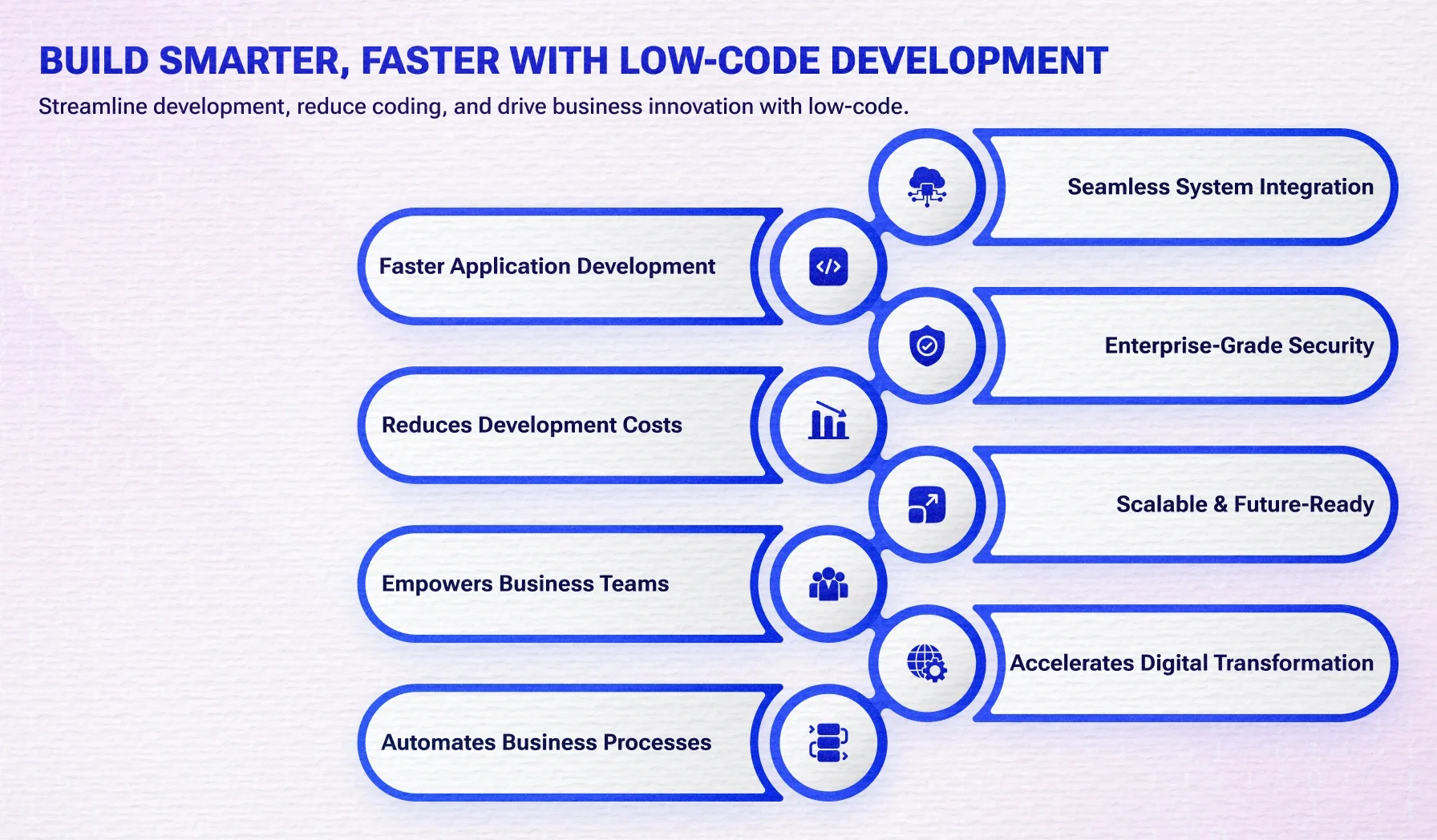
Popular Low-Code Platforms🔗
Several low-code platforms are helping organizations accelerate application development and digital transformation. Choosing the right platform depends on your business goals, existing technology stack, scalability requirements, and budget.
Microsoft Power Apps🔗
Part of the Microsoft Power Platform, Power Apps enables businesses to build custom applications quickly while integrating seamlessly with Microsoft 365, Dynamics 365, Azure, and hundreds of other services.
OutSystems🔗
OutSystems is an enterprise-grade low-code platform known for developing complex, scalable web and mobile applications with advanced customization and integration capabilities.
Mendix🔗
Mendix provides a collaborative development environment that enables both developers and business users to build enterprise applications rapidly while supporting cloud-native deployment.
Appian🔗
Appian focuses on process automation and workflow management, making it an excellent choice for organizations looking to digitize business operations and improve efficiency.
Zoho Creator🔗
Zoho Creator allows businesses to develop custom applications with minimal coding and integrates seamlessly with the Zoho ecosystem, making it ideal for small and medium-sized businesses.
Salesforce Platform🔗
Built on Salesforce CRM, this platform enables organizations to create custom business applications, automate workflows, and enhance customer relationship management.
Oracle APEX🔗
Oracle APEX is a powerful low-code development platform designed for creating secure, data-driven enterprise applications that integrate with Oracle databases.
ServiceNow App Engine🔗
ServiceNow App Engine helps organizations build workflow-centric applications that automate IT services, HR operations, customer support, and other enterprise processes.
Selecting the right platform depends on your organization's business objectives, technical requirements, and future scalability needs. Evaluating multiple platforms before implementation can help ensure long-term success.
Final Thoughts🔗
Low-code development is reshaping the way businesses build software by making application development faster, more collaborative, and more cost-effective. It enables organizations to accelerate digital transformation, automate business processes, and respond quickly to changing market demands without the complexity of traditional development.
By selecting the right low-code platform, following a structured implementation strategy, and partnering with experienced technology experts, businesses can build secure, scalable, and innovative applications that deliver long-term value. As the demand for rapid digital innovation continues to grow, adopting low-code development today can provide a significant competitive advantage and position your organization for sustained success in the years ahead.
How Suave Creators Helps🔗
At Suave Creators, we specialize in guiding businesses through the transition to low-code development. Our team can help you select the right platform, train your staff, and ensure a smooth implementation process. Let us assist you in leveraging low-code technology to unlock new levels of efficiency and growth.