





 +91 88949 00142
 +1 (307) 435-9605
Embracing Edge Computing: The Future of Business Technology in 2026
Introduction
Businesses today generate massive amounts of data through IoT devices, applications, connected machines, vehicles, and customer interactions. The challenge is no longer simply collecting this data but processing it quickly enough to support real-time decisions. While cloud computing continues to play an important role in modern business infrastructure, sending every piece of data to centralized servers can introduce latency, increase bandwidth consumption, and create challenges for applications that require immediate responses.
Edge computing is transforming how businesses process data, enhancing speed and efficiency. This article explores its benefits, challenges, and how to implement edge solutions effectively in your organization, ensuring you stay ahead in the digital landscape.
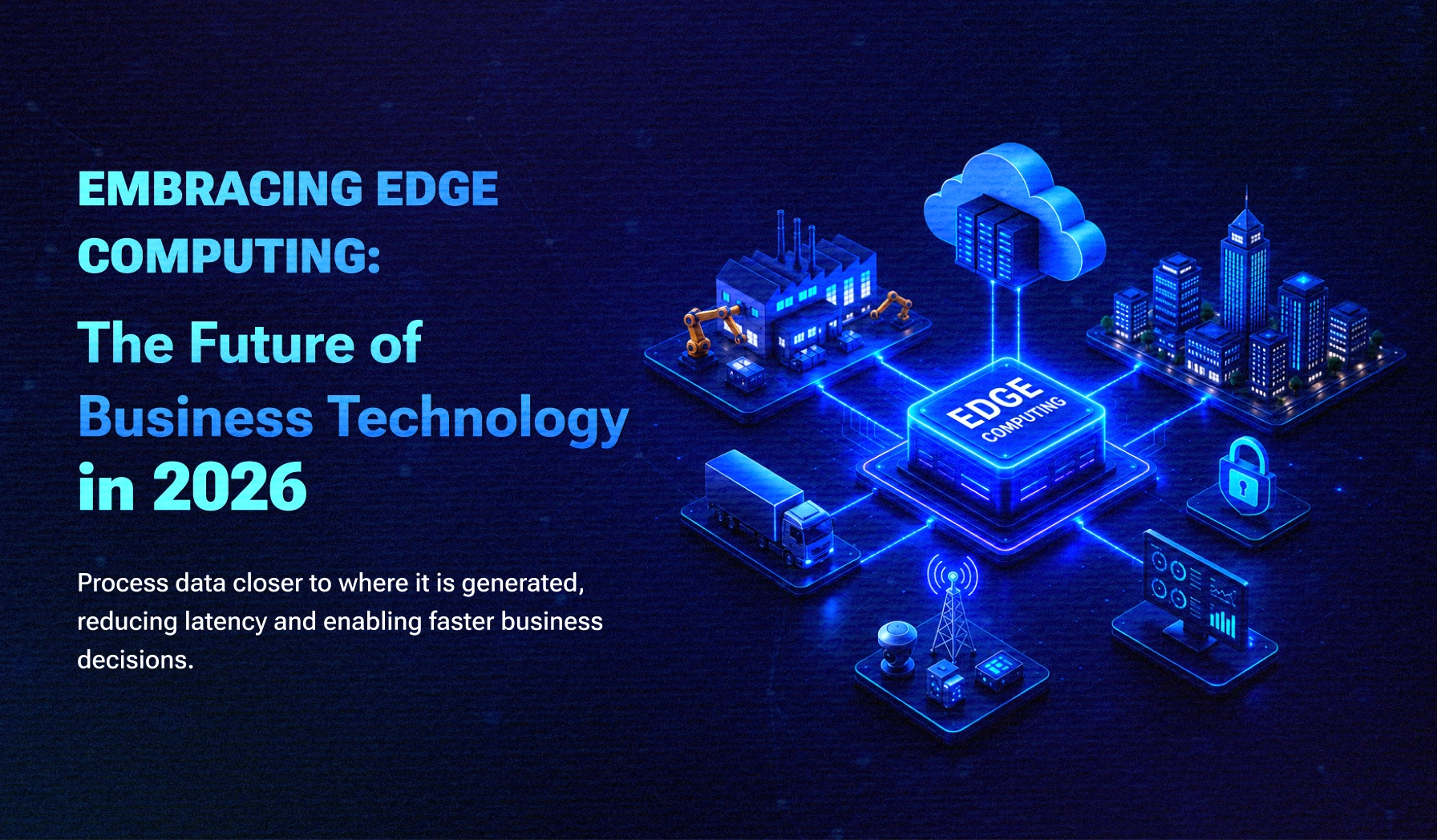
Edge computing addresses these challenges by bringing data processing closer to the source where information is generated. By processing data locally or closer to users and connected devices, businesses can improve response times, optimize network resources, and support real-time applications. As artificial intelligence, automation, IoT, and connected technologies continue to expand in 2026, edge computing is becoming an increasingly important part of modern technology strategies.
What Is Edge Computing?
Edge computing is a distributed computing approach that processes data closer to where it is generated rather than sending all information to a centralized cloud or data center. Processing can take place on connected devices, gateways, local servers, or other edge infrastructure located close to the data source. The goal is to reduce the distance that information needs to travel before it can be analyzed or acted upon.
For businesses, this approach can be particularly useful when applications require fast responses or operate in environments where connectivity may be limited. For example, a manufacturing facility can process machine sensor data locally to identify potential equipment problems, while a connected vehicle can analyze information in real time without depending entirely on a remote server. Edge computing does not replace cloud computing; instead, both technologies can work together to create a more flexible and responsive technology architecture.
Why Edge Computing Matters for Businesses in 2026
The growing adoption of IoT devices, artificial intelligence, automation, and real-time applications is increasing the amount of data businesses need to process. Traditional centralized architectures can struggle when applications require extremely fast responses or generate large volumes of data continuously. Edge computing allows organizations to move selected processing workloads closer to the source, helping them respond to information more efficiently.
By reducing the distance between data generation and processing, edge computing can support faster decision-making and lower latency. It can also reduce the amount of raw information that needs to be transferred to centralized systems, helping organizations optimize bandwidth usage. For businesses operating distributed systems, edge computing can also improve resilience by allowing certain applications to continue performing essential tasks even when connectivity to centralized infrastructure is temporarily unavailable.
How Edge Computing Works
Edge computing works by distributing computing resources across the locations where data is generated. Instead of transferring every data point to a centralized cloud environment, connected devices first send information to nearby edge infrastructure where it can be processed, analyzed, filtered, or acted upon.
The process typically begins with data generation from devices such as sensors, cameras, machines, vehicles, smartphones, or business applications. Edge devices or local servers then process this information close to the source. If an immediate response is required, the system can make a local decision without waiting for communication with a remote server. Relevant information can then be synchronized with cloud platforms for centralized storage, advanced analytics, reporting, or long-term processing.
Edge Computing vs. Cloud Computing
Cloud computing and edge computing use different approaches to processing data, but they are not necessarily competing technologies. Cloud computing centralizes computing resources within remote data centers, while edge computing distributes processing closer to users, devices, and operational environments.
Cloud platforms are highly effective for large-scale storage, application hosting, centralized analytics, backups, and enterprise systems. Edge computing is more suitable for applications that require low latency, real-time processing, local decision-making, or reduced dependence on continuous connectivity. In many modern business environments, the strongest approach is to combine both technologies, allowing edge systems to handle time-sensitive workloads while cloud platforms manage centralized data and analytics.
Business Use Cases for Edge Computing
Edge computing can be applied across industries where businesses generate large amounts of data or require fast responses. Its ability to process information closer to the source makes it particularly useful for environments involving connected devices, real-time monitoring, automation, and distributed operations.
In manufacturing, edge computing can analyze machine and sensor data locally to detect abnormal behavior and support predictive maintenance. Healthcare organizations can use edge technologies to process information from connected medical devices and monitoring systems. Retailers can use edge infrastructure for inventory monitoring, customer analytics, smart checkout systems, and connected store technologies. Logistics companies can process data from vehicles and tracking systems to improve fleet management and route optimization. Financial organizations can use low-latency processing for transaction monitoring and fraud detection, while smart buildings can use edge systems to analyze information from cameras, access systems, energy controls, and environmental sensors.
Edge Computing and AI: A Powerful Combination in 2026
Artificial intelligence is increasing the need for fast and efficient data processing. Edge computing can complement AI by allowing certain AI models and inference workloads to operate closer to where data is generated. This reduces the need to transfer every piece of raw information to a centralized cloud environment before an AI system can respond.
For example, an industrial camera can process video locally to identify equipment problems, while a connected device can use an AI model to detect unusual patterns in real time. This combination can support predictive maintenance, intelligent video analysis, smart retail, connected vehicles, industrial automation, and real-time monitoring. By combining local processing with centralized cloud capabilities, businesses can create AI-powered applications that are both responsive and scalable.
Business Benefits of Adopting Edge Computing
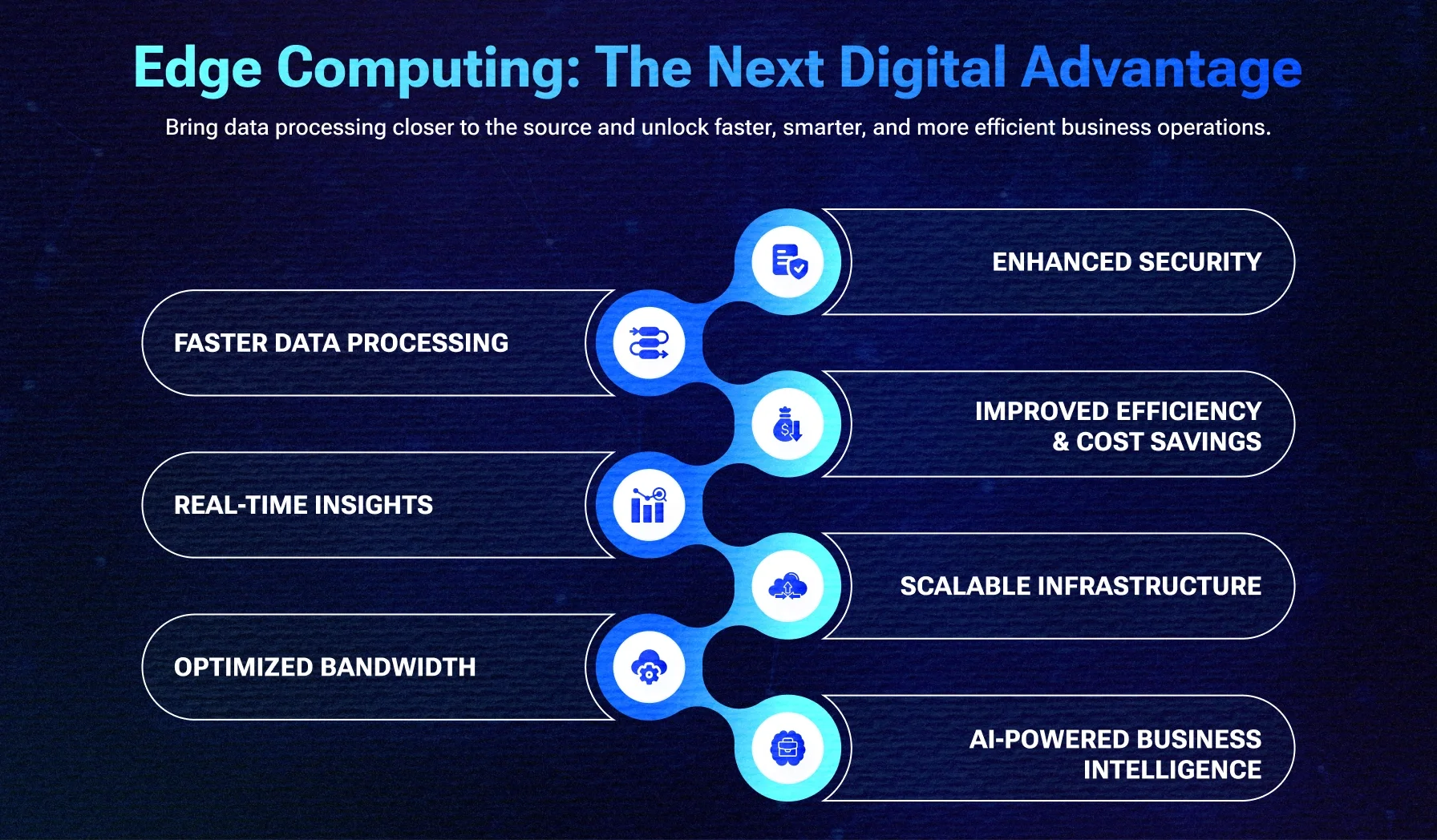
Adopting edge computing can provide businesses with several operational advantages when implemented for the right use cases. Faster local processing can improve application responsiveness and allow organizations to react to important events more quickly. Processing information closer to its source can also reduce the amount of data that needs to travel across networks, potentially improving bandwidth efficiency.
Edge computing can also support greater operational resilience by allowing certain workloads to continue functioning locally when cloud connectivity is temporarily unavailable. In addition, businesses can use local processing to support privacy-sensitive applications by limiting the amount of raw data transferred to centralized systems. When combined with cloud infrastructure, edge computing can provide a flexible architecture that balances real-time processing with centralized management and analytics.
When Does Your Business Need Edge Computing?
Not every business needs edge computing, and adopting it simply because it is a growing technology may not provide meaningful value. Organizations should consider edge computing when their applications require very low latency, generate significant volumes of data, depend on real-time decision-making, or operate in environments where reliable connectivity cannot always be guaranteed.
Businesses can begin by identifying specific operational challenges and determining whether local data processing could improve performance, efficiency, or reliability. If a cloud-based application already meets business requirements without significant latency, bandwidth, or availability problems, a traditional cloud architecture may remain the better choice. The objective should always be to select the architecture that best supports the organization's business requirements.
Challenges and Best Practices
Although edge computing offers significant benefits, distributed infrastructure can introduce additional complexity. Organizations may need to manage many devices, locations, networks, applications, and security controls instead of maintaining a smaller centralized environment. This can make deployment, monitoring, maintenance, and troubleshooting more challenging.
Security is another important consideration because every connected edge device can potentially become an entry point into the broader infrastructure. Businesses should implement strong authentication, encryption, access controls, secure software updates, network segmentation, and continuous monitoring. Organizations should also establish centralized management processes that provide visibility across their distributed edge infrastructure.
Common Implementation Mistakes to Avoid
One of the most common mistakes businesses make is implementing edge computing without identifying a clear business problem. Technology adoption should begin with specific objectives such as reducing latency, improving operational efficiency, supporting real-time analytics, or reducing unnecessary data transfers.
Another common mistake is overlooking security and scalability. As edge deployments grow, the number of connected devices and endpoints can increase significantly, creating additional management and security requirements. Businesses should also avoid treating edge computing as a complete replacement for cloud infrastructure. In many cases, edge and cloud technologies deliver the best results when they are designed to work together.
How to Implement Edge Computing: A Practical Roadmap
A successful edge computing implementation should begin with an assessment of the organization's existing infrastructure and data flows. Businesses should understand where data is generated, how it currently moves through their systems, and which applications require real-time processing. This assessment can help identify suitable opportunities for introducing edge infrastructure.
Once potential use cases have been identified, organizations can select an appropriate edge architecture based on their operational and technical requirements. The next step is to integrate edge systems with existing cloud platforms and establish clear rules for which information should be processed locally and which should be transferred to centralized systems. Security should be incorporated throughout the architecture, followed by testing, monitoring, and performance evaluation. Businesses can then gradually scale successful implementations across additional locations or workloads.
Future Outlook for Edge Computing
The future of edge computing will be closely connected to the continued growth of artificial intelligence, IoT, automation, connected devices, and high-speed networks. As organizations generate increasing amounts of data, processing everything centrally may become less practical for applications that require immediate responses.
AI-powered edge applications are expected to become increasingly important as businesses seek real-time intelligence and faster decision-making. At the same time, cloud platforms will continue to provide essential capabilities for centralized storage, large-scale analytics, AI model training, application management, and enterprise infrastructure. Rather than replacing cloud computing, edge computing is likely to become an important component of a broader distributed technology ecosystem.
Your Practical Edge Computing Checklist
Before adopting edge computing, businesses should evaluate their current infrastructure, identify where data is generated, and determine which applications require real-time processing. Organizations should also evaluate bandwidth requirements, connectivity limitations, security requirements, device-management capabilities, and potential integration with existing cloud systems.
Starting with a small pilot project can help businesses understand the practical benefits and challenges before investing in a larger deployment. Organizations should define measurable objectives such as reduced latency, improved application performance, lower bandwidth consumption, increased availability, or improved operational efficiency. This allows businesses to determine whether edge computing is delivering meaningful value before scaling the solution.
How Suave Creators Helps Businesses Adopt Emerging Technologies
Technology adoption should be based on business requirements rather than simply following the latest technology trend. Organizations need solutions that work with their existing infrastructure while supporting scalability, security, performance, and long-term growth.
At Suave Creators, we help businesses design and develop modern digital solutions that support evolving technology requirements. Our expertise across software development, web applications, API integrations, cloud-based solutions, and emerging technologies enables organizations to explore practical approaches to digital transformation.
Whether your business is exploring edge computing, artificial intelligence, cloud technologies, connected applications, or other emerging solutions, Suave Creators can help turn technology requirements into scalable digital solutions designed around your business objectives.
Bottom Line
Edge computing is becoming an important part of modern business technology as organizations generate more data and demand faster, more responsive digital applications. By moving selected processing workloads closer to the source, businesses can reduce latency, optimize bandwidth usage, support real-time analytics, and improve operational responsiveness.
However, edge computing should not be viewed as a universal replacement for cloud computing. The most effective approach for many organizations will be a combination of edge and cloud technologies, with each handling the workloads for which it is best suited. Businesses that evaluate their specific requirements, start with practical use cases, prioritize security, and scale strategically can use edge computing to build more efficient and resilient digital operations.
For organizations looking to explore modern technology solutions, the key is not simply to adopt edge computing, but to determine where computing can create the greatest business value.