





 +91 88949 00142
 +1 (307) 435-9605
Quick Summary Shopify Plus offers speed-to-market for growing retailers, but high-volume brands operating between $10M and $50M+ GMV often hit operational limits. Recurring platform fees (starting at $2,500/month or 0.40% on variable GMV), third-party payment penalties (0.15%–0.20%), rate-limited REST/GraphQL endpoints (40 req/sec), and rigid checkout logic can degrade gross margins and limit customization. Building a proprietary, high-throughput e-commerce engine on modern frameworks like Laravel, Node.js, and React gives organizations complete intellectual property ownership, zero vendor penalties, sub-second headless checkout performance, and deep, bi-directional ERP integration.

- Above roughly $10M–$15M GMV, Shopify Plus fees, gateway penalties, and app overhead often outpace the cost of an owned commerce engine.
- API rate limits and sandboxed checkout Functions constrain ERP sync and proprietary checkout logic that high-GMV brands need.
- A custom Laravel/Node.js + headless React stack transfers 100% IP ownership and removes third-party transaction taxes.
- Enterprise migrations typically run 12–18 weeks with phased ETL, microservices, headless checkout, and 301 SEO cutover.
The $10M+ GMV Turning Point: SaaS Convenience vs. Architectural Sovereignty
For fast-growing direct-to-consumer (D2C) brands, Shopify Plus is a common choice for operational bootstrapping. It handles server scaling, processes standard shopping carts, and gives merchandising teams a no-code ecosystem to launch standard product drops.
However, as annual gross merchandise value (GMV) crosses $10M, the economic and structural trade-offs shift:
| Scaling Dimension | Operational Impact on Shopify Plus |
|---|---|
| Annual Transaction Fees | 0.15%–0.20% penalty if bypassing Shopify Payments |
| Rate Limits | 40–100 req/sec throttles real-time ERP sync |
| Checkout Logic | Sandboxed Shopify Functions restrict code |
| Codebase & IP Ownership | Zero; data and logic remain on SaaS tenant |
| Database Schema Control | Flat metafields; no relational modeling |
Enterprise result: margin erosion and hard feature limitations.
When custom bundling rules, dynamic wholesale price tiers, real-time multi-warehouse dispatching, or customized checkout funnels become essential to commercial growth, multi-tenant SaaS constraints can hinder operations.
Engineering an independent, owned solution through custom e-commerce development services replaces ongoing variable taxations with an enterprise digital asset designed around proprietary business logic.
Transaction Fees and App Subscription Overhead: 3-Year TCO Breakdown
Evaluating platform investment requires analyzing visible platform subscription costs alongside hidden operational taxes.
1. Variable Platform Tax & Gateway Penalties
Shopify Plus charges an entry fee of $2,500/month on 1-year terms or switches to a variable revenue share of 0.40% of monthly GMV once sales surpass $800,000/month.
If enterprise treasury protocols or international multi-currency processing require external payment orchestrators (such as Adyen, Worldpay, or local acquiring banks) instead of Shopify Payments, a non-negotiable 0.15% to 0.20% transaction penalty is applied across gross checkout volume.
2. The App Dependency Tax
Because Shopify’s core product remains intentionally lean, enterprise capabilities require bolted-on third-party apps:
- Subscription management (Recharge, Bold)
- Search and product discovery (Algolia, Fast Simon)
- Wholesale and B2B pricing matrices
- Multi-warehouse logistics sync
- Complex discount engines
Each third-party micro-SaaS introduces monthly costs, script bloat that slows mobile load times, and separate points of failure during major sales peaks.
Financial Comparison: $20,000,000 Annual GMV Platform (3-Year Analysis)
| Cost Component | Shopify Plus (Annualized) | Custom Engine (Laravel/Node.js) |
|---|---|---|
| Platform Base Fee | $80,000/year (0.40% variable fee) | $0 (Open-source framework) |
| Payment Gateway Penalties | $30,000/year (0.15% external fee) | $0 (Direct acquiring rates) |
| Third-Party App Subscriptions | $36,000/year ($3,000/month stack) | $0 (Bespoke modules natively coded) |
| Infrastructure / Cloud Hosting | Included in platform cost | $9,600/year ($800/mo AWS/DigitalOcean) |
| Engineering / SLA Maintenance | $24,000/year (Theme patches & apps) | $48,000/year (Dedicated SLA & sprints) |
| Initial Platform Build | $40,000 (Theme build & integrations) | $120,000 (Full-stack headless build) |
| 3-Year Cumulative TCO | $550,000 | $396,800 |
| Platform Equity & Ownership | 0% (Rented SaaS Tenant) | 100% (Owned Capital Asset) |
Architectural Constraints: Rate Limits, Custom Checkout, and Data Control
For engineering leaders, the decision to migrate from Shopify Plus often comes down to technical limitations rather than just licensing costs.
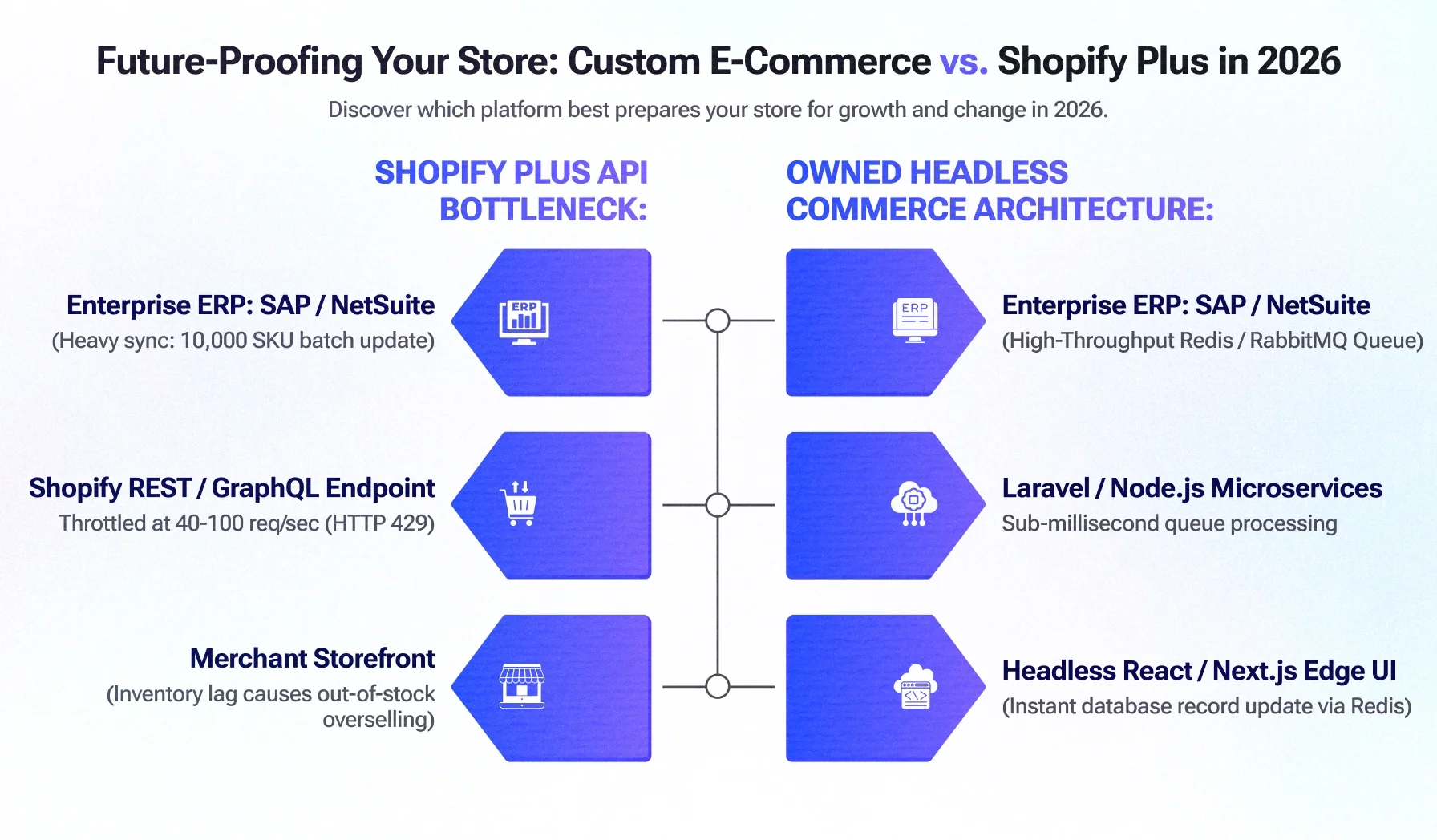
1. API Call Rate Limits and Inventory Sync
Enterprise brands managing catalogs across multiple warehouses require continuous inventory, pricing, and order synchronization with internal ERPs (NetSuite, SAP, Microsoft Dynamics).
Shopify Plus restricts GraphQL Admin APIs to bucket cost models and REST APIs to 40–100 requests per second. During high-volume flash sales or peak seasons, bulk updates can hit HTTP 429 “Too Many Requests” errors. This leads to catalog lag, overselling, and unfulfilled orders.
A custom backend running on Laravel or Node.js utilizes asynchronous workers (Redis, RabbitMQ, or AWS SQS) to process thousands of transactions per second, eliminating third-party API limits.
2. Checkout Sandboxing and Shopify Functions
Shopify discontinued legacy checkout.liquid scripts in favor of Shopify Functions and Checkout UI Extensions. While safer for multi-tenant server security, this environment is strictly sandboxed:
- Code execution limits are capped at 5 milliseconds.
- Network calls to external verification APIs during the checkout loop are restricted.
- Custom database tables cannot be queried directly within checkout steps.
If an e-commerce model requires multi-tiered B2B credit terms, complex split shipping across split vendors, or customized biometric verification, sandbox limits can prevent execution. An owned platform allows custom logic throughout the checkout flow without arbitrary execution boundaries.
3. Database Schema Sovereignty
Shopify organizes catalog data within rigid product-variant structures. Complex data models must be forced into JSON metafields, which complicates deep SQL indexing and performance tuning.
A custom database (PostgreSQL or MySQL) allows fully relational, indexed schemas optimized for advanced faceted search, multi-vendor marketplaces, and complex product configurators.
Comparison: Custom Platform vs. Shopify Plus
The decision to stay on SaaS or build custom depends on your business model, catalog complexity, and engineering capacity:
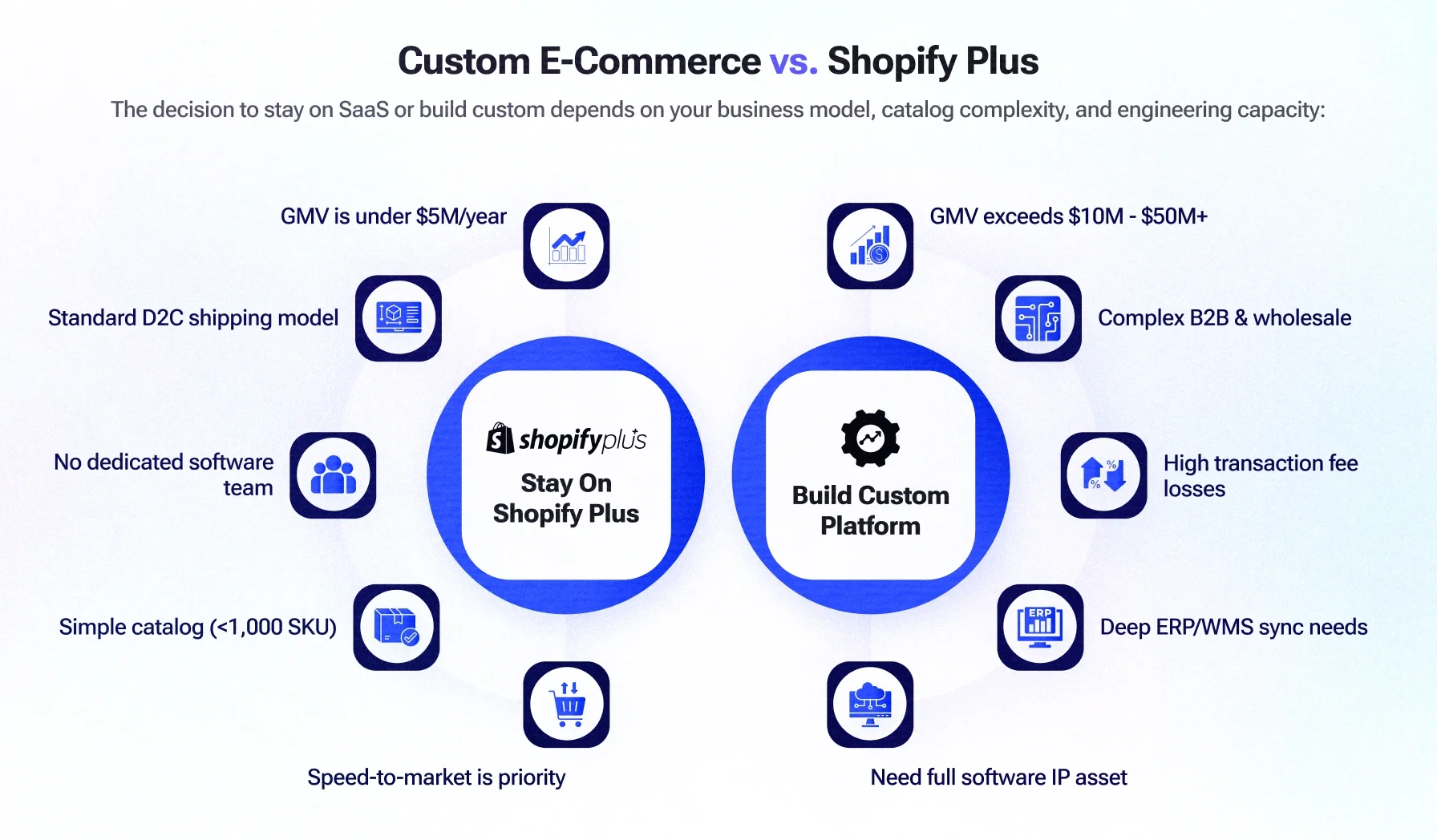
- Catalog and pricing complexity:Standard consumer goods with basic variants fit well within Shopify. Industrial equipment, customized configurators, and B2B portals with negotiated contract pricing benefit from a custom architecture.
- International multi-region routing:Shopify Markets handles regional storefronts, but complex legal entities, distinct physical warehouses, and independent localized checkout routing are easier to manage with a microservices or decoupled architecture.
- Internal engineering resources:Building custom requires an experienced development team or a reliable engineering partner providing dedicated service-level agreements (SLAs).
Technical Migration Blueprint: Moving from Shopify Plus to Headless Custom Commerce
Migrating an enterprise platform without losing search rankings, customer records, or order history requires a phased migration plan:
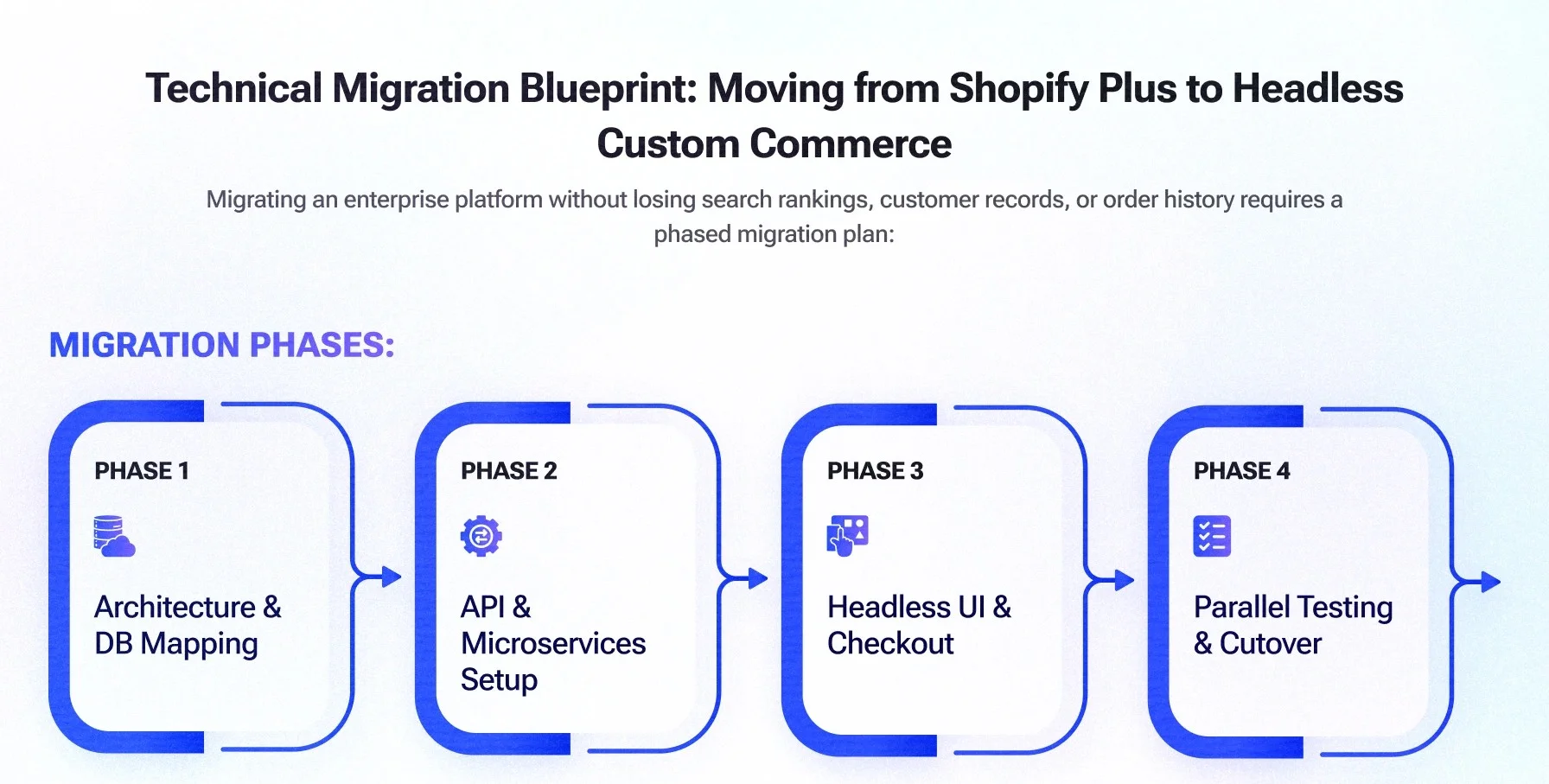
Phase 1: Data Model Extraction & Normalization
- Export catalog, customer history, order logs, and gift card ledgers via automated ETL pipelines.
- Map flat Shopify metafield schemas into clean, relational PostgreSQL/MySQL tables with foreign key constraints.
- Build automated hashing validation to verify customer credential integrity during transfer.
Phase 2: Core Microservices & Middleware Integration
- Implement backend microservices using Laravel for business logic, pricing calculations, and order routing, with Node.js handling high-concurrency real-time notifications.
- Build bi-directional webhook connectors between the custom database and enterprise systems (ERP, WMS, CRM) using dedicated message queues.
Phase 3: Headless Frontend Engineering
- Construct the customer-facing storefront using modern frontend frameworks (React, Next.js, or Vue.js) to deliver sub-second page rendering and clean Core Web Vitals (LCP < 1.5s, CLS < 0.05).
- Integrate payment processing via direct API orchestrators (Stripe Elements or Adyen Drop-in), maintaining PCI-DSS Level 1 compliance without storing card data on your servers.
Phase 4: SEO Preservation and DNS Cutover
- Export historic URL hierarchies to map 1:1 301 redirects for every category, collection, product, and blog URL.
- Audit and deploy structured Schema.org markup (Product, BreadcrumbList, Organization, and FAQPage).
- Run parallel staging load tests simulating peak traffic spikes to verify database stability before pointing apex DNS records to the new environment.
Plan Your Architecture Shift
Stop paying variable platform penalties on your hard-earned revenue. If your brand is scaling past $10M GMV, book a technical consultation with our solution architects to review your systems and build your custom e-commerce development plan.