





 +91 88949 00142
 +1 (307) 435-9605
Generative AI: Transforming Business Strategy and Innovation in 2026 🔗
Generative AI is moving beyond experimentation and becoming an increasingly important part of how businesses operate, innovate, and compete. In 2026, organizations are no longer looking at AI only as a tool for generating content or answering questions; they are increasingly using it to improve workflows, support employees, personalize customer experiences, accelerate product development, and automate complex business processes. The shift is particularly significant because generative AI is becoming more connected to business data, applications, and workflows, allowing modern AI systems to do more than simply provide answers—they can assist with multi-step tasks and, in some cases, execute work through connected tools and systems. This evolution is changing the role of AI from a productivity assistant into a component of the broader business operating model. For businesses, the opportunity is not simply to adopt the latest AI technology, but to identify where AI can create measurable value and integrate it into the processes that matter most.
Generative AI is reshaping how businesses approach strategy, creativity, and decision-making in 2026. This article explores its impact, practical applications, and how companies can leverage this technology for competitive advantage.
What Is Generative AI?🔗
Generative AI is a type of artificial intelligence that can create new content based on patterns learned from large amounts of data. Depending on the model and application, it can generate text, images, audio, video, software code, summaries, recommendations, and other forms of digital content. While traditional AI systems are primarily designed to analyze information, recognize patterns, classify data, or make predictions, generative AI adds another capability by producing new outputs based on a user’s instructions and the context provided to it. This makes generative AI particularly valuable for businesses looking to automate repetitive tasks, accelerate content and product development, support employees, and create more personalized customer experiences.
For businesses, this means AI can participate directly in activities that previously required significant human effort. Marketing teams can use it to develop campaign concepts, sales teams can generate personalized outreach, developers can accelerate coding and testing, and customer service teams can summarize conversations and generate responses. The next stage is increasingly agentic AI, where AI systems can work through multiple steps, use connected tools, retrieve information, and complete tasks rather than simply generating a response. This shift from AI-assisted tasks to AI-driven execution is becoming one of the most important developments shaping how businesses adopt and integrate AI in 2026.
Why Generative AI Is a Strategic Priority in 2026🔗
Generative AI is becoming a strategic priority because its impact extends beyond individual tasks. When integrated effectively, it can influence how organizations design processes, serve customers, develop products, and make decisions. One of the biggest shifts is the move from isolated AI experiments toward AI-enabled workflows, where businesses incorporate AI directly into CRM systems, customer service platforms, internal knowledge bases, analytics tools, and operational applications. This allows organizations to redesign processes around the strengths of both humans and AI, enabling employees to focus more on judgment, creativity, relationship-building, and strategic work while AI handles repetitive analysis, content generation, information retrieval, and other structured activities.
AI is also becoming an important source of competitive differentiation. As more organizations gain access to similar AI models, simply using AI will become less of a competitive advantage. The greater opportunity lies in how effectively businesses connect AI with their proprietary data, workflows, customer knowledge, and existing systems. Organizations therefore need to think beyond basic AI adoption and focus on AI integration and business transformation, using the technology to create more efficient operations, stronger customer experiences, and sustainable business value.
How Generative AI Is Changing Business Strategy🔗
Generative AI is changing business strategy in several important ways.
From Automation to Intelligent Workflows🔗
Traditional automation typically follows predefined rules, while generative AI introduces greater flexibility by allowing systems to interpret natural language, process unstructured information, generate content, and adapt responses to different situations. For example, a sales workflow can combine customer information, previous interactions, company research, and AI-generated recommendations to help a salesperson prepare for a prospect meeting. Instead of automating a single isolated task, AI can support an entire sequence of activities, creating intelligent workflows that connect multiple business processes and enable organizations to work more efficiently.
From Information to Execution🔗
Businesses have traditionally used software to store and access information while employees handled the work between systems. AI agents are beginning to change this model by allowing AI to interact with tools and complete multi-step tasks. For example, an AI system could research a prospect, summarize relevant information, prepare a personalized outreach message, update a CRM record, and recommend the next action, while human approval can remain part of the process when decisions require oversight. This shift allows businesses to increasingly view AI as a digital workforce capability that can support and execute business processes rather than simply as another software feature.From Generic Experiences to Personalization🔗
Customers increasingly expect interactions that are relevant to their needs, and generative AI can help organizations personalize communications, recommendations, support responses, product experiences, and marketing content at scale. Instead of creating a single message for an entire audience, businesses can generate tailored variations based on customer characteristics, previous interactions, intent, and context, enabling more relevant experiences while reducing the manual effort required to personalize customer interactions.
From Reactive Decision-Making to AI-Assisted Intelligence🔗
Generative AI can make complex business information easier to understand by allowing employees to interact with data using natural language, summarize detailed reports, identify patterns, and generate potential explanations or recommendations. The goal is not to allow AI to make every business decision independently, but to use it as an intelligent support system that helps decision-makers process information faster, explore more possibilities, and make better-informed decisions based on relevant business data.
Key Business Applications of Generative AI🔗
The value of generative AI becomes clearer when it is connected to real business functions.
Marketing and Content Creation🔗
Marketing teams can use generative AI to accelerate campaign development, content ideation, audience research, social media posts, email campaigns, product descriptions, and creative concepts while also personalizing content for different customer segments. Instead of spending significant time creating multiple variations manually, marketers can use AI to generate initial drafts and tailored content, then apply human creativity, brand guidelines, and strategic judgment to refine the final output. The greatest value is not replacing marketing teams but reducing repetitive production work, allowing marketers to focus more on strategy, creativity, experimentation, and understanding customer needs.
Sales and Lead Generation🔗
Generative AI can support sales teams by researching prospects, summarizing company information, preparing sales briefs, generating personalized outreach, and recommending follow-up actions. It can also help sales representatives quickly understand previous customer interactions and identify relevant information before a call or meeting, enabling more informed and personalized conversations. When connected to a CRM, these capabilities can become part of a broader sales workflow rather than remaining as separate AI tools, helping sales teams reduce manual research, improve productivity, and focus more on building customer relationships and closing opportunities.
Customer Service🔗
Customer service is another area where generative AI can have a significant impact. AI-powered assistants can answer common questions, summarize conversations, retrieve relevant information, draft responses, and route issues to the appropriate teams, while more advanced AI agents can perform specific service tasks and escalate sensitive or complex situations to human representatives when needed. This creates a balanced approach in which AI handles high-volume and repetitive interactions efficiently, allowing human employees to focus on situations that require empathy, judgment, problem-solving, or specialized expertise.
Software Development🔗
Generative AI is increasingly being used throughout the software development lifecycle, helping developers generate code, explain existing code, create tests, identify potential issues, write documentation, and accelerate debugging. However, developers remain essential because AI-generated code still requires careful review, testing, security validation, and architectural judgment. When used effectively, generative AI can reduce repetitive development work and speed up common tasks, allowing engineering teams to focus more on system design, product requirements, performance, scalability, and innovation.
Product Development🔗
Generative AI can accelerate product development by helping teams explore concepts, analyze customer feedback, generate prototypes, summarize research, and identify potential improvements. Product teams can bring together information from surveys, support conversations, customer reviews, and usage data with AI to identify recurring customer needs and emerging trends more efficiently. By turning scattered customer insights into actionable information, generative AI can shorten the gap between collecting feedback and making informed product decisions, enabling teams to iterate faster and build products that better align with customer expectations.
Business Operations🔗
Operations teams can use generative AI to process documents, summarize reports, extract key information, create internal communications, automate workflows, and handle repetitive administrative tasks. When integrated with enterprise applications, these capabilities can extend beyond individual tasks to support more complex workflows across multiple systems, helping organizations reduce manual effort, improve operational efficiency, and streamline how information moves between teams and business functions.
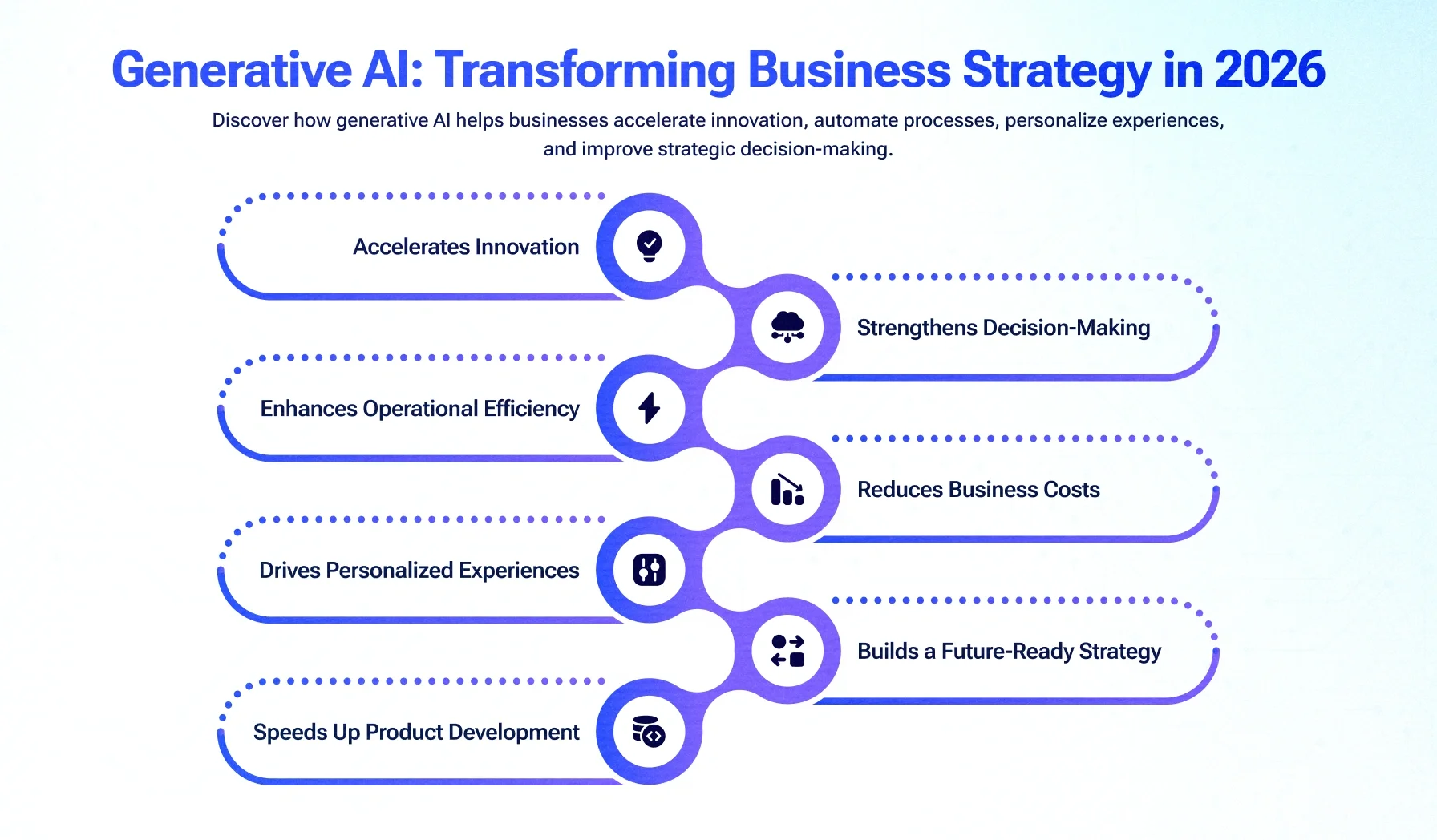
Business Impact and Benefits🔗
The value of generative AI should ultimately be measured by its impact on the business rather than by the number of AI tools deployed.
Higher Productivity🔗
Generative AI can significantly improve employee productivity by reducing the time spent on repetitive activities such as drafting emails and documents, summarizing information, searching for relevant data, formatting content, and performing basic analysis. By handling these time-consuming tasks, AI allows employees to complete routine work faster and with greater consistency, while also reducing the effort required to manage large volumes of information. This gives teams more time to focus on higher-value activities such as strategic planning, creative problem-solving, customer relationships, collaboration, and innovation. Rather than replacing human expertise, generative AI can act as a productivity partner that supports employees throughout their daily workflows and helps organizations make better use of their existing talent and resources.Faster Innovation🔗
Generative AI can accelerate innovation by making it easier for businesses to explore ideas, develop concepts, create prototypes, test solutions, and iterate based on feedback. Teams can quickly generate multiple approaches to a problem, evaluate different possibilities, and refine promising ideas without spending the same amount of time and resources on every iteration. This can shorten development cycles, encourage experimentation, and help organizations respond more quickly to changing customer expectations and market opportunities. By supporting both creative thinking and rapid execution, generative AI enables businesses to move from an initial idea to a practical solution more efficiently while allowing employees to focus on strategic decisions and innovation.
Better Customer Experiences🔗
Generative AI enables businesses to respond faster and personalize interactions across marketing, sales, customer support, and other customer-facing functions. By analyzing customer preferences, previous interactions, behavior, and context, AI can help businesses deliver more relevant communications, recommendations, and support at the right time. This level of personalization can make customer interactions more consistent and meaningful across different touchpoints, while also helping teams respond more efficiently to individual needs. As a result, businesses can create smoother customer journeys, strengthen engagement, improve satisfaction, and build stronger long-term relationships with their customers.Improved Operational Efficiency🔗
When AI is embedded into business workflows, organizations can reduce manual handoffs, streamline repetitive processes, and improve how information moves between teams and systems. Instead of requiring employees to repeatedly collect, organize, and transfer information across different applications, AI can help automate routine steps, coordinate tasks, and surface relevant information when it is needed. This can reduce delays, minimize errors caused by manual processes, and create more consistent workflows across departments. By connecting AI with existing business applications and systems, organizations can improve operational efficiency while allowing employees to spend more time on tasks that require human judgment, collaboration, and strategic thinking.
Faster Access to Business Knowledge🔗
Employees often spend considerable time searching through documents, applications, emails, reports, and internal resources to find the information they need. Generative AI can make organizational knowledge easier to access by allowing employees to interact with business information using natural language instead of manually searching across multiple systems. AI-powered knowledge tools can quickly summarize documents, identify relevant information, answer questions, and bring together insights from different internal sources, helping employees find useful information faster. This can reduce time spent on information retrieval, improve collaboration between teams, and help employees make more informed decisions based on the knowledge already available within the organization.
Greater Scalability🔗
Generative AI can help businesses handle increasing volumes of content, customer interactions, data, and operational tasks without requiring every increase in workload to be matched by an equivalent increase in manual effort. By automating repetitive activities, assisting employees with high-volume processes, and supporting AI-powered workflows, organizations can scale their operations more efficiently while maintaining consistent service and productivity. This can be particularly valuable for growing businesses that need to manage increasing customer demand without continuously expanding their operational workload. However, these benefits are not automatic. Organizations need clear objectives, reliable and appropriate data, well-designed workflows, effective human oversight, and measurable success criteria to ensure that AI investments deliver meaningful business value. A thoughtful approach to implementation allows businesses to scale AI responsibly while continuously improving its performance and impact.
Challenges of Generative AI Adoption🔗
Generative AI creates significant opportunities, but businesses also need to manage its risks carefully.
Data Privacy and Security🔗
AI systems may interact with sensitive business, customer, or employee information, making data privacy and security essential considerations for any generative AI implementation. Organizations should establish clear policies defining what data can be shared with AI systems, where that data is processed and stored, who can access it, and how it is protected from unauthorized use or exposure. Businesses should also implement appropriate access controls, data protection measures, monitoring, and security practices based on the sensitivity of the information involved. Security should be considered from the beginning of the AI project rather than added after deployment, ensuring that privacy, compliance, and data protection are built into the system's design and ongoing operation.
Accuracy and Hallucinations🔗
Generative AI can sometimes produce incorrect, incomplete, or misleading information while presenting it with a high level of confidence, making accuracy a critical consideration for businesses adopting the technology. This is particularly important in high-impact areas where inaccurate AI-generated outputs could result in financial losses, legal issues, operational disruptions, compliance concerns, or reputational damage. Organizations should therefore establish appropriate validation and human-review processes based on the risk and importance of each use case. AI-generated content, recommendations, or decisions should be reviewed by qualified employees when human judgment is required, especially for sensitive or business-critical processes. By combining AI capabilities with appropriate oversight, businesses can reduce the risks associated with inaccurate outputs while still benefiting from the speed, efficiency, and scalability that generative AI provides.
Governance and Accountability🔗
As AI systems become more autonomous and capable of performing tasks across multiple business processes, effective governance becomes increasingly important. Organizations need clear visibility into which AI systems and agents are being used, what data and applications they can access, what actions they are authorized to perform, who is responsible for managing them, and when human approval or intervention is required. Establishing clear permissions, monitoring processes, accountability structures, and review mechanisms can help businesses maintain control over AI systems as their use expands. This is particularly important as organizations move from small AI experiments to deploying agents across larger workflows, where uncontrolled access or unclear responsibilities can increase operational and security risks. A strong governance framework allows businesses to scale AI more responsibly while maintaining transparency, oversight, and accountability throughout the AI lifecycle.
Integration Complexity🔗
Generative AI delivers limited value when it operates in isolation from the systems and workflows a business already relies on. To achieve meaningful results, organizations often need to connect AI with CRMs, databases, business applications, APIs, internal knowledge bases, and existing operational workflows. These integrations can introduce technical and operational complexity, particularly when systems use different data formats, architectures, security requirements, or access controls. Businesses may also need to address data synchronization, system reliability, permissions, monitoring, and ongoing maintenance as AI becomes more deeply embedded in daily operations. A well-planned integration strategy can help organizations connect AI capabilities with existing technology while minimizing disruption and ensuring that AI supports real business processes rather than functioning as a standalone tool.
Measuring ROI🔗
Businesses should avoid adopting AI simply because competitors are doing so. Each initiative should have a measurable objective such as reducing processing time, improving conversion rates, lowering support costs, increasing employee productivity, or improving customer satisfaction. AI investment is increasing, but organizations still face challenges in connecting spending with measurable business outcomes.
How to Build a Generative AI Strategy🔗
Successful AI adoption begins with business objectives rather than technology.
1. Identify High-Value Use Cases🔗
Start by identifying repetitive, time-consuming, or costly processes where AI can solve a clear business problem. Not every process needs AI, so focus on use cases where it can deliver measurable improvements in efficiency, productivity, or customer experience.
2. Define Measurable Outcomes🔗
Define what success looks like before building the AI solution. Depending on the use case, this could mean reducing processing time and operational costs, improving response times, increasing sales productivity, enhancing customer satisfaction, or boosting conversion rates. Clear metrics help businesses measure the actual impact of AI and determine whether the solution is delivering meaningful value.
3. Evaluate Data and Technology Requirements🔗
Identify the data, systems, APIs, models, security requirements, and infrastructure needed to support the AI use case. Organizations should also choose the right AI approach, whether that involves a general-purpose model, a specialized model, retrieval-based system, or an AI agent connected to business tools. This ensures the solution is practical, secure, and aligned with business needs.
4. Start With a Controlled Pilot🔗
Instead of trying to transform the entire organization at once, start with a focused, high-value use case. A controlled pilot allows businesses to test the solution, evaluate performance, user adoption, security, costs, and business impact, and identify potential issues before expanding AI across larger workflows.
5. Design Human Oversight🔗
Human involvement should be designed according to the risk and importance of each task. AI can independently handle low-risk, repetitive activities, while higher-impact decisions may require human approval, validation, or escalation. This balanced approach allows businesses to benefit from AI automation while maintaining appropriate oversight and accountability.
6. Integrate AI Into Existing Workflows🔗
The goal should not be to create another disconnected AI tool, but to integrate AI naturally into the applications and workflows employees already use. This could include adding AI capabilities to a CRM, customer support platform, internal dashboard, document workflow, or custom business application, making AI easier to adopt and more useful in everyday operations.
7. Establish Governance and Security🔗
Define clear rules for data access, permissions, monitoring, model usage, human review, auditing, and incident response. Strong governance becomes increasingly important as businesses deploy multiple AI systems and agents across different teams and workflows. A centralized approach can help organizations maintain visibility, control access, assign accountability, and reduce the risks associated with uncontrolled AI adoption and agent sprawl.
8. Measure, Improve, and Scale🔗
After deployment, continuously monitor AI performance, user adoption, costs, and business outcomes to ensure the solution delivers its intended value. Successful use cases can be improved and expanded across the organization, while ineffective implementations can be redesigned, adjusted, or discontinued based on measurable results.
Common Implementation Mistakes to Avoid🔗
Many AI initiatives fail to deliver their expected value because businesses focus too heavily on the technology and not enough on the underlying process.
Starting With Technology Instead of the Problem🔗
Choosing an AI model first and searching for a use case later can lead to unnecessary complexity, higher costs, and solutions that do not address real business needs. Businesses should begin by identifying a specific problem, understanding its impact, and determining whether AI is the right solution. This problem-first approach helps organizations select the appropriate technology, define clear goals, and focus resources on use cases that can deliver measurable business value.
Automating a Broken Process🔗
AI cannot automatically fix a poorly designed workflow. If a process contains unnecessary steps, unclear ownership, inconsistent procedures, or unreliable data, these issues should be addressed before introducing AI. Improving the underlying workflow first helps ensure that AI is applied to a well-structured process and can deliver meaningful improvements in efficiency, accuracy, and scalability.
Ignoring Employees🔗
AI adoption affects the people who use and manage the technology, making employee involvement an important part of successful implementation. Employees need appropriate training, clear expectations, and opportunities to provide feedback as AI becomes part of their workflows. The goal should be to help employees work more effectively with AI rather than simply introducing automation without explaining its purpose, benefits, or role. A people-focused approach can improve adoption, build confidence, and ensure AI supports employees instead of creating unnecessary disruption.
Expecting Full Autonomy Too Early🔗
Not every task should be fully automated. Businesses should begin with low-risk activities and gradually increase AI autonomy as the system becomes more reliable and effective. Strong monitoring, clear governance, and appropriate human oversight can help organizations determine when AI is ready to take on more complex responsibilities while reducing potential risks.
Failing to Measure Results🔗
Without measurable goals, it can be difficult to determine whether an AI project is delivering meaningful business value. Every major AI initiative should have clear performance indicators tied to specific outcomes, such as improved productivity, reduced costs, faster processes, higher conversion rates, or better customer satisfaction. Regularly tracking these metrics helps businesses evaluate performance and make informed decisions about improving or scaling the solution.
Creating AI Without Governance🔗
As AI systems become more capable and connected to business tools, governance should be built into the solution from the beginning rather than treated as an afterthought. Organizations need clear visibility into their AI systems, permissions, data access, and the actions AI is authorized to perform. Establishing these controls early helps businesses maintain security, accountability, and oversight as AI adoption grows.
The Future of Generative AI in Business🔗
The future of generative AI is moving toward systems that can better understand context, interact with business applications, and complete multi-step workflows. AI agents are an important part of this transition, allowing AI to plan tasks, retrieve information, use connected tools, and execute defined actions rather than simply respond to instructions. This could enable AI-powered workflows across sales, customer service, finance, operations, marketing, software development, and internal knowledge management. At the same time, increasing AI autonomy makes governance, monitoring, permissions, and human oversight more important, requiring businesses to balance automation with appropriate control. Organizations may also begin moving toward AI-native processes, where workflows are designed around AI capabilities from the start rather than simply adding AI to existing systems. Ultimately, the businesses that benefit most may be those that connect AI effectively with proprietary knowledge, customer needs, employee expertise, and measurable business outcomes rather than simply deploying more AI tools.
How Suave Creators Can Help🔗
Generative AI delivers the greatest value when it is connected to real business processes and measurable goals. At Suave Creators, we help businesses identify practical AI opportunities and implement solutions that go beyond basic content generation. Our approach focuses on designing AI-powered workflows, integrating AI with existing systems, and building solutions around specific operational and customer needs. From AI-powered sales and CRM workflows to business automation, intelligent assistants, data-driven applications, and custom AI solutions, we help businesses reduce manual work, improve efficiency, and create more effective digital experiences. The goal is not to adopt AI simply because it is a growing technology, but to build practical solutions that solve real business problems, support employees, enhance customer experiences, and deliver measurable business value.
Bottom Line🔗
Generative AI is becoming an important part of business strategy in 2026 because its impact extends far beyond content creation. It can reshape how organizations operate, make decisions, engage with customers, develop products, and automate workflows. The most valuable implementations will not necessarily come from using the most advanced AI model, but from identifying the right business problems, connecting AI to relevant data and systems, establishing effective governance, and continuously measuring results. As generative AI evolves toward more capable and autonomous systems, businesses have an opportunity to move from isolated experimentation to meaningful transformation. Organizations that approach AI strategically—balancing innovation with security, human judgment, and measurable outcomes—will be better positioned to turn generative AI from an emerging technology into a sustainable competitive advantage.