





 +91 88949 00142
 +1 (307) 435-9605
As businesses operate in an increasingly competitive and data-driven environment, the ability to turn information into meaningful action has become a critical advantage. Organizations generate data through customer interactions, sales activities, marketing campaigns, financial operations, websites, applications, and internal systems. However, collecting large volumes of data is no longer enough. The real challenge is understanding what that data means and using it to make smarter decisions. In 2026, AI-powered business intelligence is helping organizations move beyond traditional reporting by transforming complex data into real-time, predictive, and actionable insights. By combining artificial intelligence with business intelligence, companies can identify patterns, anticipate opportunities, reduce inefficiencies, and support strategic growth with greater speed and confidence.
In 2026, AI-powered business intelligence is redefining how organizations make strategic decisions. This blog explores its benefits, implementation strategies, and how you can leverage it to drive growth and innovation in your business.
Why AI-Powered Business Intelligence Matters
AI-powered business intelligence is becoming increasingly important because modern organizations need to make faster and more informed decisions while managing growing volumes of complex information. Traditional business intelligence systems are useful for analyzing historical performance, but they often require users to manually explore dashboards, generate reports, and interpret data. AI enhances this process by automatically identifying patterns, detecting anomalies, forecasting future outcomes, and presenting relevant insights in a more accessible way. This allows decision-makers to spend less time searching for information and more time acting on it. AI-powered BI can also help businesses respond to changing market conditions by analyzing customer behavior, sales performance, operational efficiency, and emerging risks as data becomes available. Instead of relying entirely on retrospective analysis, organizations can use AI to understand current conditions, anticipate potential outcomes, and make more proactive strategic decisions.
Traditional BI vs. AI-Powered BI
Traditional business intelligence primarily focuses on understanding what has happened and what is currently happening within an organization. Users typically access reports and dashboards to answer questions such as how much revenue was generated, which products performed best, or how sales changed during a specific period. While this information remains valuable, traditional BI often depends on manual exploration and requires users to know which questions to ask before they can find meaningful answers. AI-powered BI extends these capabilities by helping organizations understand not only what happened but also why it happened, what may happen next, and, in some cases, which actions may be worth considering. AI systems can analyze large datasets, identify relationships that may not be immediately visible, detect unusual patterns, and generate forecasts based on historical and current information. Another major advantage is accessibility. Rather than requiring every user to navigate complex dashboards or understand data structures, AI-powered systems increasingly support natural language interactions. A business user can ask, “Why did sales decline this month?” and receive an analysis based on relevant business data, making intelligence more accessible to employees across different departments and levels of technical expertise.
How AI-Powered Business Intelligence Works
AI-powered business intelligence begins by collecting and integrating information from multiple sources, including CRM platforms, ERP systems, websites, marketing tools, customer support systems, financial software, and external market data. Bringing this information together creates a more complete view of business performance and allows organizations to identify relationships between different areas of the business. Once the data is collected, AI and machine learning technologies help process and analyze it. Data may be cleaned, categorized, structured, and prepared before AI models identify trends, patterns, correlations, and anomalies. Machine learning algorithms can also use historical information to generate forecasts related to customer behavior, sales performance, demand, operational risks, and other important business outcomes. The resulting insights can then be presented through dashboards, automated reports, visualizations, alerts, and conversational interfaces. Rather than requiring users to manually search through large volumes of information, AI-powered BI can highlight important developments and make relevant insights easier to discover.
Key Business Benefits of AI-Powered Business Intelligence
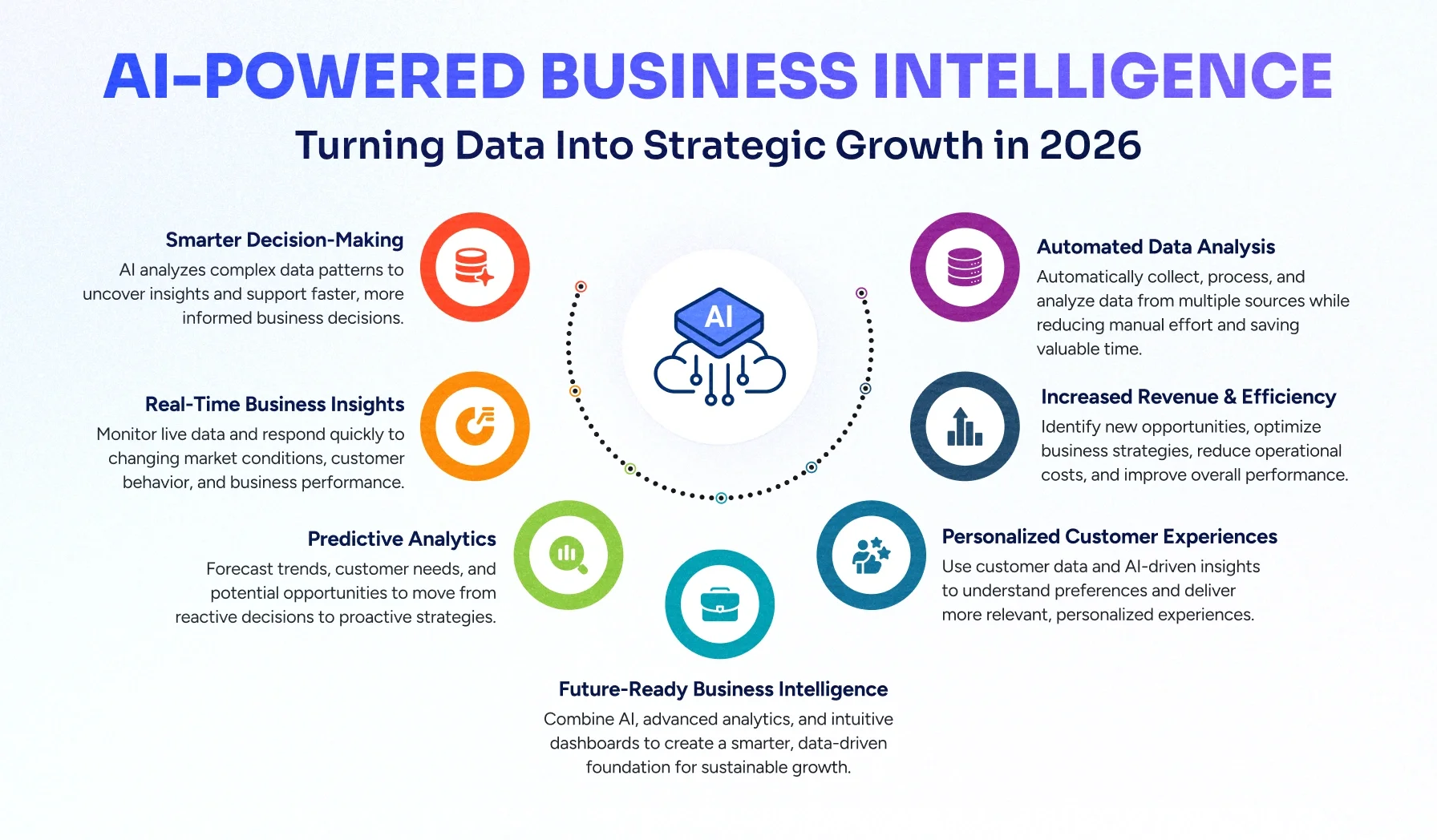
One of the most important benefits of AI-powered BI is improved decision-making. AI can analyze large and complex datasets efficiently and identify patterns that might otherwise be overlooked, giving business leaders a broader and more timely understanding of their operations. AI-powered BI can also improve operational efficiency by automating repetitive analytical tasks. Employees can spend less time preparing reports, combining spreadsheets, and manually searching for trends, allowing them to focus more on strategic planning, problem-solving, and business growth. Another significant benefit is predictive capability. By analyzing historical and current information, AI systems can forecast potential trends and outcomes, helping businesses anticipate customer demand, identify revenue opportunities, improve inventory planning, and prepare for operational risks. AI-powered insights can also strengthen the customer experience by helping organizations better understand customer preferences, purchasing behavior, engagement patterns, and potential churn risks. These insights can support more personalized services, targeted marketing strategies, and proactive customer engagement.
Real-World Use Cases Across Industries
AI-powered business intelligence is being applied across a wide range of industries to solve practical business challenges. In retail and e-commerce, businesses can analyze purchasing patterns, forecast demand, optimize inventory, and create more personalized customer experiences. For example, a retailer may identify declining demand for a product in a specific region and adjust inventory before excess stock becomes a larger issue. In sales organizations, AI-powered BI can help teams identify high-value prospects, prioritize leads, predict conversion opportunities, and analyze the activities that contribute to successful outcomes. Marketing teams can use AI-powered BI to evaluate campaign performance, customer engagement, audience segments, and marketing attribution, helping them understand where budgets are generating the strongest results. In finance, AI-powered analytics can support forecasting, risk assessment, fraud detection, and financial performance monitoring, while manufacturing and supply chain organizations can use AI to predict equipment issues, improve demand planning, and optimize production processes. Across these industries, the common advantage is the ability to transform large volumes of information into insights that support more timely and effective business decisions.
The Rise of Conversational BI and AI Agents
One of the most significant developments in business intelligence is the growth of conversational analytics. Instead of requiring users to understand dashboards, filters, or complex reporting systems, conversational BI allows employees to interact with business data using natural language. A manager can ask a question such as, “Which region had the highest revenue growth this quarter?” and receive a response based on relevant data. This approach makes information more accessible throughout the organization and reduces the dependency on technical teams for every analytical request. Employees across sales, marketing, operations, and leadership can explore data more independently and access insights without needing advanced analytical skills. AI agents are taking this capability further by moving business intelligence from passive analysis toward more proactive monitoring. An AI agent can continuously track business metrics, identify unusual changes, investigate potential causes, and alert relevant teams. For example, instead of waiting for a sales manager to discover a sudden decline in conversions, an AI agent could identify the change, analyze possible contributing factors, and highlight areas that require attention. As these capabilities continue to develop, business intelligence systems will increasingly help organizations identify important opportunities and risks before employees actively begin searching for them.
Implementation Challenges and Best Practices
Despite its potential, implementing AI-powered BI requires careful planning. One of the most important challenges is data quality because inaccurate, incomplete, outdated, or inconsistent information can lead to unreliable insights. Organizations should establish clear processes for data validation, governance, and ongoing quality management before relying heavily on AI-driven analysis. Integration is another important consideration, as business data is often distributed across multiple systems, creating information silos that can limit the effectiveness of BI initiatives. Organizations should evaluate how their existing platforms connect and ensure that information can be accessed securely and in a structured way. Employee training is equally important because even advanced technology will have limited value if employees do not understand how to use it or trust the insights it provides. Businesses should invest in training and encourage teams to develop stronger data literacy while also understanding the limitations of AI-generated insights. A phased implementation approach can further reduce risk by allowing organizations to begin with a focused use case, measure results, learn from the implementation, and gradually expand successful initiatives across other areas of the business.
Common Implementation Mistakes to Avoid
One common mistake is focusing too heavily on technology without clearly defining the business problem it is intended to solve. AI-powered BI should support specific organizational objectives rather than being implemented simply because AI is a popular technology. Businesses should begin by identifying the decisions they want to improve and the outcomes they hope to achieve. Another mistake is neglecting user adoption. If employees are not involved in the planning and implementation process, they may resist new tools or continue relying on existing manual workflows. Gathering feedback from end-users and designing solutions around their actual needs can improve adoption and long-term success. Organizations should also avoid overlooking data security and privacy, especially because business intelligence platforms often process sensitive customer, financial, and operational information. Strong access controls, data protection practices, and governance policies are essential for maintaining trust and reducing risk. Finally, AI-powered BI should not be treated as a one-time project. Data sources, business priorities, and market conditions change continuously, which means AI models and BI systems require regular monitoring, evaluation, and improvement to remain accurate and relevant.
How to Measure ROI From AI-Powered BI
Measuring return on investment is essential for determining whether an AI-powered BI initiative is creating meaningful business value. Organizations should define success metrics before implementation so they can compare results over time and evaluate the impact of the technology across financial, operational, and decision-making outcomes. Financial metrics may include increased revenue, improved conversion rates, and lower operating costs, while operational metrics can include reductions in reporting time, improved process efficiency, and higher employee productivity. Decision-related outcomes may include faster response times and improvements in forecast accuracy, while customer-focused metrics can include retention, satisfaction, and engagement. For example, a sales organization may measure improvements in lead conversion and revenue growth, while an operations team may focus on reducing delays and improving efficiency. By connecting AI-powered insights to measurable business outcomes rather than simply tracking technology usage, organizations can identify which initiatives are delivering the strongest value and make better decisions about future investments.
Emerging AI Business Intelligence Trends in 2026
In 2026, business intelligence is evolving from a reporting-focused technology into a more intelligent and proactive decision-support capability. Conversational analytics is making business data easier to access, while AI agents are beginning to monitor performance and identify important developments automatically. Real-time intelligence is also becoming more important as organizations seek to respond to changing conditions as they emerge rather than analyzing information only after an event has occurred. Predictive and prescriptive analytics are expected to play a larger role as well, with predictive analytics helping businesses understand what may happen in the future and prescriptive capabilities helping identify potential actions based on available data. Another important trend is embedded analytics, where AI-powered insights are integrated directly into the applications and workflows employees already use, allowing decisions to be supported closer to the point of action. At the same time, as AI becomes more deeply integrated into business intelligence, data governance, transparency, and responsible AI will become increasingly important. Organizations will need to balance automation with human oversight to ensure that AI-driven recommendations remain reliable, secure, fair, and aligned with business objectives.
How Suave Creators Can Help
At Suave Creators, we help businesses explore and implement AI-powered solutions that support smarter decision-making and sustainable growth. Our team works with organizations to understand their business objectives, evaluate existing data and technology systems, and develop solutions that align with their specific operational requirements. From AI strategy and system integration to intelligent automation and data-driven platforms, we focus on building solutions that create practical business value. We can help organizations identify relevant opportunities for AI-powered business intelligence, improve workflows, and create more connected systems that transform complex information into actionable insights.
Bottom Line
AI-powered business intelligence is becoming an important capability for organizations operating in an increasingly data-driven business environment. The value of business data no longer lies simply in collecting and storing it but in understanding it quickly and using it effectively. By combining AI with business intelligence, organizations can move beyond traditional reporting and gain access to predictive, conversational, and increasingly proactive insights that support better decision-making across the business. From identifying emerging opportunities and improving customer experiences to optimizing operations and measuring performance, AI-powered BI can help organizations turn information into a meaningful strategic advantage. However, successful implementation requires more than selecting the right technology. Strong data quality, employee adoption, security, governance, clear business objectives, and continuous improvement are all essential. As business intelligence continues to evolve, organizations that combine human expertise with AI-driven insights will be better positioned to make smarter decisions, respond effectively to change, and support sustainable long-term growth.