





 +91 88949 00142
 +1 (307) 435-9605
Why Generative AI Matters and the Benefits It Delivers
Generative AI can create new content such as text, images, code, audio, and other digital outputs based on information and instructions provided to it. For businesses, its value comes from helping employees complete knowledge-based and creative tasks faster while reducing repetitive manual work. One of its biggest benefits is improved productivity. Teams can use AI to draft documents, summarize information, research topics, prepare reports, and handle routine communication. This gives employees more time to focus on work that requires creativity, strategy, and human judgment.
Generative AI is transforming business operations in 2026 by improving productivity, automating workflows, and enabling smarter, more personalized experiences.
Generative AI can also help businesses move faster. Marketing teams can create campaign ideas more quickly, product teams can explore concepts and prototypes, and developers can get assistance with coding and documentation. At the same time, AI can help businesses personalize customer interactions by generating relevant messages, recommendations, and responses at scale.
How Generative AI Works
Generative AI learns patterns from large amounts of data and uses them to generate new outputs based on a prompt or instruction. Large language models, or LLMs, are widely used in business applications because they can understand and generate natural language. Modern AI systems can also work with different types of information, including text, images, audio, video, and structured data. Businesses can connect these systems to their own documents and knowledge bases using approaches such as retrieval-augmented generation, or RAG, allowing AI to work with relevant company information instead of relying only on general knowledge. AI is also moving beyond simple question-and-answer tools. When connected to business applications, AI can become part of a workflow, helping employees retrieve information, prepare content, and complete specific tasks.
Generative AI vs. Traditional Automation
Traditional automation works mainly through predefined rules. When a specific condition occurs, the system performs a fixed action. This works well for predictable processes but can be less effective when tasks involve language, unstructured information, or changing situations. Generative AI adds more flexibility by understanding requests and generating responses based on context. For example, traditional automation can send a standard confirmation email after a customer submits a form. An AI-powered workflow can understand the customer's request, find relevant information, create a personalized response, and route the request to the right team. The two technologies can work together. Traditional automation can handle predictable steps, while generative AI can manage tasks that require interpretation or content generation.
Where Generative AI Creates the Most Value
Generative AI is already being applied across many areas of business. In marketing, it can support campaign planning, content creation, customer research, email marketing, and personalized communication. This allows marketing teams to spend less time on repetitive content production and more time on strategy.
In sales, AI can assist with prospect research, account summaries, meeting preparation, outreach, and CRM activities. It can gather relevant information about a prospect and help sales teams prepare more personalized communication. Customer service teams can use AI to understand customer questions, find relevant information, summarize conversations, and prepare responses. This can help reduce response times while allowing support representatives to focus on more complex cases. Software and product teams can also benefit from generative AI. Developers can use it for coding assistance, testing, debugging, and documentation, while product and design teams can use it to explore ideas, analyze feedback, and create early concepts. Operations teams can use AI for tasks such as document processing, reporting, research, and internal knowledge management. By making business information easier to access and work with, AI can reduce time spent on routine information-heavy tasks.
From Generative AI to AI Agents
One of the biggest developments in business AI is the rise of AI agents. Unlike a basic AI assistant that responds to individual prompts, an AI agent can be designed to complete multiple steps within a defined workflow. For example, a sales AI agent could research a company, summarize relevant information, prepare personalized outreach, and update a CRM record for review. An operations agent could collect information, prepare a report, and send it to the appropriate team. AI agents are making AI more closely connected to business processes. However, they should operate within clear permissions and boundaries, especially when they are allowed to interact with business systems or perform actions on their own.
Implementation Challenges and Mistakes to Avoid
Introducing generative AI also comes with challenges. Data quality is one of the most important factors, as outdated or inaccurate information can lead to unreliable results. Businesses should ensure that AI systems have access to relevant and trustworthy information. Security and privacy are equally important. Companies often work with sensitive customer, financial, employee, and business data, so AI solutions need appropriate access controls and data-handling policies. Another challenge is accuracy. Generative AI can sometimes produce information that sounds correct but is inaccurate. Important outputs should therefore be reviewed and validated based on the risk involved. Businesses should also avoid treating AI as a standalone tool. When possible, it should be connected to the systems employees already use, such as CRM platforms, databases, knowledge bases, and business applications. This makes AI part of the workflow rather than another separate task.
Best Practices for Implementing Generative AI
Successful AI adoption starts with identifying a real business problem. Instead of adopting AI simply because it is popular, businesses should look for processes where AI can save time, improve productivity, reduce costs, or improve customer experiences. Starting with a focused pilot is a practical way to test an AI solution. A pilot allows businesses to measure its accuracy, usability, and impact before expanding it across the organization. Clear goals are also important. Businesses should decide what success looks like and measure results such as time saved, productivity, response times, accuracy, or cost reduction. These results can help determine whether the solution should be improved or scaled. Employees should also be involved throughout the process. AI works best when it supports human expertise rather than operating without appropriate oversight. Providing teams with the right training can help them use AI effectively and understand its limitations.
The Future Outlook for Generative AI in Business
Generative AI is likely to become more deeply integrated into everyday business operations. Instead of using AI only to generate content or answer questions, businesses will increasingly use it to support complete workflows and interact with their existing applications. AI agents and multimodal systems will expand these possibilities further, allowing businesses to work with different types of information and automate more complex processes. At the same time, organizations will need to place greater focus on security, governance, and responsible AI adoption. The future of business AI is therefore not simply about generating more content. It is about creating smarter workflows where AI, business systems, and human expertise work together.
How Suave Creators Can Help
At Suave Creators, we help businesses turn AI opportunities into practical solutions. From AI-powered sales and customer experiences to intelligent automation and custom AI applications, we help organizations identify where AI can solve real business challenges. Our focus is on creating solutions that fit existing workflows and deliver measurable value. By combining AI with business data, automation, and human expertise, businesses can build more efficient and scalable operations.
Bottom Line
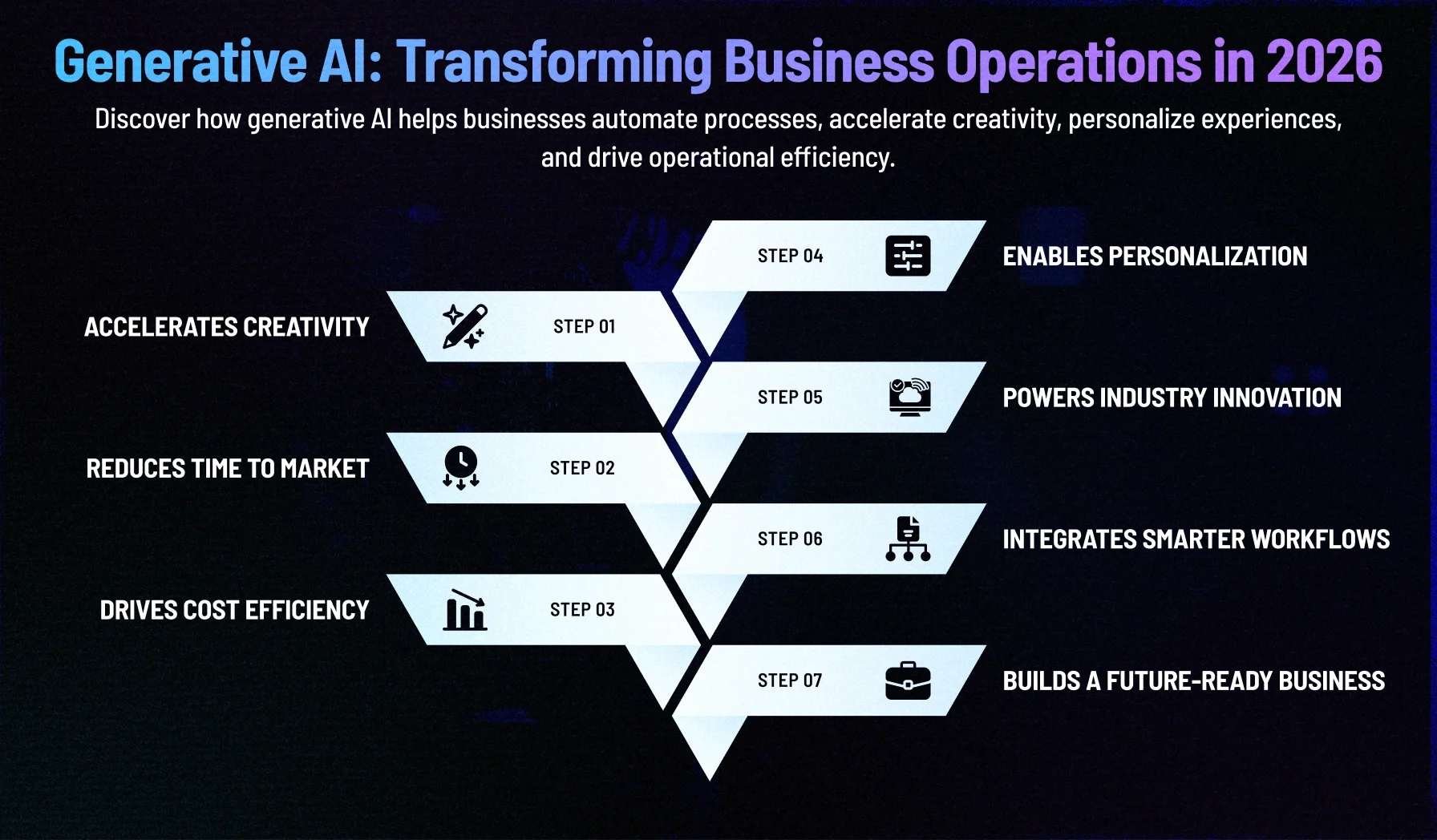
Generative AI is transforming business operations in 2026 by helping organizations work faster, automate repetitive tasks, personalize customer experiences, and explore new ways of working. Its value is not simply in generating content but in how effectively it can be applied to real business processes. Businesses that start with clear objectives, reliable data, appropriate human oversight, and measurable outcomes can use generative AI to improve operations while creating a stronger foundation for future innovation.