





 +91 88949 00142
 +1 (307) 435-9605
The Future of Enterprise Automation: AI-Driven Business Transformation
In 2026, enterprise automation is transforming the way businesses operate. What once focused primarily on automating repetitive, rule-based tasks has evolved into a more intelligent approach that connects people, processes, data, applications, and business systems. Organizations are increasingly combining workflow automation, artificial intelligence, AI agents, process orchestration, and system integrations to streamline operations, reduce manual effort, minimize errors, and support faster, more informed decision-making.
Enterprise automation is reshaping the way businesses operate in 2026. Discover how automating processes can enhance efficiency, reduce costs, and improve decision-making. Learn practical steps for implementation and the common pitfalls to avoid.
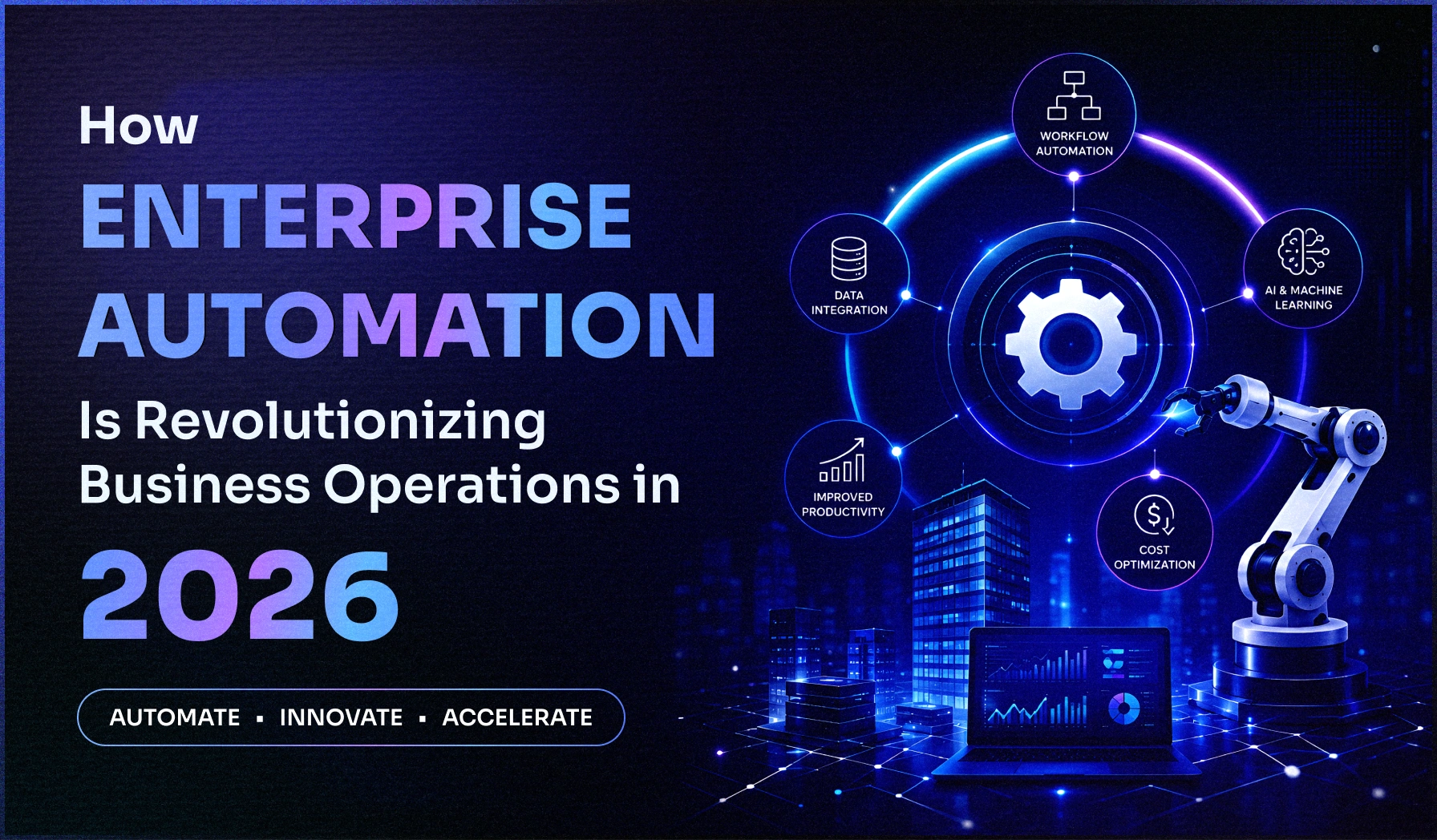
As businesses manage growing volumes of data and increasingly complex workflows, automation has become essential for improving efficiency, scalability, and operational resilience. Modern enterprise automation is no longer limited to completing individual tasks. It can coordinate activities across departments, connect previously disconnected systems, trigger actions based on real-time events, and provide teams with better visibility into business processes. This article explores how enterprise automation is revolutionizing business operations, the technologies driving this transformation, the areas where automation creates the greatest value, and the strategies businesses can use to implement automation successfully.
Why Enterprise Automation Matters and the Benefits It Delivers
In today’s fast-paced business environment, manual and disconnected processes can slow operations, increase errors, and make it difficult for organizations to scale efficiently. Employees often spend valuable time transferring information between systems, updating records, managing repetitive requests, and coordinating tasks that could be handled through automated workflows. Enterprise automation helps address these challenges by connecting business systems and reducing the amount of manual intervention required to complete routine processes. Instead of relying on employees to repeatedly move information between applications or follow the same steps for every request, businesses can create automated workflows that perform actions consistently and efficiently.
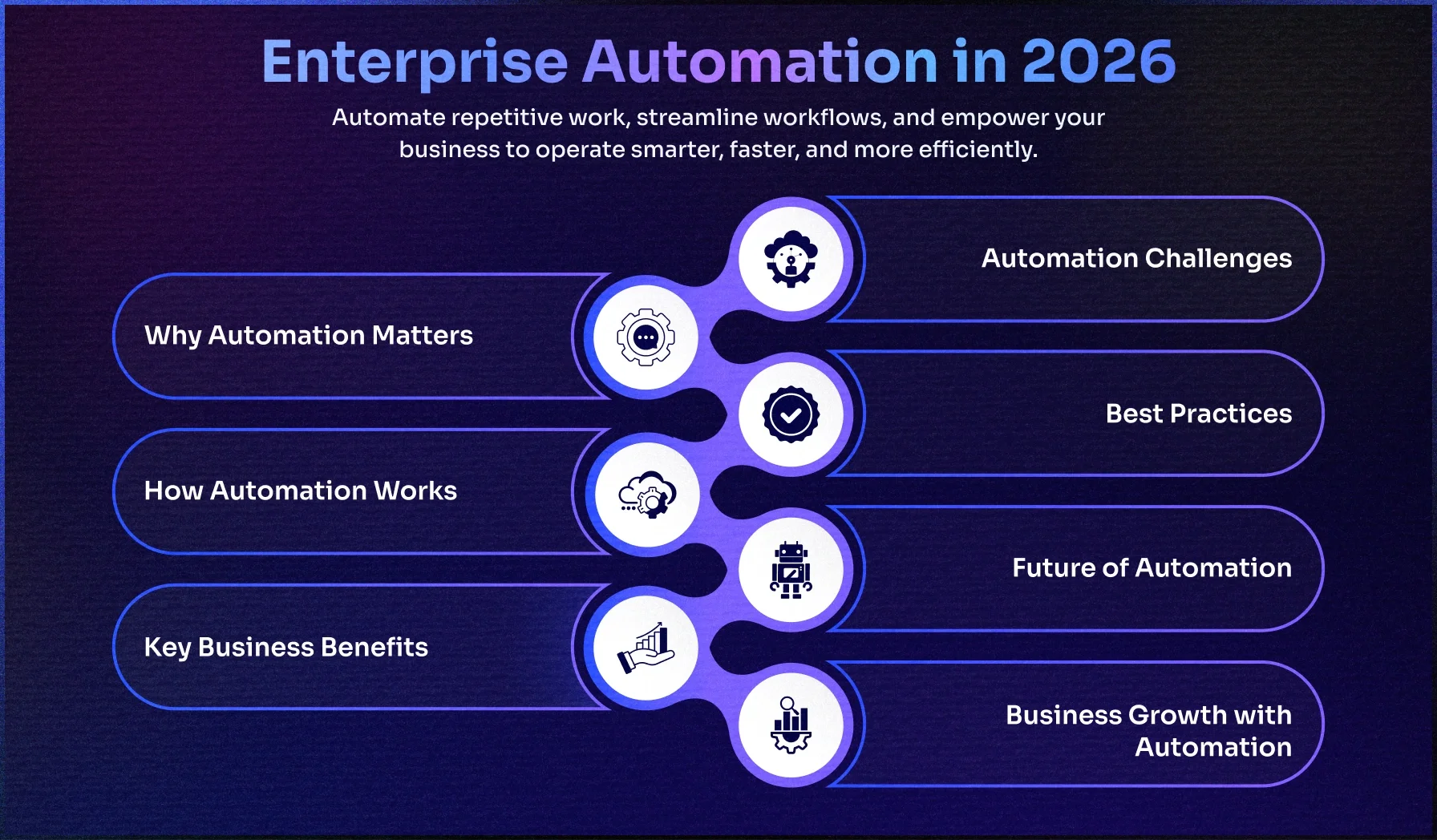
The benefits extend beyond simply saving time. Enterprise automation can reduce repetitive and time-consuming work, minimize manual errors, and improve the consistency of routine processes. This can lead to lower operational costs while allowing employees to focus more on strategic decision-making, problem-solving, innovation, and customer-facing activities. Automation also supports greater scalability. Automated workflows can help businesses manage increasing workloads and transaction volumes without requiring a proportional increase in administrative effort or operational overhead. This allows organizations to grow more efficiently while maintaining consistency across business processes. Another important benefit is faster and more reliable service delivery. By reducing delays caused by manual handoffs and automatically coordinating routine actions, businesses can respond more quickly to customer and operational requirements. Connected workflows can also strengthen collaboration between departments and improve visibility into how business processes are performing. Automation further supports better decision-making by improving access to business data. Automated systems can collect, process, and synchronize information across multiple applications, helping teams access more timely and relevant insights.This combination of improved efficiency, scalability, visibility, accuracy, and decision-making makes enterprise automation an important foundation for modern business operations.
How Enterprise Automation Works
Enterprise automation brings together multiple technologies to automate tasks, connect systems, and streamline end-to-end business processes. Modern automation does not simply replace individual manual activities. It can coordinate workflows across multiple departments, analyze information, trigger actions based on predefined conditions, and support more intelligent decision-making. Robotic Process Automation, commonly known as RPA, uses software bots to perform repetitive and rule-based tasks. These tasks can include data entry, data extraction, report generation, document processing, and information transfer between systems. RPA is particularly useful when processes follow predictable steps and require limited human judgment. Artificial Intelligence adds a more advanced layer of automation by enabling systems to analyze large volumes of data, recognize patterns, process unstructured information, and generate useful insights. AI can support activities such as document analysis, classification, forecasting, recommendations, and decision support, making automated workflows more intelligent and adaptable.
Workflow automation connects tasks and actions through predefined rules or events. For example, when a customer submits a request, a workflow can automatically create a record, notify the appropriate team, update related systems, and trigger the next required action. This reduces delays and helps processes move efficiently between employees, departments, and applications. AI agents are also becoming an increasingly important part of enterprise automation. These AI-powered systems can analyze context, retrieve relevant information, and perform defined tasks across connected business systems within established rules and permissions. By combining AI capabilities with workflow automation and system integrations, AI agents can support more adaptive and intelligent business processes. Process orchestration coordinates multiple automated workflows, applications, systems, and teams to manage complex end-to-end processes. API and system integrations play a critical role by allowing enterprise applications such as CRM platforms, ERP systems, customer support tools, and internal applications to exchange information and trigger automated actions without manual intervention.
Together, these technologies help businesses move beyond isolated task automation and build connected, intelligent workflows that improve efficiency, operational visibility, and the ability to manage increasingly complex business processes.
Where Enterprise Automation Creates the Most Value
Enterprise automation can create value across almost every business function. The greatest opportunities often exist in processes that are repetitive, time-consuming, error-prone, or dependent on manual handoffs between employees and systems. In sales and CRM operations, automation can manage lead enrichment, customer data updates, follow-ups, pipeline activities, notifications, and sales reporting. This reduces administrative work while helping sales teams maintain accurate and up-to-date customer information. Customer support teams can use automation to classify and route tickets, send notifications, synchronize customer information, assist with responses, and manage escalation workflows. By reducing manual coordination, businesses can improve response times and create a more consistent customer experience. In finance, automation can streamline invoice processing, approval workflows, reconciliation, reporting, and routine financial data management. These improvements can reduce manual effort, minimize processing delays, and improve the consistency of financial operations.
Human resources teams can use automation to streamline employee onboarding, document collection, approval processes, internal requests, and employee data management. Automating these processes can reduce administrative workloads while improving the experience for both employees and HR teams. Across broader business operations, automation can support task assignments, data synchronization, notifications, reporting, and cross-platform workflows. When systems and departments are better connected, organizations can reduce communication gaps and improve coordination across the business. By identifying high-impact processes across these areas, organizations can develop an automation strategy that delivers measurable operational improvements rather than isolated productivity gains.
Implementation Challenges and Mistakes to Avoid
While enterprise automation can deliver significant benefits, successful implementation requires careful planning. Technical limitations, employee adoption, system integration, security, governance, and long-term maintainability can all affect the success of an automation initiative. One of the most common challenges is resistance to change. Employees may hesitate to adopt new technologies or change established workflows, particularly when they do not understand how automation will affect their roles. Neglecting change management can therefore lead to low adoption and reduced value. Businesses should communicate the purpose and benefits of automation clearly, provide appropriate training, and involve employees throughout the implementation process. Another common issue is automating inefficient processes. If a workflow is poorly designed, automation may increase the speed of execution without solving the underlying problem. Organizations should review, simplify, and optimize existing workflows before automating them. Integration requirements must also be considered early. Many businesses rely on legacy applications and disconnected systems that were not originally designed to work together. Automation solutions that cannot effectively connect with existing systems may create additional manual work or new operational silos.
Businesses should therefore evaluate APIs, data flows, system compatibility, and technical limitations before implementation. Data security and privacy are equally important. Automated workflows may process sensitive business and customer information, making strong access controls, authentication, encryption, monitoring, and data governance essential. As automation becomes more deeply integrated into business operations, organizations must ensure that automated systems operate within appropriate security and compliance requirements. Businesses should also avoid focusing only on immediate requirements. Choosing automation technologies that meet current needs but cannot support future growth may create limitations as the organization evolves. Scalability, maintainability, and long-term integration requirements should be considered from the beginning. Finally, automation should not be treated as a one-time implementation. Failing to monitor workflow performance can reduce its long-term value. Automated processes should be reviewed regularly to identify errors, bottlenecks, security issues, and opportunities for continuous improvement.
By addressing these challenges and avoiding common mistakes early, organizations can reduce implementation risks and build automation systems that remain secure, scalable, and effective as business needs evolve.
Best Practices for Implementing Enterprise Automation
A successful enterprise automation strategy requires more than selecting the right technologies. Businesses need a structured approach that focuses on process improvement, measurable outcomes, employee adoption, scalability, governance, and long-term sustainability. The process should begin with a thorough assessment of existing operations. Businesses should identify repetitive, time-consuming, error-prone, and highly manual processes that are suitable for automation. Each opportunity should then be evaluated based on business impact, complexity, potential return on investment, customer impact, and technical feasibility. Clear objectives and KPIs should be established before implementation. Businesses should define measurable outcomes such as reduced processing times, fewer errors, lower operational costs, improved productivity, or faster customer response times. These measurements provide a clear way to evaluate whether automation is delivering meaningful value. Rather than attempting to automate everything at once, organizations should begin with pilot projects. Smaller automation initiatives allow businesses to test technologies, measure results, identify challenges, and refine workflows before expanding automation across multiple departments or business functions.
Employee involvement is also essential throughout the implementation process. Employees who work directly with affected processes can provide valuable insights into workflow design, operational challenges, and practical requirements. Their involvement can improve automation outcomes while increasing adoption and reducing resistance to change. Businesses should select automation technologies that support scalability and integration. The chosen solutions should work effectively with existing systems while providing flexibility for future growth and changing business requirements. Security and governance should also be built into the automation strategy from the beginning, with clear access controls, approval requirements, monitoring processes, data protection measures, and appropriate human oversight. After deployment, automation performance should be continuously monitored and optimized. Organizations should review workflows regularly, identify bottlenecks or failures, and refine processes as business requirements and technologies evolve.
Enterprise Automation in 2026 and Beyond
Enterprise automation is moving beyond simple rule-based task execution toward more intelligent, connected, and adaptive business systems. Advancements in artificial intelligence, machine learning, AI agents, and process orchestration are enabling organizations to automate increasingly complex workflows while improving decision-making and operational responsiveness. AI-powered systems are expected to play a larger role in analyzing business data, identifying potential issues, recommending actions, and coordinating workflows across multiple platforms. AI agents may become more deeply integrated into enterprise operations, supporting employees by retrieving information, processing requests, analyzing context, and performing defined tasks across connected systems. Automation will also increasingly combine autonomous capabilities with human oversight. Businesses may automate routine decisions and operational activities while maintaining human control over high-impact processes. This balance can help organizations improve efficiency while maintaining accountability where human judgment is essential.
Governance, security, monitoring, and access controls will become even more important as organizations deploy automation across critical business functions. Businesses will need stronger frameworks to manage how automated systems access information, make recommendations, perform actions, and interact with employees and customers. The competitive advantage of enterprise automation will not come simply from automating more tasks. It will come from building intelligent, integrated workflows that connect people, data, processes, and technology across the organization.
How Suave Creators Can Help
Enterprise automation works best when it is designed around the way a business actually operates. At Suave Creators, we help businesses identify automation opportunities, design connected workflows, and develop technology solutions that reduce manual effort while supporting long-term growth. Our approach can include AI-powered automation, workflow automation, CRM automation, API integrations, custom business applications, and intelligent workflows tailored to specific operational requirements. From automating repetitive tasks and connecting disconnected systems to implementing AI-driven workflows and improving existing business processes, our team can help organizations move from manual operations to more efficient and scalable digital workflows.
Whether you are starting with a single automation initiative or looking to modernize multiple business processes, Suave Creators can help you plan, build, integrate, and continuously optimize automation solutions around your business goals.
Bottom Line
Enterprise automation is no longer simply a way to reduce repetitive work; it is becoming a strategic foundation for modern business operations. In 2026, organizations can combine workflow automation, artificial intelligence, AI agents, system integrations, and intelligent process orchestration to create faster, more connected, and scalable operations. The key to successful automation is not automating everything. It is identifying the right processes, selecting the right technologies, and implementing automation with clear goals, strong governance, appropriate human oversight, and continuous improvement.
Businesses that approach automation strategically can reduce operational costs, improve productivity, make faster data-driven decisions, and deliver better customer experiences. As enterprise automation continues to evolve, organizations that invest in intelligent and well-integrated workflows will be better positioned to adapt, scale, and compete in the years ahead.