





 +91 88949 00142
 +1 (307) 435-9605
What Is API-First Development?🔗
API-first development is a software development approach in which APIs are designed and defined before the implementation of the applications and services that consume them. The API acts as a formal contract between software components, defining how systems communicate, what data they exchange, what operations are available, and how authentication, responses, and errors are handled. In a traditional code-first approach, developers typically implement backend functionality first and expose selected capabilities through APIs afterward. While this can work well for smaller applications, interfaces may become inconsistent as systems and teams grow. API-first development addresses this challenge by establishing the interface before the underlying implementation.
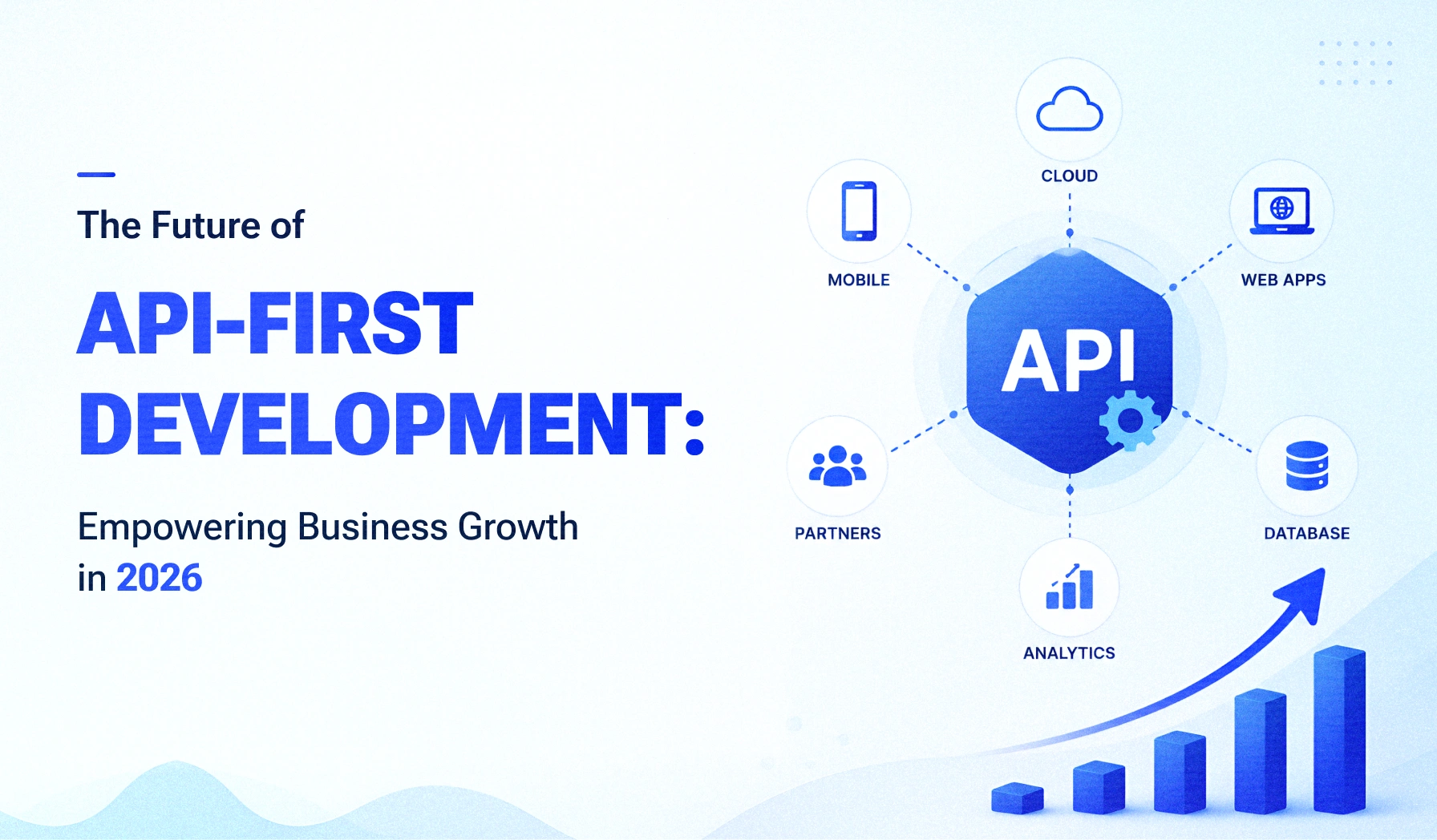
API-first development is transforming how businesses build and integrate software solutions in 2026. This post explores the advantages of an API-first approach, its impact on scalability, and practical steps to implement it effectively in your organization.
An API contract can define endpoints, HTTP methods, request and response structures, authentication requirements, validation rules, status codes, and error responses. Standards such as OpenAPI provide a machine-readable way to describe these interfaces and support documentation, validation, mock servers, automated testing, and code generation. The API-first philosophy also treats APIs as products. Rather than simply exposing database structures, teams design interfaces around business capabilities and consumer requirements. A well-designed API should be predictable, secure, consistent, documented, versioned, observable, and easy to integrate.
In simple terms, code-first focuses on how functionality is implemented, while API-first focuses first on how consumers interact with that functionality.
Why API-First Architecture Matters in 2026🔗
How API-First Development Works🔗
API-first development begins by identifying the business capability that needs to be exposed. Teams determine what the API should accomplish, who will consume it, what information needs to be exchanged, and which business rules must be enforced. The next step is designing the API contract, including endpoints, HTTP methods, request parameters, response structures, authentication mechanisms, validation rules, status codes, and error handling. An OpenAPI specification can document the contract and allow stakeholders to review it before implementation begins. Teams can then create mock APIs so frontend and integration teams can work against the expected interface while backend services are still being developed, enabling parallel development and reducing dependencies. Backend engineers then implement the services behind the agreed contract, which may involve databases, business logic, authentication, external integrations, queues, or caching systems. Because the consumer-facing interface has already been established, internal implementation details can evolve independently as long as the agreed contract remains stable. Testing continues throughout the lifecycle, with functional, contract, integration, security, and performance testing helping ensure that APIs behave as expected. After deployment, teams monitor latency, error rates, traffic, authentication failures, and unusual access patterns while managing versioning, backward compatibility, and deprecation.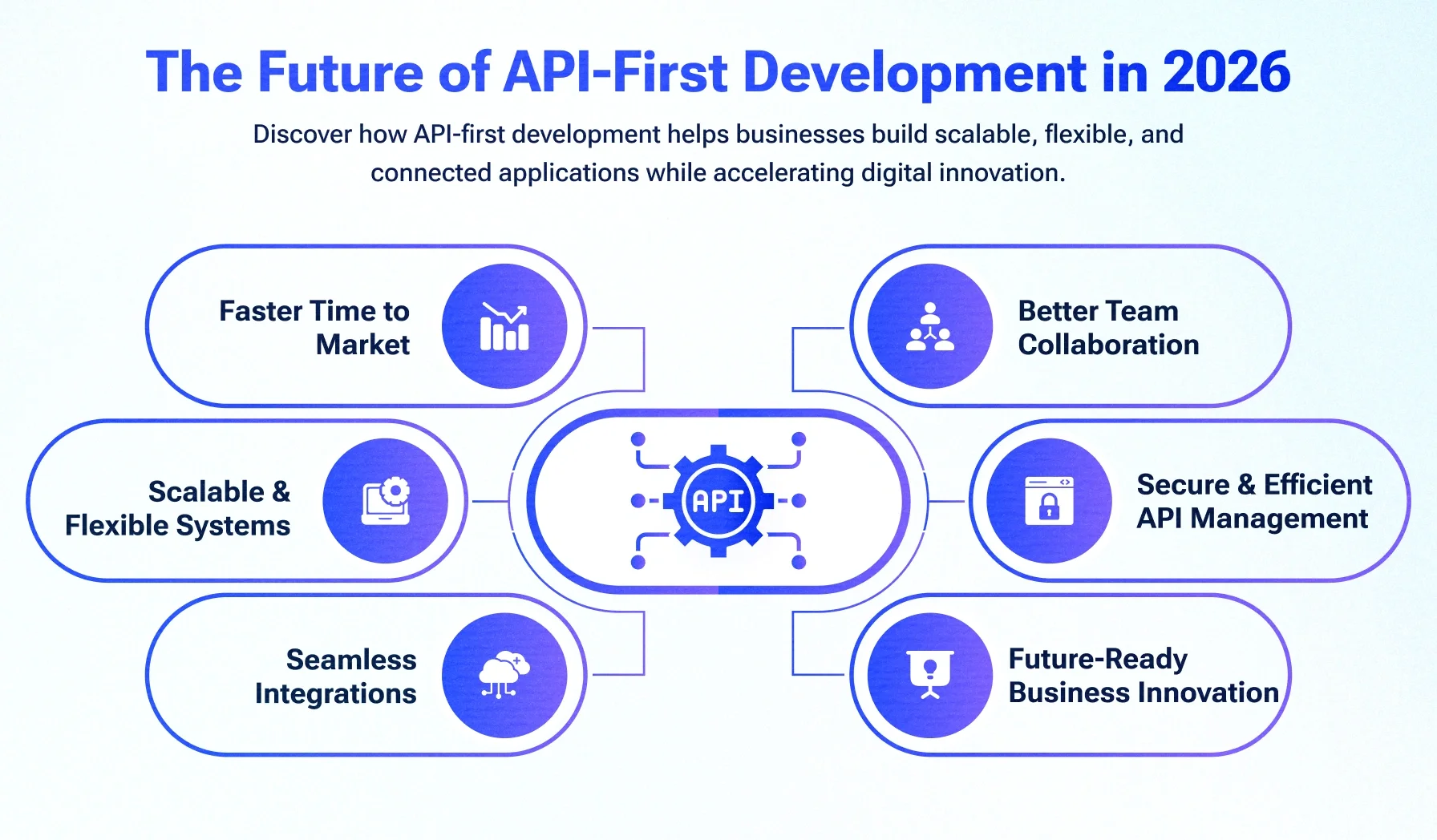
Choosing the Right API Technology🔗
API-first architecture does not require every organization to use the same API technology. REST, GraphQL, and gRPC serve different needs, so the right choice depends on the type of application, data requirements, performance needs, and how systems communicate. REST is a simple and widely supported option for public-facing APIs, web applications, mobile apps, and external integrations. It typically uses HTTP methods and JSON, making it easy to develop and integrate. GraphQL is useful when applications need flexible and precise data retrieval, allowing clients to request only the fields they need. This makes it a good choice for data-rich applications, although it can introduce additional schema and query complexity. gRPC is designed for fast service-to-service communication and uses strongly typed Protocol Buffers, making it well suited for microservices and internal distributed systems. Organizations can also use these technologies together—for example, REST for external APIs, GraphQL for complex frontend applications, and gRPC for internal services. The goal of API-first architecture is not to choose one technology for everything, but to select the approach that best fits each use case.API-First vs. Code-First Development🔗
API-first development begins with the API interface and contract before the underlying functionality is implemented. Teams can review data structures, security requirements, error handling, compatibility, and usability early in the development process. This approach is especially useful when multiple teams or applications depend on the same services because a shared contract establishes clear expectations and reduces inconsistencies in endpoint naming, response formats, authentication, and error handling.In a code-first model, developers implement the underlying functionality first and expose APIs afterward. This approach can be effective for prototypes, smaller applications, or systems with limited consumers. While it may allow teams to move quickly during initial development, APIs can require additional changes as integration requirements grow. API-first development requires more planning upfront, but that investment can help reduce rework and integration problems as systems scale.
Business Benefits of API-First Development🔗
API-first architecture can create several practical business advantages, including reusability, faster delivery, integration efficiency, and maintainability. Organizations can develop a business capability once and reuse it across multiple applications and services, reducing duplicated development and making it easier to launch new digital initiatives. Shared API contracts and mock APIs also allow development, QA, and integration teams to work in parallel, accelerating delivery. Standardized interfaces simplify connections between systems such as CRM, ERP, payment, analytics, communication, and SaaS platforms while reducing tightly coupled dependencies. At the same time, separating the API contract from its underlying implementation allows databases, infrastructure, and service logic to evolve without disrupting consumers. Well-designed APIs can also create new digital opportunities through partner integrations, developer platforms, embedded services, and API-based products.Key Technologies and Practices🔗
Successful API-first development requires more than creating endpoints. Organizations need consistent standards, tooling, testing, security, observability, and governance throughout the API lifecycle. OpenAPI provides a standardized way to describe HTTP APIs, including endpoints, parameters, request bodies, responses, and authentication requirements, while tools such as Swagger can turn these specifications into interactive documentation. Postman supports API development, testing, documentation, collaboration, and automated workflows across technologies such as REST, GraphQL, and gRPC. API gateways and management platforms, such as Konnect, can provide centralized capabilities for routing, authentication, rate limiting, traffic management, logging, analytics, and policy enforcement. API versioning helps organizations introduce changes without unnecessarily disrupting existing consumers, while backward compatibility and clear deprecation strategies help maintain reliable integrations. Automated testing should cover contracts, integrations, functionality, security, and performance, while observability through logs, metrics, and distributed traces helps teams monitor production behavior and troubleshoot issues. Finally, API governance establishes consistent standards for naming, resource design, authentication, authorization, error handling, documentation, versioning, and lifecycle management.
API Security Considerations🔗
Security should be incorporated into API design rather than added after implementation. APIs often provide access to sensitive information and business operations, making them potential targets for unauthorized access and abuse. Authentication establishes the identity of a client or user, while authorization determines what that entity is permitted to access. Depending on the use case, organizations may use OAuth 2.0, OpenID Connect, JWT-based authentication, API keys, or other identity mechanisms. APIs should follow the principle of least privilege, validate incoming requests, limit unnecessary data exposure, and enforce authorization consistently. Rate limiting can help control excessive traffic and reduce abuse, while sensitive data should be protected during transmission and handled according to applicable privacy and security requirements. Logging and monitoring can help identify suspicious activity, repeated authentication failures, and unusual access patterns. Security should therefore be considered throughout the entire API lifecycle, from design and development through deployment, monitoring, versioning, and retirement.Common API-First Implementation Mistakes🔗
A common mistake is designing APIs around database tables instead of business capabilities, as directly exposing database structures can create tightly coupled interfaces that become difficult to maintain when the underlying data model changes. Inconsistent design is another challenge, as different naming conventions, response structures, authentication methods, and error formats can make APIs harder to understand and integrate; organization-wide standards can help maintain consistency. Poor documentation can also limit adoption, so developers should be able to understand endpoints, parameters, authentication requirements, responses, and errors without inspecting the underlying implementation. Organizations should also avoid breaking changes without migration strategies, using versioning, backward compatibility, deprecation policies, and clear communication to protect existing consumers. Security weaknesses such as excessive permissions, weak authentication, insufficient validation, and missing rate limits can create additional risks, while overengineering can make APIs unnecessarily complex. Focused and predictable interfaces are generally easier to use and maintain. Finally, APIs should be treated as continuously managed products, with ongoing monitoring, performance analysis, security reviews, documentation, and lifecycle management after deployment.Real-World API-First Use Cases🔗
API-first architecture can be applied across industries, with each implementation addressing different operational requirements. In e-commerce, APIs can support product catalogs, inventory, orders, payments, shipping, promotions, and customer accounts, allowing businesses to connect specialized capabilities without embedding every function into a single application. In financial services, APIs can connect payment processing, identity verification, banking platforms, fraud detection, and reporting systems while maintaining strict security and authorization controls. Healthcare and enterprise platforms can use controlled APIs to exchange permitted operational, scheduling, and administrative information, helping connect otherwise isolated systems while maintaining appropriate privacy requirements. SaaS businesses commonly expose APIs that allow customers to connect their platforms with CRM, marketing, analytics, customer support, ERP, and internal applications. For AI-powered applications, APIs provide a controlled mechanism for AI systems to interact with approved business operations, such as retrieving customer records, creating CRM tasks, checking appointment availability, or initiating authorized workflows without providing unrestricted access to internal databases. The key advantage is that APIs clearly define what an external consumer can request, what data it can access, and how the system responds.
The Future of API-First Architecture🔗
The next stage of API-first architecture will be shaped by the increasing intelligence and autonomy of software systems. AI agents will require reliable interfaces through which they can discover and execute approved operations, creating greater demand for machine-readable documentation, granular authorization, auditability, and predictable API behavior. Event-driven architecture will complement traditional request-response APIs by allowing systems to publish events when business conditions change, triggering notifications, workflows, synchronization processes, and downstream services without requiring constant polling. As organizations manage larger API ecosystems, API management will become increasingly important, providing centralized visibility into API usage, security policies, traffic, performance, consumer behavior, and lifecycle status. The growth of composable architecture will further strengthen the role of APIs as reusable building blocks, allowing organizations to assemble capabilities from independently managed services rather than relying on large, tightly coupled applications. Together, these developments are transforming APIs from simple application interfaces into structured access points through which people, software services, automation platforms, and AI agents can securely interact with business capabilities.Practical Implementation Checklist🔗
Organizations starting an API-first transformation should:
- Establish API standards for naming, resource structures, authentication, authorization, errors, versioning, and documentation.
- Identify high-value business capabilities that provide meaningful reuse, integration, or automation opportunities.
- Choose appropriate API technologies such as REST, GraphQL, or gRPC based on consumer and performance requirements.
- Design API contracts before implementation and review them with development, product, QA, security, and integration teams.
- Implement security and testing from the beginning, including authentication, authorization, validation, contract testing, and performance testing.
- Use appropriate tooling such as OpenAPI, Swagger, Postman, and API gateway or management platforms.
- Establish monitoring and lifecycle management to track performance, usage, security, versioning, and deprecation.
- Continuously improve APIs using consumer feedback, performance data, changing requirements, and emerging technologies.
How Suave Creators Can Help🔗
At Suave Creators, we understand that successful digital transformation requires more than simply connecting applications. Businesses need reliable architecture, scalable integrations, secure APIs, and technology solutions that can adapt to changing requirements. Suave Creators helps businesses design and implement API-driven solutions that connect applications, business systems, third-party platforms, automation workflows, and modern digital experiences. Our capabilities include API architecture, backend development, system integration, authentication, workflow automation, and cloud-based solutions. A strong API foundation can also help organizations prepare for AI-enabled workflows by establishing secure interfaces around business capabilities, allowing intelligent automation to operate without tightly coupling AI systems to internal databases or application logic. Whether modernizing an existing application, developing a SaaS platform, integrating multiple systems, or preparing for AI-driven workflows, API-first architecture provides the flexibility and foundation businesses need for long-term digital growth.Conclusion: Building a More Connected Digital Future🔗
API-first architecture provides more than a technical method for exposing application functionality. It creates a structured foundation for connecting business capabilities, applications, data, automation, partners, and intelligent systems. By designing APIs around business requirements, choosing appropriate technologies, prioritizing security, establishing governance, and managing APIs throughout their lifecycle, organizations can reduce integration complexity while creating technology that is easier to reuse and evolve. As AI, cloud-native technologies, composable architecture, and distributed systems continue to develop, APIs will become increasingly important as controlled interfaces between business capabilities and the software that consumes them. For organizations looking to modernize infrastructure, connect fragmented systems, or prepare for AI-driven workflows, the future is not simply about building more applications. It is about building better interfaces that allow people, applications, services, and intelligent systems to work together.
- Software Development
- Insights