





 +91 88949 00142
 +1 (307) 435-9605
AI Teams at Work: Multi-Agent Systems in 2026
Businesses are moving beyond AI tools designed to perform isolated tasks and are increasingly exploring AI systems that can manage complex, multi-step workflows. In 2026, multi-agent systems (MAS) are emerging as an important approach to business automation, bringing together multiple specialized AI agents that can plan, communicate, execute tasks, analyze information, and coordinate actions toward a shared objective. Instead of depending on a single AI model to manage an entire workflow, organizations can assign different responsibilities to specialized agents and allow them to work together. This approach can help businesses automate complex processes, improve operational efficiency, accelerate decision-making, and support employees across departments. However, successful multi-agent AI implementation requires more than deploying several AI agents. Businesses need clearly defined objectives, reliable data, secure integrations, appropriate governance, human oversight, and continuous performance monitoring.
Multi-agent systems are revolutionizing how businesses automate processes and enhance decision-making. This article explores their functionality, benefits, and how organizations can effectively implement them to stay competitive in 2026.
What Are Multi-Agent Systems?
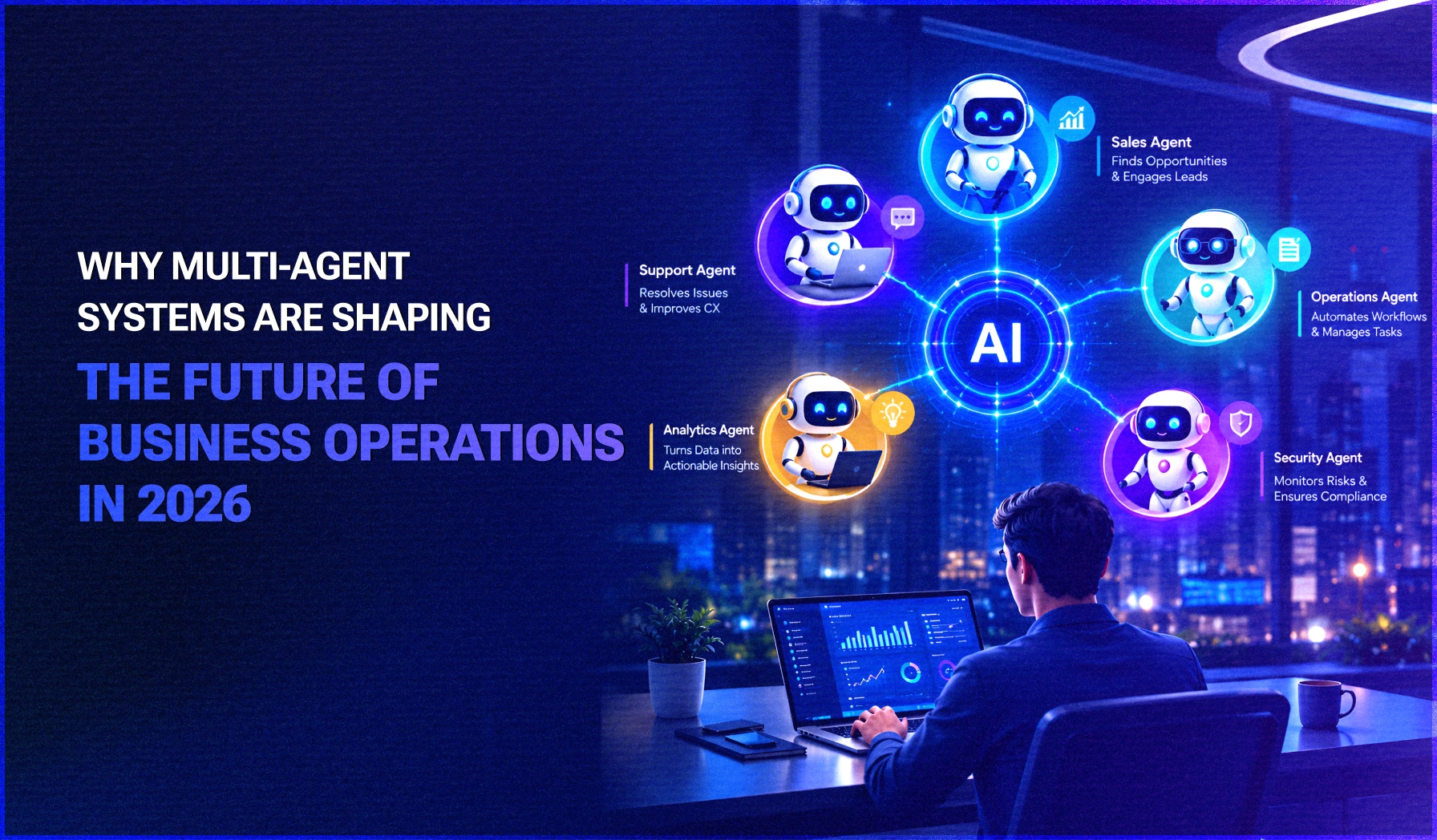
A multi-agent system is an environment where multiple autonomous or semi-autonomous AI agents interact with one another, use data and business tools, and work toward one or more shared goals. Each agent can be designed for a specific responsibility, allowing the overall system to divide complex workflows into smaller tasks. For example, in an AI-powered sales workflow, one agent could identify potential prospects, another could research companies and decision-makers, another could create personalized outreach, and another could monitor engagement and recommend follow-up actions. Rather than requiring employees to manually coordinate every stage, the agents can communicate and pass information between one another as part of a connected workflow. A simple way to understand multi-agent AI systems is to think of them as a digital team of specialized workers, where each agent has a defined role such as researching information, analyzing data, generating content, making recommendations, executing actions through business applications, monitoring processes, or reviewing results.
How Multi-Agent Systems Differ From Traditional AI
Traditional AI applications are often built to perform a specific task, such as answering customer questions, recommending products, generating content, analyzing information, or summarizing documents. Multi-agent systems take a broader approach by coordinating multiple AI capabilities within a single workflow, allowing different agents to handle specialized tasks and collaborate toward a common outcome. While a traditional AI application may be appropriate for a focused problem, a multi-agent architecture can be more useful when a business process involves multiple steps, systems, decisions, tools, or specialized capabilities. However, multi-agent systems are not automatically the best solution for every AI use case. If a task can be handled effectively by a single AI model or automation workflow, adding multiple agents may introduce unnecessary complexity and cost. The key is to use a multi-agent architecture when collaboration and task specialization provide meaningful business value.
How Multi-Agent Systems Work
A multi-agent AI workflow typically begins with a business objective and determines the tasks required to achieve that objective, which are then distributed among specialized AI agents based on their capabilities, available tools, workload, or role within the workflow. For example, in an AI-powered customer support process, a planning agent can identify the customer's request, a research agent can retrieve relevant information from a knowledge base or customer system, a response agent can prepare an answer, and a review agent can check the response for accuracy and compliance before it is delivered. If the request is complex, sensitive, or outside the system's defined boundaries, the workflow can escalate it to a human employee. Agent communication plays a fundamental role in this process because individual agents need to exchange information, pass tasks, and communicate the results of their work, allowing one agent to build on another agent's output instead of repeating the same work. Task allocation determines which agent handles each part of the workflow, while a coordinating agent or orchestration layer can assign responsibilities according to an agent's capabilities, available tools, workload, or business requirements.
AI agents can also connect with APIs, databases, CRM platforms, internal applications, analytics tools, knowledge bases, and other enterprise software, allowing them to retrieve information and perform actions rather than simply generate text or recommendations. Some multi-agent systems can use historical outcomes, feedback, and performance data to improve how tasks are handled over time, although learning and adaptation should be implemented carefully when agents interact with sensitive information or critical business processes. Monitoring and human oversight are equally important because businesses need to track agent activity, identify errors, review decisions, and intervene when necessary. Human approval can remain part of workflows involving financial transactions, legal matters, customer-impacting decisions, security operations, or other high-impact activities. A typical multi-agent workflow can therefore follow a sequence such as Business Goal → Planning → Task Delegation → Specialized Agents → Collaboration → Review → Execution → Monitoring, enabling businesses to coordinate multiple AI capabilities within a structured, controlled, and scalable workflow.
Where Businesses Can Use Multi-Agent Systems
The potential of multi-agent systems in business becomes clearer when the technology is applied to real-world operational processes, allowing organizations to use specialized AI agents across sales, marketing, customer service, finance, supply chain management, IT operations, and business intelligence. In sales and marketing, multi-agent AI can support different stages of the customer acquisition process by identifying potential prospects, researching companies, industries, and business requirements, preparing personalized outreach, monitoring engagement, and recommending follow-up actions, helping sales professionals reduce repetitive research and administrative work while focusing more on conversations, relationships, and strategic opportunities. In customer service, a multi-agent customer support system can classify customer requests, retrieve information from internal knowledge bases and customer systems, generate and review responses, and escalate complex cases to human representatives, helping businesses manage larger volumes of customer interactions while maintaining human involvement when judgment, empathy, or specialized expertise is required. In finance and accounting, AI agents can assist with data reconciliation, financial reporting, transaction analysis, anomaly detection, and document processing by collecting financial information, identifying inconsistencies, and preparing reports for human review, while strong controls, validation, permissions, and human approval should remain in place for high-impact financial activities.
In supply chain management, multi-agent systems can monitor inventory data, supplier information, logistics operations, demand forecasts, and changing market conditions to identify potential supply issues, analyze demand patterns, evaluate alternatives, and notify decision-makers when intervention is needed, helping businesses respond more quickly to operational changes and potential disruptions. IT teams can use multi-agent AI for infrastructure monitoring, incident detection, log analysis, troubleshooting, and operational response, where one agent can identify a potential issue, another can investigate its likely cause, and another can recommend remediation steps while a human administrator approves critical changes, reducing manual investigation without giving AI unrestricted control over production systems. In business intelligence, multi-agent systems can gather information from different business platforms, analyze trends, identify relevant patterns, and transform operational data into decision-ready insights, helping organizations reduce the time spent collecting and processing information while enabling teams to focus more on interpretation, strategic analysis, and business decision-making. Overall, the strongest multi-agent AI use cases are workflows where employees spend significant time gathering information, coordinating multiple steps, switching between systems, or performing repetitive decisions, allowing businesses to create more connected and responsive operations while enabling employees to focus on work that requires human judgment, creativity, expertise, and relationship management.
Key Benefits of Multi-Agent Systems🔗
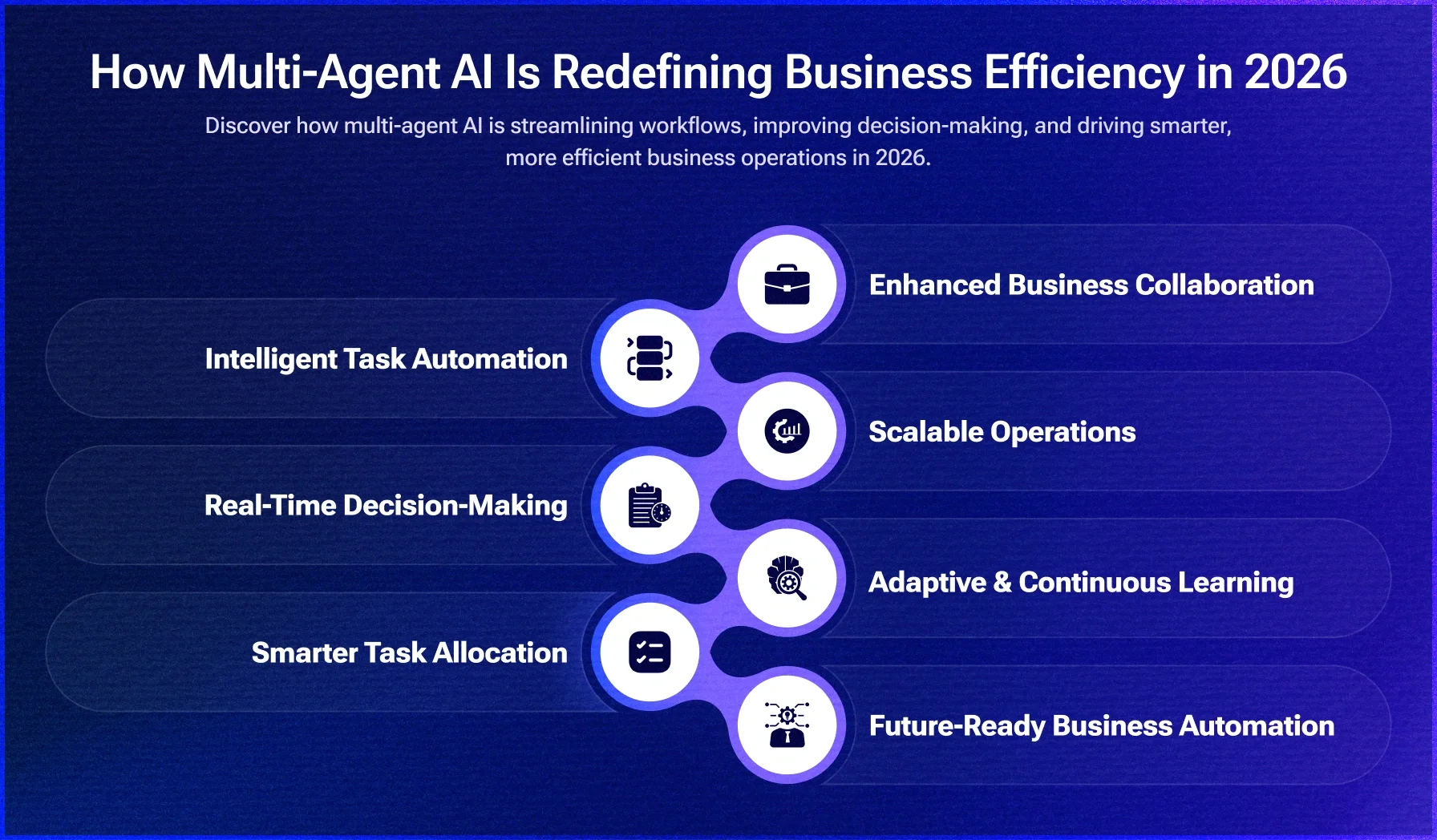
When implemented around the right business problem, multi-agent AI can deliver several operational benefits. Coordinated agents can automate complex workflows, provide faster decision support, improve resource utilization, support business growth, connect activities across departments, and contribute to more responsive customer experiences. The actual benefits depend on the workflow, quality of implementation, available data, system integrations, and how effectively the organization measures outcomes.
Greater Workflow Automation🔗
Multi-agent systems can automate workflows that involve multiple interconnected tasks rather than simply automating one repetitive action. By allowing specialized agents to handle different stages of a process, organizations can reduce the amount of manual coordination required between employees, systems, and business processes.
Faster Decision Support🔗
AI agents can process information and coordinate tasks quickly, helping employees receive relevant insights and recommendations without manually gathering information from multiple sources. This can reduce delays in information-heavy workflows and give decision-makers faster access to the information they need.
Better Resource Utilization🔗
Different agents can be assigned to tasks according to their capabilities, allowing organizations to distribute workloads more efficiently and reduce unnecessary duplication. Employees can then spend more time on activities that require expertise, judgment, communication, and strategic thinking.
Improved Scalability🔗
As businesses grow, they often need to manage increasing volumes of customer requests, data, transactions, and operational processes. Agent-based workflows can provide additional automation capacity and help organizations manage larger workloads without requiring every individual step to be handled manually.
Cross-Functional Coordination🔗
Many business processes involve multiple departments, making coordination a major source of operational complexity. Multi-agent architectures can connect activities across sales, marketing, customer service, finance, operations, and IT, creating workflows that can move information between functions more efficiently.
Better Customer Experiences🔗
Faster response times, personalized interactions, and more consistent processes can contribute to better customer experiences when AI agents are properly connected to customer information and business systems. However, organizations should ensure that automation does not come at the expense of accuracy, transparency, or appropriate human support.
Challenges of Implementing Multi-Agent Systems
Despite their potential, multi-agent systems introduce technical, operational, security, and governance challenges that businesses need to address before deploying them at scale. Organizations must consider system integration, data quality, security, reliability, governance, AI and infrastructure costs, and observability. These considerations are particularly important when agents can access business applications or take actions without direct human intervention.
System Integration
AI agents need access to the systems where business data and processes exist, which can include CRM platforms, ERP systems, databases, APIs, internal applications, and other enterprise tools. Connecting multiple agents with these systems can require significant engineering effort, particularly when existing applications use different data formats, authentication methods, or integration standards.
Data Quality
The quality of an AI agent's output depends heavily on the quality and availability of the information it receives. Inaccurate, incomplete, outdated, or inconsistent business data can lead to unreliable recommendations and incorrect actions. Organizations therefore need effective data management practices before relying on agents for important business decisions.
Security
Multi-agent systems can interact with sensitive business information and operational systems, making security a critical consideration. Organizations should implement appropriate authentication, authorization, access controls, data protection, and permission boundaries to ensure agents can only access the information and perform the actions necessary for their assigned responsibilities.
Reliability
AI agents can produce incorrect outputs or unexpected behavior, particularly when workflows involve ambiguous inputs or incomplete information. Businesses should therefore test multi-agent workflows against realistic scenarios, establish validation mechanisms, and provide appropriate escalation paths before allowing agents to perform important actions independently.
Governance
AI governance defines what agents can access, what actions they can perform, when human approval is required, and how their activities should be monitored. For example, an organization could allow an AI agent to prepare a payment recommendation while requiring a human employee to approve the transaction before it is processed. Clear governance policies help businesses balance automation with accountability.
Cost Management
Operating multiple AI agents can increase model usage, API calls, infrastructure requirements, integration costs, and monitoring expenses. Businesses should evaluate the total cost of a multi-agent workflow against the measurable value it creates and avoid introducing multiple agents where a simpler automation or single-agent solution would be sufficient.
Observability
Businesses need visibility into what their AI agents are doing and how workflows are performing. Effective observability should help teams understand agent actions, tool usage, workflow failures, errors, and decision paths. Without adequate monitoring and logging, identifying and resolving problems in complex agent workflows can become difficult.
Common Multi-Agent Implementation Mistakes to Avoid
Businesses can avoid many problems by treating multi-agent implementation as a business and engineering initiative rather than simply an AI experiment. One common mistake is using multiple agents when a single agent or traditional automation would be sufficient, because unnecessary agents can increase complexity, costs, and maintenance requirements. Organizations should also avoid giving agents unrestricted access to business systems and should instead establish clear permissions, approval requirements, and operational boundaries. Poorly defined agent responsibilities can create duplicated work or conflicting decisions, so each agent should have a clear purpose, defined inputs and outputs, available tools, and decision boundaries. Skipping testing and evaluation can also create problems when AI workflows encounter unexpected inputs or real-world scenarios, making it important to evaluate accuracy, reliability, response time, cost, and failure cases before production deployment. Finally, organizations should avoid focusing solely on the number of AI agents deployed; the real objective is to solve a meaningful business problem, reduce unnecessary work, improve operational performance, or create measurable improvements in customer experience.
How to Implement a Multi-Agent System
A successful multi-agent system implementation should begin with the business problem rather than the technology. Organizations should first identify a process that is repetitive, time-consuming, complex, or dependent on multiple systems and clearly define the improvement they want to achieve. The existing workflow should then be mapped from beginning to end, including employees, systems, data sources, decisions, and manual steps, so businesses can identify where AI agents can provide meaningful value. Before designing a multi-agent architecture, teams should determine whether multiple agents are actually necessary and whether specialized roles, task delegation, or coordination would improve the process. Each agent should then receive a clearly defined responsibility, including the tools it can use, the information it can access, and the actions it is permitted to perform. The required databases, APIs, CRM platforms, knowledge bases, analytics systems, and internal applications should be integrated carefully, followed by appropriate permissions and human approval mechanisms for high-impact actions. The system should be tested using realistic scenarios, including incorrect inputs, missing information, unexpected outputs, and system failures, before being introduced into production. Businesses can then deploy the solution gradually through a controlled use case, monitor performance, measure results, identify weaknesses, and continuously optimize prompts, tools, workflows, permissions, and agent responsibilities as business requirements evolve.
How to Measure Multi-Agent System Success
The success of a multi-agent system should be measured through business outcomes rather than the number of AI agents deployed. Organizations can evaluate metrics such as task completion rate, workflow processing time, human intervention rate, error rate, cost per workflow, customer response time, employee productivity, conversion or revenue impact, customer satisfaction, and system reliability. These metrics help businesses determine whether an AI workflow is actually improving operations rather than simply adding another layer of technology. For example, if an AI-powered sales workflow reduces the time required for prospect research while maintaining or improving conversion rates, the organization can demonstrate a measurable business benefit from its multi-agent implementation.
The Future of Multi-Agent Systems in 2026 and Beyond
The future of multi-agent systems in business is likely to involve deeper integration with the software, data, and workflows organizations already use. Rather than operating as standalone AI applications, agents can become part of broader business ecosystems where they interact with enterprise software, databases, communication platforms, analytics systems, and internal applications. Developments in specialized AI agents, agent-to-agent communication, governance, observability, and more efficient AI models can further improve how these systems operate. At the same time, human-agent collaboration is likely to remain an important part of enterprise AI adoption. Instead of removing humans from every workflow, businesses can use AI agents to handle research, preparation, coordination, monitoring, and routine execution while employees provide judgment, approval, strategic direction, and accountability. This creates an operating model where AI manages more operational complexity while people remain responsible for decisions that require context, expertise, and human judgment.
How Suave Creators Helps Businesses Adopt AI
At Suave Creators, we help businesses identify opportunities where AI can create measurable operational value. Our approach focuses on connecting AI capabilities with the workflows, data, and business systems organizations already use rather than introducing AI simply for the sake of automation. Depending on the business requirement, this can involve workflow automation, AI-powered applications, intelligent business systems, or multi-agent architectures designed around specific operational goals. A practical implementation approach can follow Identify → Design → Integrate → Test → Deploy → Monitor → Optimize, helping businesses move from identifying an opportunity to building, deploying, and continuously improving an AI-powered solution.
Bottom Line
Multi-agent systems are becoming an important approach to AI-powered business automation in 2026, particularly for organizations managing complex workflows that involve multiple tasks, systems, data sources, and decisions. Instead of using AI for isolated activities, businesses can coordinate specialized agents to research information, analyze data, make recommendations, execute defined actions, monitor workflows, and support employees. However, the value of multi-agent AI does not come from simply deploying more agents. It comes from designing the right architecture around a clearly defined business problem and combining automation with reliable data, secure integrations, governance, monitoring, and human oversight. For organizations exploring multi-agent systems in 2026, the best starting point is to identify processes where coordinated AI can reduce bottlenecks, improve productivity, accelerate decision-making, or enhance customer experiences and then build a measurable, controlled solution around those goals.