





 +91 88949 00142
 +1 (307) 435-9605
Key takeaways
- An AI agent development company builds systems that plan, use tools and take actions inside your software, not just chat interfaces on top of a model.
- Cost depends on the number of workflows, integrations, approvals and the quality bar, plus ongoing model usage per task.
- The best partners start with one measurable workflow, build evaluations before scaling, and hand you ownership of the code, prompts and test data.
- Ask the 12 questions below before signing. Vague answers on ownership, quality measurement or running costs are the biggest red flags.
In 2024 most companies shipped AI as a text box: a prompt wrapped around a large language model. In 2026 buyers expect more. They want AI that qualifies a lead and updates the CRM, reads a purchase order and creates the record in the ERP, or triages a support ticket and drafts the reply for approval. That takes AI agents, often several working together, connected to the systems you already run. This guide explains what you are buying, what it costs, and how to choose the right development partner.
What does an AI agent development company build?
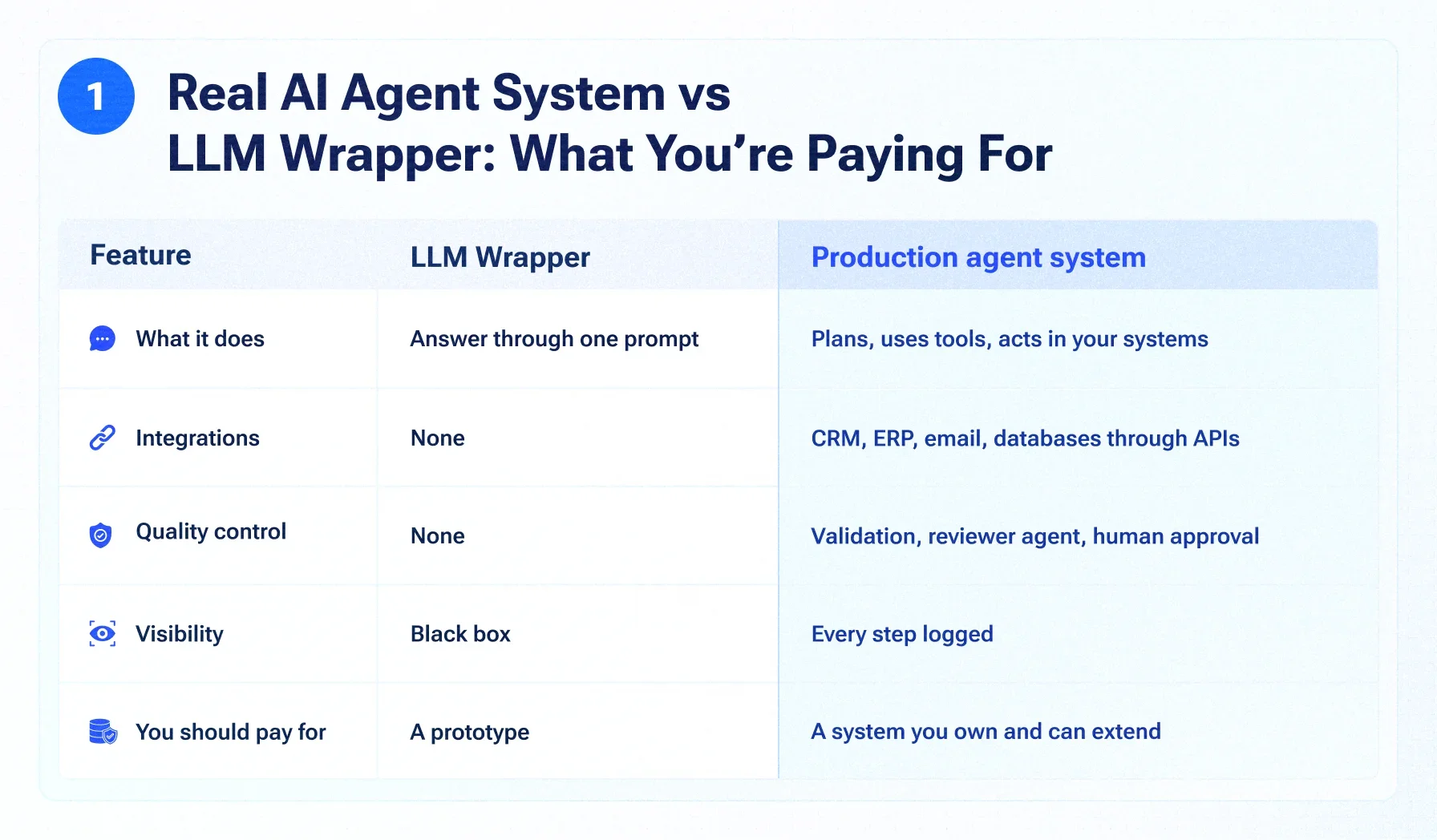
An AI agent development company designs and builds software in which a language model works toward a goal by planning steps, calling tools such as APIs and databases, checking results and repeating until the task is done. The company also builds what makes that reliable in production: integrations, permissions, human approval steps, monitoring and quality testing.
Three levels are worth distinguishing:
| Level | What it is | Typical use |
|---|---|---|
| LLM wrapper | One prompt sent to a model; the answer comes back | Drafting text, simple Q&A |
| Single AI agent | One model in a loop with a set of tools | Research, data lookup, one-department tasks |
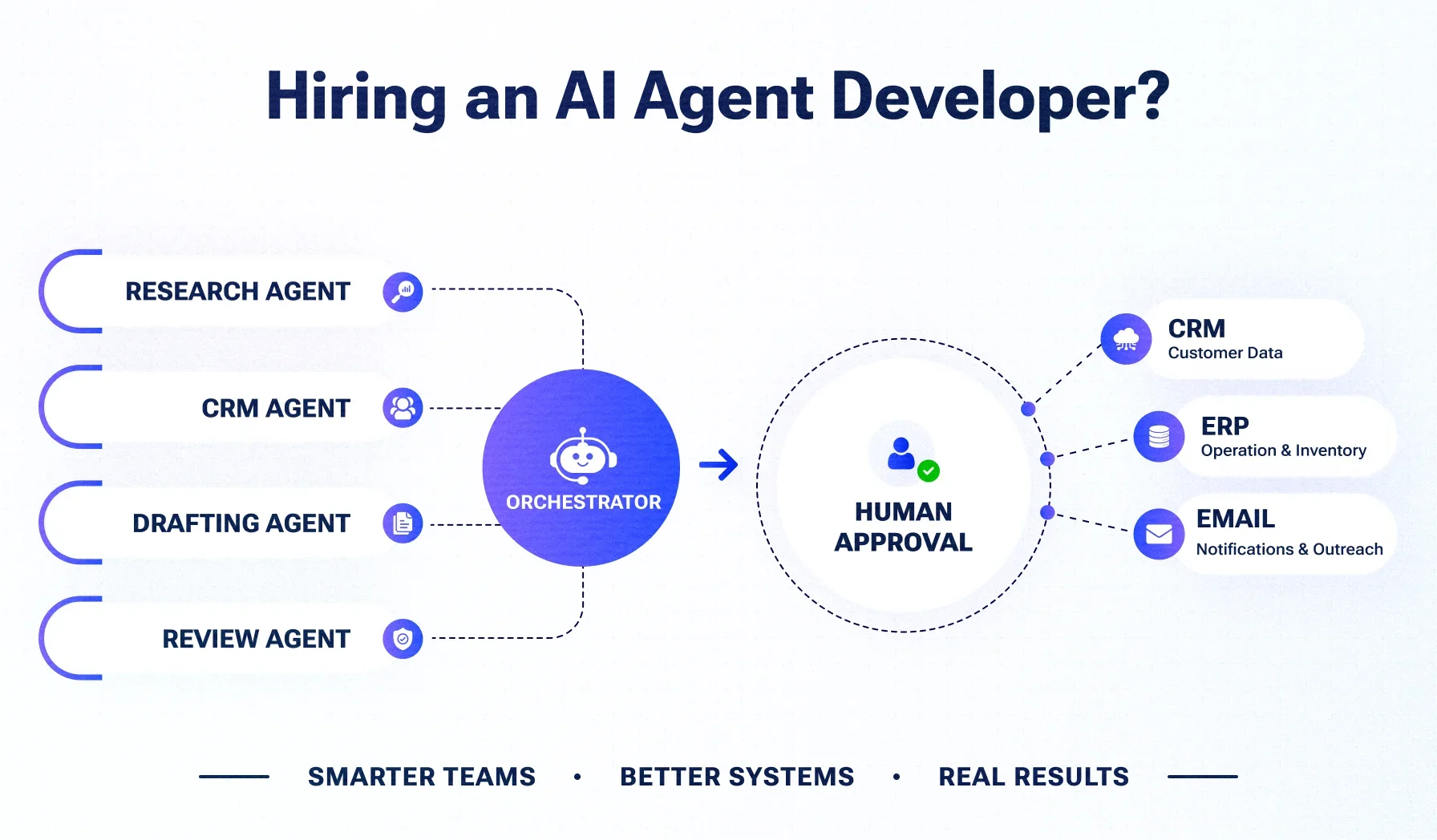
| Multi-agent system | Several specialist agents coordinated by an orchestrator | Cross-system workflows with review and approval steps |
If a vendor's proposal is really a wrapper priced as an agent system, you will find out in production. The tables and questions below help you find out earlier.
When you need a development partner, not a SaaS add-on
Many CRMs and help desks now include built-in AI agents. They are the quickest start when your process matches the vendor's. A custom build makes sense when:
- The workflow spans several systems, such as a CRM, ERP, email and an internal database.
- The agent must follow your own rules, pricing, data and approval chain.
- Per-seat or credit-based AI pricing grows faster than the value it delivers.
- You need to own the logic, prompts and data rather than rent them.
How much does AI agent development cost?
Cost is driven by scope, not by the word "AI". The main drivers:
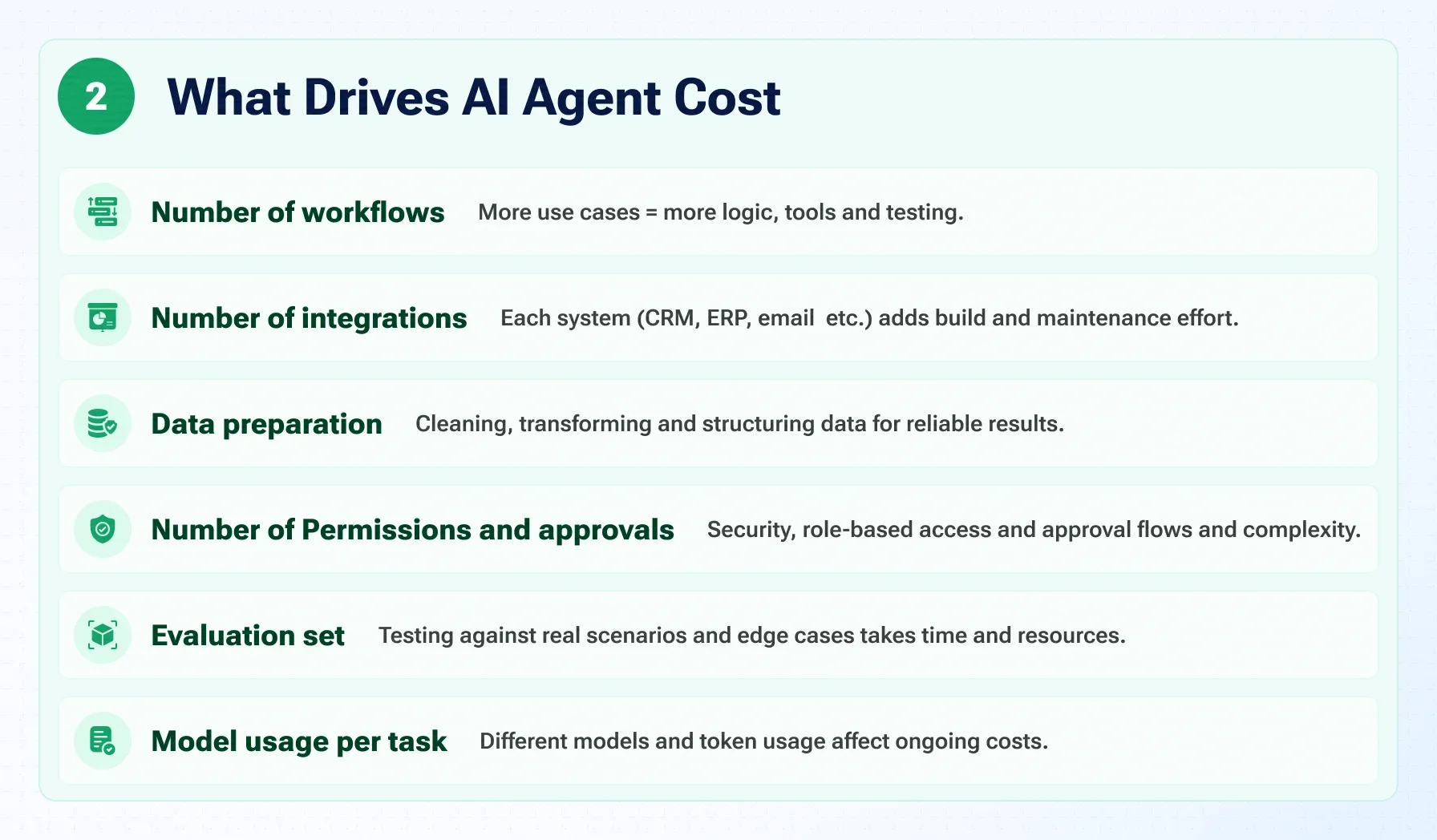
At Suave Creators, a focused pilot on one workflow typically costs [ $3000 - $8,000 ] and takes [ 4–6 ] weeks , a production system with several integrations typically costs [$15,000 - $30,000]. Running costs depend on model choice and volume; we estimate cost per completed task during discovery so there are no surprises.
What a production AI agent system includes
Orchestration and state
A controller decides which step or agent runs next and keeps a record of the task. Treating the workflow as an explicit state machine makes it predictable and easy to debug. Frameworks such as LangGraph, CrewAI and the OpenAI Agents SDK provide this layer, or it can be built directly into your back end.
Tools and integrations
Tools are the functions and APIs an agent can call. Open standards such as the Model Context Protocol (MCP) give agents a consistent way to connect to systems, which makes integrations easier to add and maintain.
Memory and data access
Short-term memory holds the current task. Long-term memory, often a vector database or structured store, holds account history, documents and past decisions the agent can retrieve.
Guardrails and human approval
Each agent gets only the permissions its role needs. Outputs are validated against a schema. Irreversible actions, such as sending an external email or changing a price, wait for a person to approve them. Content pulled from emails and web pages is treated as untrusted to defend against prompt injection.
Observability and evaluations
Every step, tool call and cost is logged. A test set of real cases runs before every change to prompts, models or tools, so you know whether quality went up or down.
One agent or many?
Start with one well-equipped agent. Split into specialist agents only when one agent's instructions, tools or permissions become too broad to manage reliably, or when outputs need independent review. Common multi-agent patterns include orchestrator–worker (a coordinator delegates to specialists), generator–reviewer (one agent drafts, another checks) and parallel fan-out (several agents research at once). A good partner will tell you when you do not need more agents, because each one adds cost and latency.
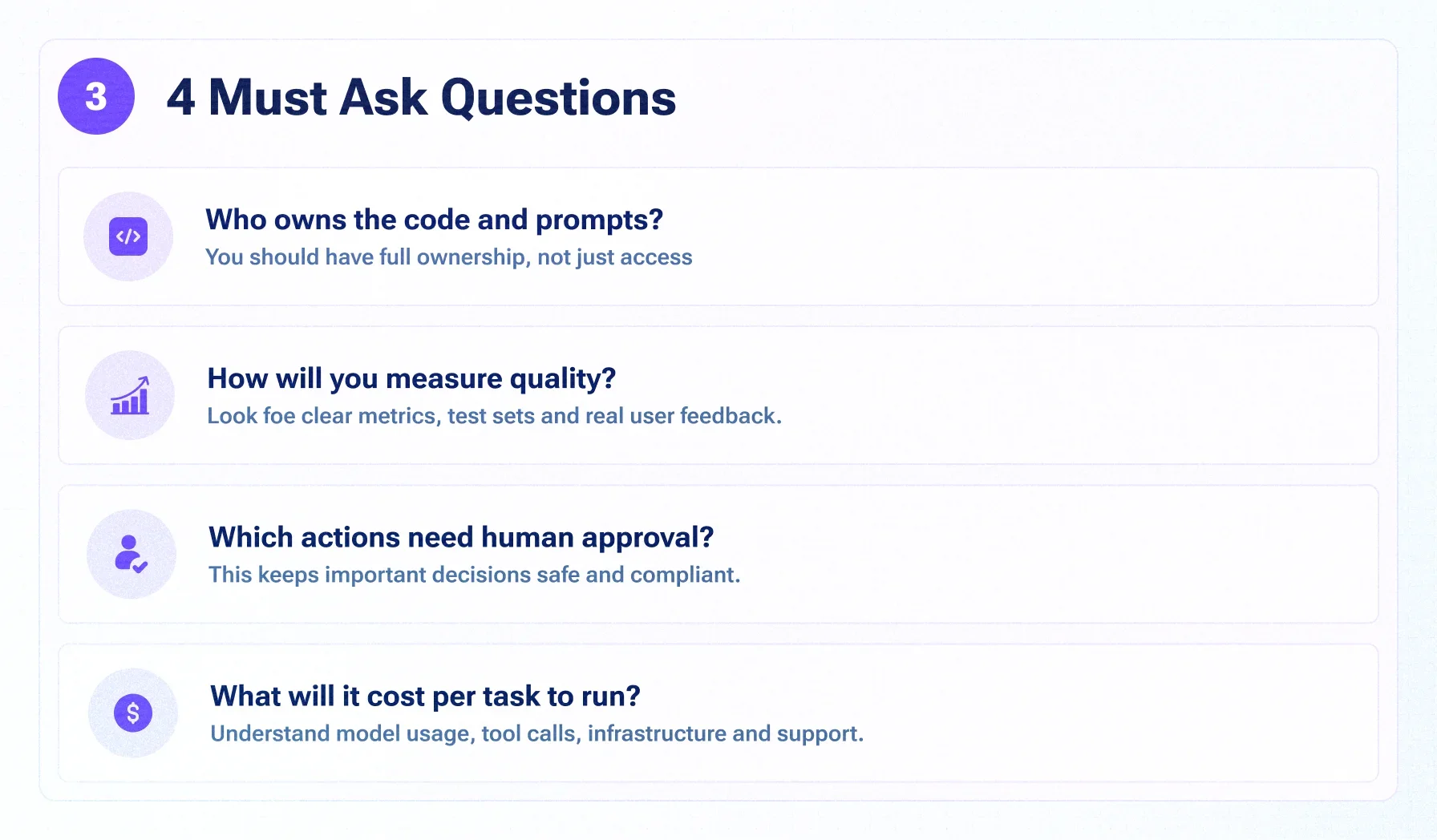
12 questions to ask an AI agent development company
- Which single workflow would you build first, and how will we measure success?
- Is this a wrapper, a single agent or a multi-agent system, and why that design?
- Which of our systems will the agents connect to, and through which APIs?
- What can each agent read, and what can it change?
- Which actions require human approval?
- How will you test quality before and after launch?
- What will it cost to run per completed task at our volume?
- How do you defend against prompt injection and data leakage?
- Can we switch model providers later without a rebuild?
- Who owns the code, prompts, evaluation sets and data?
- Where will the system be hosted, and who maintains it?
- Can we talk directly to the engineers building it?
Red flags
- A fixed price for a complex agent system before any discovery
- No plan for evaluations or quality measurement
- "The model handles it" in place of a permissions design
- The vendor keeps ownership of prompts or code
- No estimate of running costs
In-house team, freelancer or development company?
| Option | Strengths | Watch-outs | Best for |
|---|---|---|---|
| In-house AI team | Full control, deep context | Slow and costly to hire scarce AI, back-end and integration skills together | Companies with AI as a core product |
| Freelancer | Fast, low commitment | Rarely covers integrations, security and long-term support | Prototypes and experiments |
| AI agent development company | Full team: AI, back end, front end, integrations, QA | Quality varies; vet with the 12 questions | Production systems connected to business software |
Why companies choose Suave Creators to build AI agents
Suave Creators builds custom AI agents and multi-agent systems that connect to the CRMs, ERPs and databases companies already run. Because we are a full-stack software company, not an AI-only studio, the same team builds the agents, the integrations, the user interface and the back end, so the system fits seamlessly into how your team works.
- Integration-first: agents work inside your existing systems through secure APIs, typically with a Laravel or Node.js orchestration layer and streaming responses to the interface.
- One measurable workflow first: discovery defines the outcome, permissions and cost per task before we build.
- You own everything: 100% of the code, prompts and evaluation sets.
- Transparent delivery: 2-week sprints with direct access to senior architects and engineers.
- US contract, India engineering center: a US-registered company with its engineering team in Palampur, India.
See our applied AI solutions, the technology stack we build on, and AI in production in our AI product matching case study and AI sales coaching case study. Building agents into a CRM? See custom CRM development.
How to start
- Share one workflow. Tell us the process, the systems involved and what "done" looks like.
- Discovery and scoping. We map the workflow, design permissions and approvals, and estimate build and running costs.
- Pilot, then scale. We ship one workflow to production with evaluations in place, then extend to the next.
For background on the architecture shift, read how multi-agent AI systems are automating B2B workflows.