



 +91 88949 00142
 +1 (307) 435-9605
Tech isn't merely a support mechanism in modern business; it is a critical component of your competitive advantage. When selecting your Customer Relationship Management software, you have only two choices: a standardised, out-of-the-box solution or a custom-developed solution. For many companies, especially those in unique, complex, or highly regulated businesses, an off-the-shelf CRM is akin to buying a suit off the rack - fine but might fit awkwardly.
Learn why customised CRM software often beats off-the-shelf solutions for unique workflows, integrations, and long-term growth.
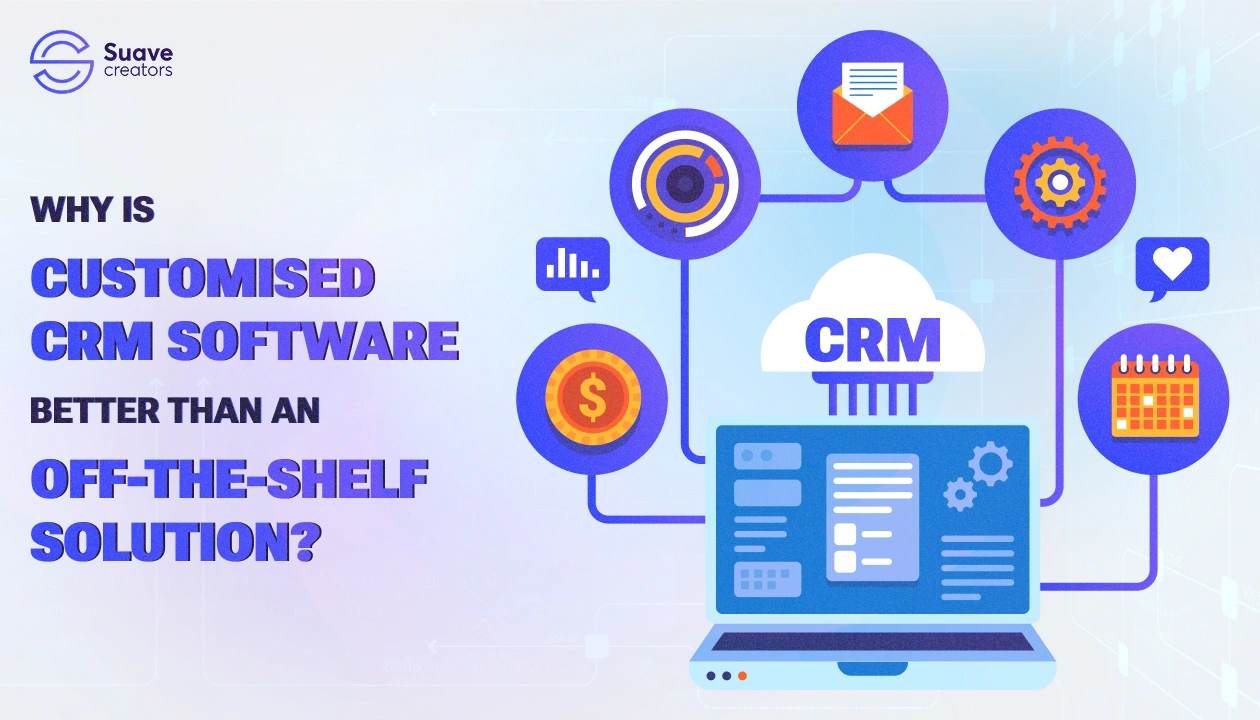
A custom CRM is like being fitted for a suit tailored to your dimensions. The tailor made your suit so it works with your body, not the other way around. In this guide, we will discuss why a custom CRM is better and how it can transform businesses for companies with ambitious goals.
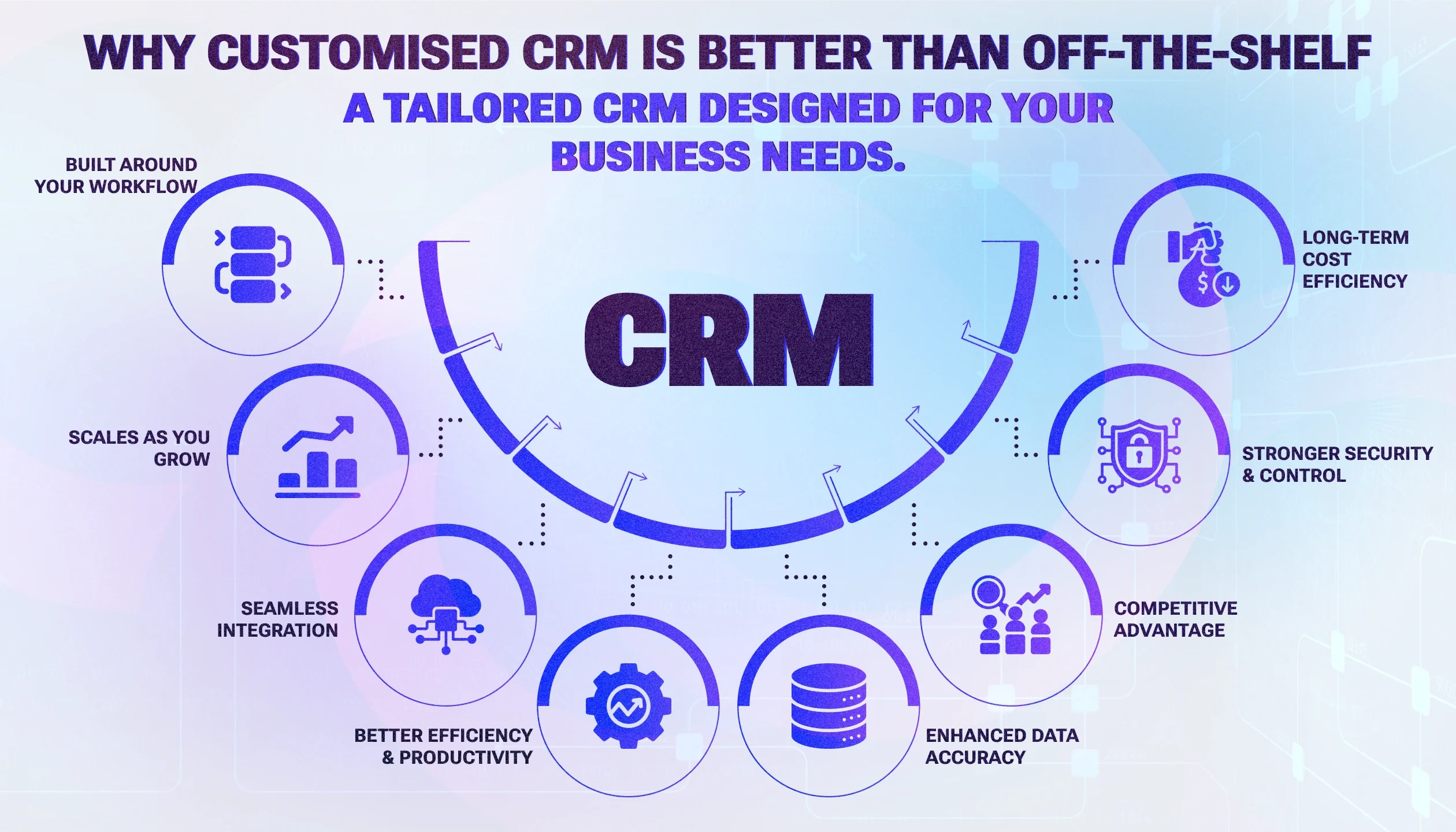
The Power of Perfect Alignment: Building for Your Process
The main argument in favour of a custom CRM is starkly clear: it demonstrates itself in the way you operate. Your particular proven business process is a key to your success; add-ons are not negotiable.
A generic system requires an operation to fit the app's rigid process. If your sales process requires five sign-offs, for example, and the app only includes three, you will develop frustrating workarounds and often end up with a discouraged team.
A custom CRM avoids this friction. It mirrors your system's efficiency so your staff can work without unwanted interruptions or disruptions in their process. If you need to include an additional field for compliance or whatever, it is part of the software.
Eliminating Digital Noise: Focus Fosters Adoption
Because generic CRMs are built to attract everyone, they are designed with lots of features/fields/tabs that your company will never use. Custom software embraces the "less is more" idea. This means your software is built only to include the features/fields/reports necessary for your specific employees to do their jobs.
As low adoption rates are the single biggest reason CRMs fail, intuitive simplicity could very well be the most significant ROI you receive from a custom build. A highly complex, highly powerful system that no one uses is simply a failure.
True Integration: Forging Deep System Connections
In a specialised or large organisation, the CRM is never on an island. It needs to work perfectly with your ERP systems, proprietary financial tools, custom inventory database, and specialised software for your industry.
Off-the-shelf CRMs rely on standard connectors that are often brittle and very costly and will not serve the fine points of complex proprietary data. Integration soon becomes an overwhelming, ongoing, expensive headache for your IT department.
A custom CRM is designed for deep integration from day one. Developers create stable, direct integrations with your specific existing technology stack. A custom CRM guarantees a smooth, correct flow of data throughout the entire organisation, eliminating manual data entry between systems, and confirms that the CRM really is the definitive "single source of truth."
Future-Proofing: Your Asset, Your Roadmap
An off-the-shelf system can be inflexible; at some point in your growth curve, you might find the ceiling or parameters of the off-the-shelf vendor's data model or feature roadmap. You could be faced with a massive, painful migration because your software could not scale to support your success.
A custom CRM solution is the ultimate scaling and flexibility solution because you own the code base. The custom CRM is a modular system designed to be updated, grown upon, and changed as your business model matures. This brings down the risk and costs of potential future expensive replacements, ultimately developing your custom CRM into a long-term investment that grows hand in hand with you.
Competitive Edge and Data Sanctuary
In a competitive market, customer experience is your last remaining differentiator. A custom CRM allows you to embed your "secret sauce" - unique automation, proprietary models, or custom client reporting - into the software, giving your business a distinct competitive advantage over generic CRMs.
When it comes to strict laws like GDPR, custom CRM provides complete control. You have full authority over where data lives, how it is encrypted, and who sees it, resulting in top security and total compliance for sensitive customer information.
The True Long-Term Cost Perspective
The elevated initial development cost of a custom CRM is likely the foremost objection to its use. However, note that you should consider this an upfront investment in a capital expense that will save you money over time.
When you use an off-the-shelf system, you may think you are saving in the beginning, but you will be faced with cumulative costs that increase yearly: monthly per-user subscription fees, additional storage fees, premium features or modules costs, along with exorbitant repeat fees for recurring integration connectors. In five to ten years, those ongoing operating expenses can easily exceed the upfront price of a custom solution.
A custom CRM allows you to avoid licensing fees and general overhead fees for external tools you may buy to fill gaps in your system. A custom CRM is a better Return on Investment (ROI) based on efficiency directly related to nicely aligned workflows that save time, lead to fewer errors, and yield higher sales conversion cycle times—actual operational savings that matter and only compound the longer you use your system.
Conclusion
With tightening data privacy laws like GDPR, it’s nice to have your custom CRM to feel secure. Your CRM is really an organisational fortress that you control entirely. It offers the total peace of mind that you control exactly where the data is stored, how it is encrypted, and who has access to it. This way, you can accomplish every internal and external compliance requirement while treating valuable customer information at the utmost levels of safety and protection.