





 +91 88949 00142
 +1 (307) 435-9605
Unlocking the Power of AI Search: Transforming Business Intelligence in 2026
In 2026, businesses are generating more data than ever—from customer interactions and sales records to internal documents, support tickets, and market insights. The real challenge is no longer collecting information; it is finding the right information quickly and turning it into meaningful business intelligence.
AI search technologies are redefining how businesses access and analyze data. This article explores its significance, benefits, and implementation strategies to help your organization remain competitive in the data-driven landscape of 2026.
Traditional keyword-based search often struggles to understand what users actually mean, especially when information is spread across multiple systems. AI search is changing this by using natural-language understanding, semantic search, machine learning, and contextual intelligence to deliver more relevant and actionable results.
Instead of simply matching keywords, AI-powered search can understand the intent behind a query, connect related information, and help users discover insights across large and complex datasets. For businesses, this means faster knowledge discovery, more informed decision-making, improved productivity, and better customer experiences.
As AI continues to reshape how organizations work with information, AI search is becoming an essential technology for businesses looking to turn their data into a competitive advantage.
Why AI Search Matters for Businesses in 2026
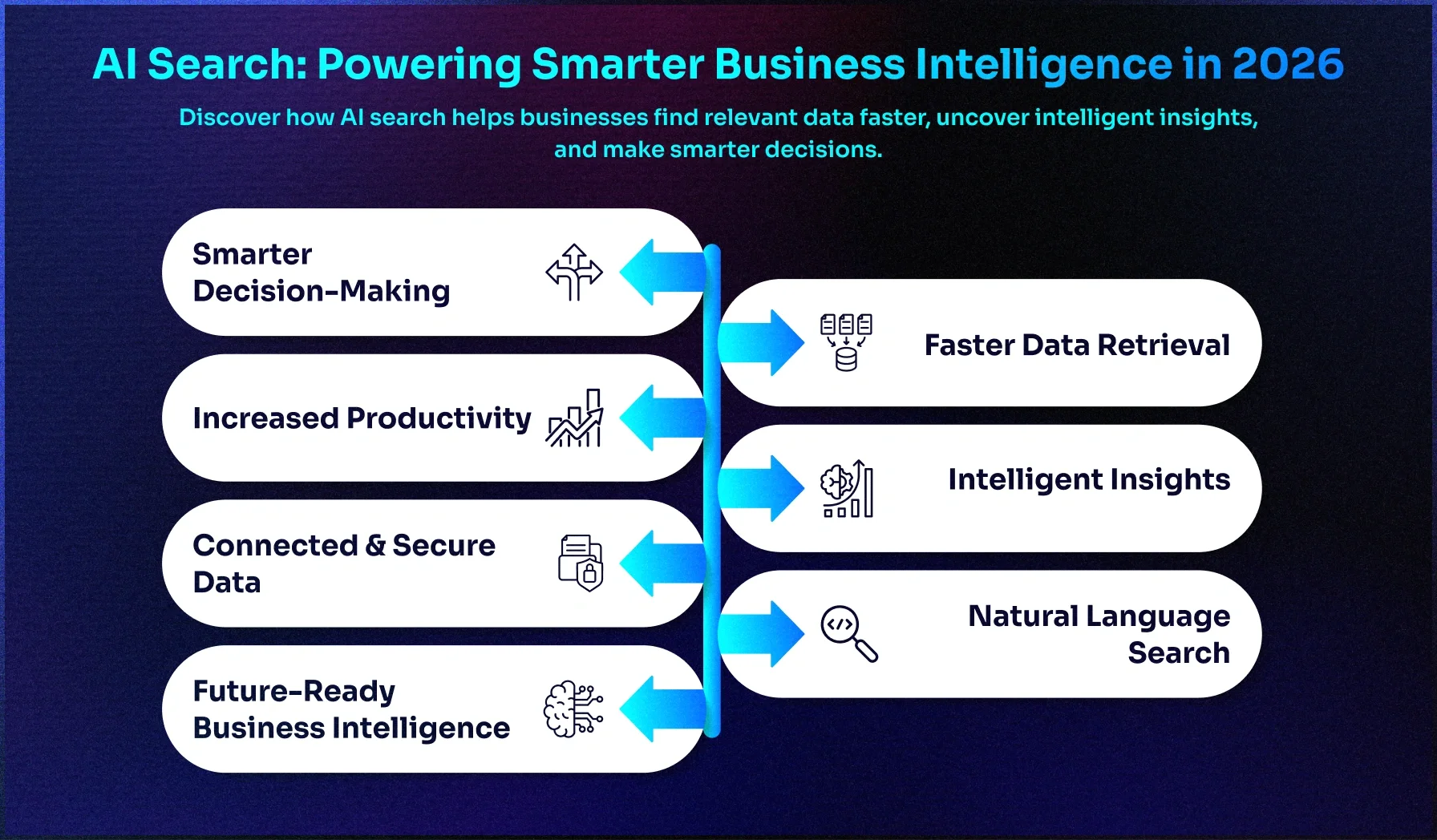
AI search is becoming increasingly important as businesses deal with growing volumes of complex information. By understanding natural-language queries and the context behind them, AI-powered search helps teams find relevant data faster, reducing the time and resources spent searching through documents, databases, and internal systems. Beyond simple information retrieval, AI search can analyze queries and business context to surface meaningful insights, recommendations, and related information. This supports faster and more informed decision-making while creating a smoother experience for employees and customers who need quick access to relevant information.
Traditional Search vs. AI Search
Traditional search typically relies on matching keywords between a user's query and available content. While this approach works well for straightforward searches, it can struggle when users use conversational language, misspellings, or complex questions.
AI search takes a more intelligent approach by analyzing the meaning, context, and intent behind a query. Instead of simply returning documents containing matching keywords, AI-powered search can identify semantically related information and surface results that are more relevant to what the user is actually looking for. This makes AI search particularly valuable for businesses where information is distributed across databases, CRM systems, documents, knowledge bases, and other applications.
How AI Search Works
AI search combines natural language processing (NLP), machine learning, semantic search, vector embeddings, and contextual understanding to deliver more intelligent and relevant search results. When a user submits a query, NLP models analyze the language and intent behind it, while vector embeddings convert the query and available content into numerical representations that allow the system to identify semantically related information.
AI search can also use hybrid search, combining traditional keyword matching with semantic retrieval to improve both accuracy and relevance. In advanced implementations, retrieval-augmented generation (RAG) retrieves relevant information from business databases, documents, or knowledge bases and provides it as context for an AI model to generate a grounded response.
By combining these technologies, AI search can move beyond simple keyword matching and provide businesses with faster, context-aware access to complex data and organizational knowledge.
Business Benefits of Adopting AI Search
Implementing AI search can provide significant benefits by making valuable information easier to find, understand, and use. With faster access to accurate and relevant data, teams can make more informed decisions without spending excessive time searching through documents, databases, and internal systems.
AI-powered search can also improve operational efficiency by reducing repetitive information-retrieval tasks and helping employees focus on higher-value activities. By streamlining workflows, improving productivity, and reducing the time and resources required to access business information, organizations can lower operational costs and achieve a stronger return on investment.
Ultimately, AI search enables businesses to turn their growing data into actionable insights while creating a more efficient and intelligent way of working.
Real-World Business Use Cases for AI Search
AI search can be applied across departments and industries to make business information easier to discover and use.
Customer Support
Support teams can use AI search to quickly find relevant product documentation, troubleshooting guides, previous support cases, and knowledge-base articles. This can help representatives resolve customer issues faster and provide more accurate responses.
Sales and CRM
Sales teams can search customer profiles, previous conversations, account activity, product information, and opportunities using natural-language queries. Instead of manually reviewing multiple CRM records, sales representatives can quickly discover information relevant to an account or opportunity.
Internal Knowledge Management
Businesses often have valuable information spread across documents, presentations, policies, wikis, and internal applications. AI-powered enterprise search can provide employees with a more intuitive way to discover organizational knowledge without needing to know exactly where the information is stored.
E-Commerce
AI search can improve product discovery by understanding conversational and descriptive searches. Customers can describe what they need in natural language, while semantic search helps identify products that match their intent rather than relying solely on exact keywords.
Business Intelligence
AI search can make business data more accessible by allowing users to ask questions about reports, customer trends, operational data, and other business information. This can help teams discover insights without relying entirely on manual data exploration.
Challenges and Best Practices
While AI search can significantly improve how businesses access and use information, successful implementation requires careful planning and ongoing management. Data quality is one of the most important factors, as inaccurate, outdated, or poorly structured information can negatively affect search relevance and reliability.
Businesses should also provide proper user training to help employees understand how to interact with AI search and make the most of its capabilities. Data security and access control are equally important, particularly when AI search connects sensitive customer, financial, employee, or internal business information.
In addition, continuous monitoring and optimization are essential for maintaining performance as business data, user needs, and technology evolve. By maintaining high-quality data, protecting sensitive information, supporting users, and regularly evaluating search performance, organizations can build a more reliable and effective AI search experience.
Common Implementation Mistakes to Avoid
Although AI search can deliver substantial value, poor implementation can limit its effectiveness and lead to unreliable results. One common mistake is neglecting user feedback, as employees and customers can provide valuable insights into search accuracy, usability, and missing information.
Businesses should also avoid overlooking system integration. AI search should work smoothly with existing databases, CRM platforms, knowledge bases, and business applications rather than operating as an isolated tool.
Another important consideration is underestimating ongoing maintenance. AI search systems require regular updates, data quality checks, performance monitoring, and optimization to remain accurate and relevant as business information changes.
Organizations should also avoid implementing AI search without clearly defining what success looks like. Establishing measurable goals around search relevance, user satisfaction, productivity, or operational efficiency makes it easier to evaluate whether the solution is delivering real business value.
Future Outlook for AI Search
The future of AI search is set to become more intelligent, contextual, and deeply integrated into the way businesses interact with information. As AI technologies continue to evolve, search systems will become better at understanding complex queries, user intent, and business context, delivering more accurate and personalized results.
AI search is also likely to work more closely with AI agents, virtual assistants, enterprise applications, and multimodal technologies, enabling users to find and act on information through natural conversations and more intuitive interfaces.
At the same time, growing concerns around data privacy and security will make secure data handling, access controls, and responsible AI practices increasingly important. These advancements will help businesses create faster, smarter, and more secure ways to discover and use information.
Practical Checklist for Implementing AI Search
A successful AI search implementation starts with a clear strategy, reliable data, and continuous improvement. Before deploying an AI-powered search solution, businesses should assess their existing data infrastructure and identify the information sources that need to be connected.
Organizations should define clear objectives and measurable outcomes, then select an AI search platform or architecture that aligns with their business requirements, data volume, security needs, and scalability goals. It is equally important to train employees so they can use the system effectively and understand its capabilities.
Finally, businesses should continuously monitor search accuracy, user feedback, system performance, security, and business results to identify opportunities for optimization and ensure the solution continues to deliver value as requirements evolve.
How Suave Creators Can Help
At Suave Creators, we help businesses harness the power of AI to transform how they search, manage, and utilize their data. Our team develops custom AI search solutions designed around your business processes, data sources, and specific goals.
From understanding your requirements and connecting relevant information sources to implementing intelligent search capabilities and optimizing performance, we help create solutions that are scalable, secure, and user-friendly.
Whether you need an AI-powered knowledge base, enterprise search solution, or intelligent search functionality within an existing application, Suave Creators can help turn complex business data into accessible, actionable insights that support productivity, efficiency, and long-term growth.
Bottom Line
AI search is more than a growing technology trend—it is becoming a valuable business capability for organizations navigating an increasingly data-driven world. By making information easier to discover, understand, and act upon, AI-powered search can help businesses improve decision-making, increase productivity, streamline operations, and uncover valuable insights hidden within their data.
As AI continues to evolve in 2026 and beyond, organizations that adopt secure, scalable, and intelligent search solutions can stay ahead of changing customer expectations and build a stronger competitive advantage.
Investing in AI search today can help businesses turn their data into smarter decisions and prepare for a more intelligent digital future.