





 +91 88949 00142
 +1 (307) 435-9605
What started as a straightforward $75/user/month contract inevitably escalates. You add custom reporting add-ons, purchase sandbox environments, upgrade tiers to unlock basic role permissions, pay for API call packs, and hire specialized third-party implementation consultants charging $220 to $300 an hour just to add a custom field to your pipeline.
By year three, a 60-person revenue and operations team is frequently spending $180,000 to $260,000 annually on software licenses—while their sales reps actively avoid the platform because it takes eight clicks and two slow screen reloads just to log a discovery call.
In 2026, mid-market businesses are increasingly rejecting this model. Rather than renting rigid multi-tenant SaaS environments, forward-looking companies are turning to bespoke CRM engineering.
By investing in an owned system, organizations eliminate per-seat licensing penalties, retain 100% data and code ownership, and gain an operational engine engineered precisely around their proprietary sales cycles.
Here is the architectural, financial, and migration blueprint for how mid-market teams successfully replace commercial SaaS with custom software.
The True 3-Year TCO: Multi-Tenant SaaS vs. Bespoke Engineering
When software buyers compare buying off-the-shelf software to building custom software, they often make a critical mistake: they compare the initial development cost of a custom build against only Year 1 software seat licenses, completely ignoring the compound consulting, add-on, and renewal escalations built into SaaS contracts.
To see the financial reality, let’s look at a typical mid-market company with 65 total CRM users (40 sales reps, 15 customer support specialists, and 10 executive/operations managers) over a standard 36-month horizon.
3-Year Total Cost of Ownership (TCO) Comparison
| Cost Element | Commercial SaaS Stack (Salesforce / HubSpot Enterprise) | Bespoke Custom CRM (Suave Creators Engineering Model) |
|---|---|---|
| Year 1 License / Dev Costs | $165,000 (65 seats @ 165–210/mo avg + required add-ons) | $55,000 – $75,000 (Turnkey milestone-based build) |
| Implementation & Integrations | $45,000 (Third-party implementation agency fees) | Included in initial development scope |
| Year 2 Operational Costs | $181,500 (Standard 10% contract renewal escalation) | $7,200 (AWS/GCP hosting & Redis infrastructure) |
| Year 3 Operational Costs | $199,650 (Further contract escalation + team expansion) | $7,200 (Infrastructure hosting & storage) |
| Maintenance & Feature Iterations | $60,000 (Ongoing retainer for certified platform admins) | $24,000 (Optional 20 hrs/mo SLA retainer) |
| Total 3-Year Capital Outlay | $651,150 | $93,400 – $113,400 |
| Asset Value at End of Year 3 | $0 (100% operational expense; zero equity) | High-Value Balance Sheet Asset (100% Owned IP) |
Over three years, bespoke CRM engineering delivers over $530,000 in direct cash savings for a mid-market team of 65 people.
More importantly, it shifts software spend from an extractive, inflating operational expense into an internal capital asset that strengthens company valuation during private equity or acquisition audits.
For companies evaluating similar economics across manufacturing or warehousing, our 3-year enterprise software TCO models demonstrate that the financial delta is equally dramatic in ERP environments.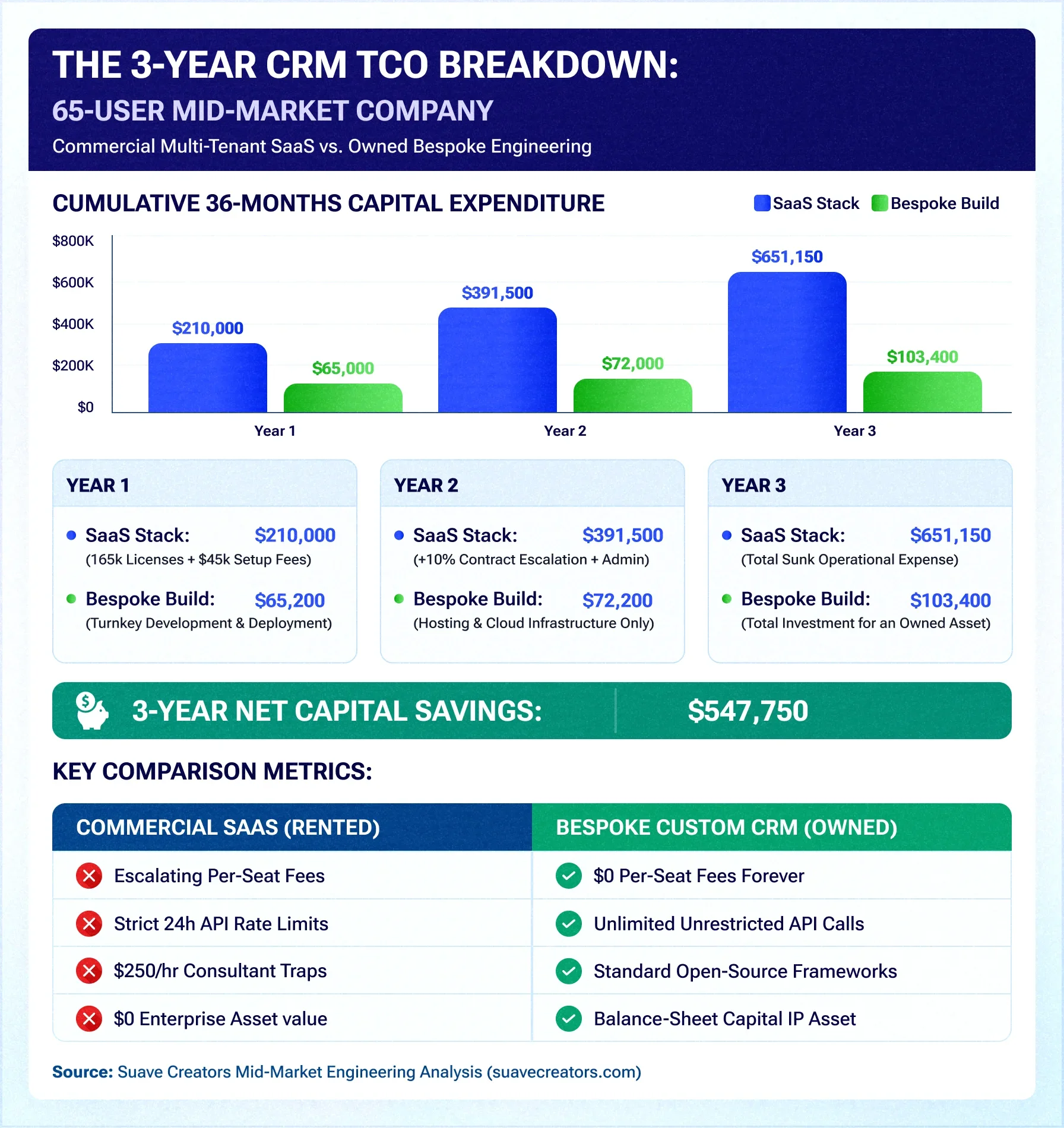
The Four Operational Walls of Commercial SaaS
The financial penalty is significant, but the operational frustration is often what actually drives the push to custom software. Commercial CRMs are engineered to serve millions of generic businesses simultaneously. To make that architecture work, vendors impose rigid constraints that bottleneck unique operational workflows.
Commercial SaaS Bottlenecks
- The Per-Seat Tax (Every hire penalizes margins)
- API Rate Caps (High-frequency data syncs are restricted)
- Rigid Object Schemas (Custom logic requires complex workarounds)
- Bloated Interfaces (Reps spend more time logging than selling)
1. The Per-Seat Penalty on Support & Field Teams
Commercial CRMs charge per user seat. As a consequence, companies intentionally limit who gets access.
Field reps, warehouse managers, and junior technicians are routinely locked out of the CRM to save license costs. Staff are forced to email customer notes to a "licensed user" who manually copies them into the system. In a custom system, user seats cost zero dollars. You can give access to 500 warehouse workers, drivers, or external contractors without paying an extra cent.
2. Arbitrary API Limits and Sync Throttling
If you operate real-time systems—such as live freight telematics, high-volume e-commerce transactions, or IoT tracking—commercial CRMs will actively throttle your connections.
Standard Salesforce API quotas limit the number of calls you can make in a 24-hour rolling window. Once you cross that threshold, your integrations silently fail or queue indefinitely unless you negotiate expensive contract expansions.
3. Rigid Object Models vs. Your Actual Business Logic
Off-the-shelf CRMs organize data around rigid parent-child relationships (Leads, Contacts, Accounts, Opportunities).
If your business runs on a non-standard operational unit—such as multi-truck logistics dispatch, equipment rental rotations, or doctor-patient compliance chains—you are forced to build awkward custom objects and flow rules that break every time the vendor pushes a platform update.
4. Interface Bloat and Rep Burnout
Sales reps do not hate sales; they hate clicking through five nested tabs to update a deal stage. Commercial CRMs are packed with hundreds of enterprise configuration settings your team will never touch.
A bespoke system gives reps exactly what they need: a clean, responsive interface that loads in under 300 milliseconds, features direct keyboard shortcuts, and automates mundane administrative data entry.
Architectural Blueprint: Building a High-Performance Custom CRM
A custom CRM should never be built using brittle "no-code" builders that introduce another layer of vendor dependency. It must be engineered on proven, enterprise-grade open-source technologies that your company owns forever.
1. The Core Relational Database: PostgreSQL with JSONB
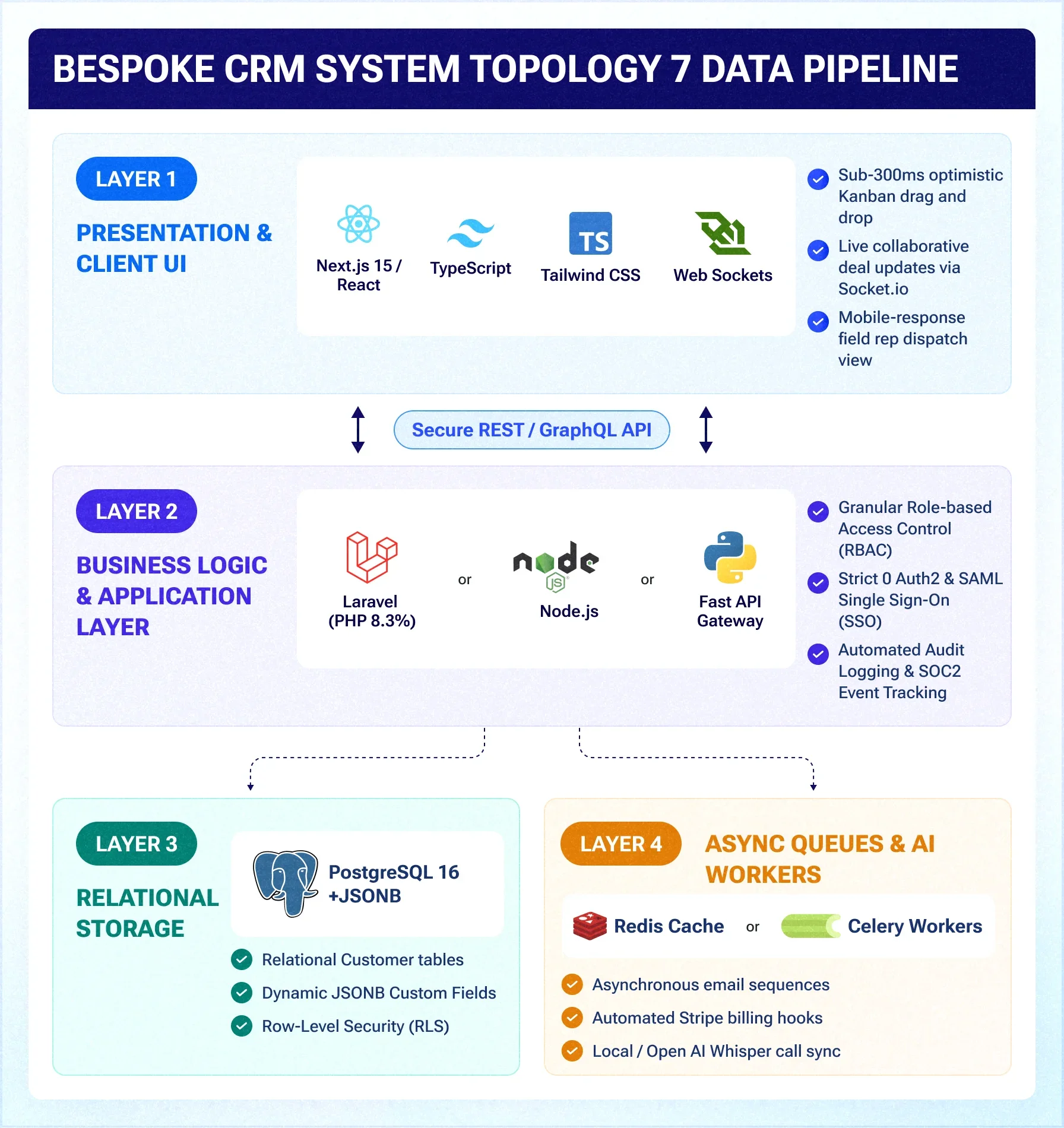
We build the data layer on PostgreSQL. Structured business records (customers, invoices, deal stages, contracts) are stored in clean, normalized relational tables to ensure strict ACID compliance.
To give your team the agility of a commercial platform, custom user attributes and dynamically configured deal properties are stored using PostgreSQL JSONB fields indexed with GIN (Generalized Inverted Index) trees. This allows your team to add custom attributes on the fly without running schema migrations or locking database tables in production.
2. The Application Framework: Laravel (PHP 8.3+) or Node.js
For the core business logic, Laravel provides a mature, secure foundation trusted by global enterprises. It includes native Object-Relational Mapping (Eloquent), fine-grained Role-Based Access Control (RBAC), built-in security protections against SQL injection and cross-site scripting (XSS), and a robust background queue runner.
When high-frequency real-time event streaming is required, we pair the backend with Node.js microservices.
3. Fast Asynchronous Processing: Redis Job Queues
Sales operations rely heavily on background processing: sending automated email follow-ups, fetching credit scores, processing webhooks, and updating ERP ledgers.
We decouple these tasks from the user interface using Redis-backed background workers. When a sales rep moves a deal to "Closed-Won," the UI updates immediately in less than 50 milliseconds, while the background queue quietly generates invoices, provisions accounts, and alerts fulfillment teams.
4. Reactive Frontend: Next.js, React & TypeScript
The interface is engineered as a responsive Single Page Application (SPA). By leveraging optimistic UI updates, drag-and-drop Kanban deal boards update instantly on the rep's screen before the server response even completes. If a network blip occurs, the application gracefully rolls back the state and alerts the user.
Native AI Integration: Moving Beyond $50/Seat SaaS Copilots
Commercial CRM vendors are currently charging an extra $30 to $50 per user per month for basic "AI add-ons" that do little more than pass prompt strings to external LLM APIs.
In a bespoke CRM, artificial intelligence is integrated directly into your database pipeline without third-party seat markups. You pay only for raw token usage directly to providers like OpenAI, Anthropic, or local open-weight models hosted on your own AWS infrastructure—typically costing pennies per day.
High-Impact Native AI Capabilities We Engineer:
Automated Call & Meeting Summarization: Audio recordings from sales calls are automatically transcribed via Whisper, summarized into structured bullet points, and mapped directly to customer fields without human intervention.
Deterministic Lead Qualification: Instead of relying on crude point-scoring rules, background LLM workers evaluate inbound leads against your ideal customer profile (ICP) criteria, assigning verified qualification tags and drafting customized briefing notes for sales reps.
Automated Follow-Up Generation: By analyzing past conversation history, the system drafts personalized follow-up emails that reference specific objections or requirements mentioned by the buyer.
Outreach & Prospect Discovery: If your sales strategy relies heavily on outbound discovery, we integrate the pipeline directly with platforms like The Suave App (AI CRM) to automate map-based company discovery and multichannel messaging sequences.
Real-World Proof: The TurboTrans Dispatch & Operations Engine
The power of bespoke engineering is best demonstrated through real production outcomes.
TurboTrans Corporation, a fast-scaling freight logistics provider, was severely constrained by off-the-shelf software. Their operations team was juggling commercial dispatch software, standalone accounting tools, and shared spreadsheets to manage hundreds of loads, trucks, and driver settlements.
Because standard software could not handle their dynamic spot-rate calculations or fleet telematics requirements without manual workarounds, their dispatchers spent hours re-entering data.
Suave Creators engineered a custom dispatch and fleet management platform tailored entirely to TurboTrans’s operational workflow.
TurboTrans Operational Transformation
-
42% Increase in Qualified Dispatch Leads
-
3.4x Faster Quote Response Times
-
85% Reduction in Administrative Paperwork
-
100% Real-Time Fleet Visibility
By connecting telematics hardware directly to their central database and automating quote routing, TurboTrans achieved 42% more qualified dispatch leads and reduced lead response times by 3.4x.
More importantly, their system operates with zero per-user software fees, allowing them to onboard dozens of new drivers, brokers, and dispatchers as their fleet expands without increasing their software overhead.
You can review our complete collection of production implementations on our client case studies page.
The 4-Stage Migration Playbook: How to Transition Without Risk
The number one fear leadership teams have about replacing Salesforce or HubSpot is data loss and operational disruption during migration.
Transitioning does not require a risky, sudden cutover. We execute a disciplined, 4-stage migration playbook that guarantees data integrity and zero business downtime:
The 4-Stage Migration Playbook: How to Transition Without Risk |
|---|
Stage 1: Schema Audit & Data Cleansing |
Stage 2: Staging Parity & Automated ETL |
Stage 3: The Parallel Run (2–4 Weeks) |
Stage 4: Off-Hours Cutover & Legacy Archive |
Schema Audit & Data Cleansing
We analyze your existing CRM data models, identify unused custom fields, and purge duplicate or unverified records before any migration scripts are written.
Automated ETL Pipeline & Staging Validation
We construct automated Extract, Transform, Load (ETL) scripts that map legacy data structures into your new PostgreSQL schema. Everything is verified in an isolated staging environment using automated checksum tests to confirm that every customer record, historical note, and transaction history matches to the penny.
The Parallel Run (2–4 Weeks)
Your operations team continues working in your old CRM while transactions are mirrored into the new custom platform. This allows department leads to validate real-world workflows and request minor UI adjustments with zero business risk.
Off-Hours Cutover & Archival
The live switch occurs over a scheduled weekend window. A final delta sync captures any records created during the preceding 24 hours. The legacy CRM subscription is downgraded to a single read-only administrative seat for audit compliance, freeing your operating budget immediately.
Take Complete Control of Your Revenue Operations
Renting your primary revenue engine from multi-tenant SaaS vendors leaves your business vulnerable to escalating fees, arbitrary feature limits, and frustrating operational friction.
By investing in bespoke CRM engineering, you transform a compounding operational expense into a permanent, highly scalable company asset built to serve your team for the next decade.
If your team is ready to evaluate the technical feasibility, data migration requirements, and exact cost of building an owned CRM, our senior engineering team is available to help.
Schedule an Architectural Scoping Session
Speak directly with a solutions architect to review your data schemas, integration dependencies, and implementation roadmap.