





 +91 88949 00142
 +1 (307) 435-9605
Today, fast and accurate delivery has become a basic requirement for consumers, rather than just a benefit. This encompasses the entire Logistics & Supply Chain Apps to bring goods from the manufacturer to the end consumer's location.
Custom software can streamline logistics and eliminate delivery delays, ensuring efficient supply chain management.
The logistics and supply chain process is one that requires a highly complex, coordinated effort involving thousands of products and many types of vehicles, warehouses, and routing systems (such as Vox and Routes) that must be in place at all times. If outdated tools (such as spreadsheets or disparate computer systems) are used to manage the logistics and supply chain process, it will be almost impossible to manage the logistics and supply chain efficiently, resulting in many mistakes, the possibility of lost orders, and delayed delivery to customers.
The Big Three Ways Custom Software Kills Delays
1. Conquering the ‘Last Mile’ Challenge
The last part of the delivery process, referred to as the ‘last mile’, is one of the most expensive and complicated stages of shipping. Delivery route planning software eliminates this:
● Route Planning: The use of Logistics Software to help plan delivery routes has enabled delivery companies to use smart algorithms in real time based on traffic conditions and window restrictions from customers to calculate the most effective, fuel-efficient routes available (with respect to those conditions). This helps to eliminate excessive driving time and allows for fewer late arrivals.
● Driver in the Loop: By using logistics & supply chain apps on mobile phones, drivers can receive detailed route information, offer proof of delivery (which may consist of a photo and e-signature), and quickly inform the dispatch department about any difficulties (for instance, a road that is closed) that have occurred. This functionality is the core of effective last-mile delivery optimisation software.
2. Getting Everyone on the Same Page: Supply Chain Automation
The challenging part of the supply chain automation system is getting every part of a company to be able to share information so that one part can talk to another. For example, someone scheduling deliveries may have no clue there is a shortage of materials at a factory until it is too late. Supply Chain Automation Systems allow for this communication by connecting everything that happens from when an order has been placed, until the package has left the local distribution centre to be delivered to the customer, which allows the automation to perform things like:
● Automatically placing a new order for raw materials when stock is at a certain level
● It is done automatically when a delivery is made to the warehouse; the required check-in is carried out and the driver is guided to the unloading dock that is free.
● By doing this, the possibility of mistakes made by humans is removed, and the time that could be used waiting for someone to check a system or to call someone else for information is saved.
3. Total Control Over Assets: Warehouse & Fleet Management
Delays are typically caused by internal factors such as (misplaced product or malfunctioning truck).
By using Fleet & Warehouse management platforms, managers have complete visibility and access to real-time information regarding all items stored within their warehouse and vehicles located on the road.
● In the warehouse: Through the use of scanners/sensors, a warehouse management system provides accurate, real-time identification of each item in the warehouse to improve pick accuracy while reducing the costs associated with returns and delays.
● On the road (fleet): Fleet management systems allow all companies to monitor the location of vehicles, track the fuel consumption of vehicles, identify vehicle maintenance schedules, and anticipate upcoming service needs, thus eliminating the worry of losing time and money on repairs and expenses during transport.
The Custom Advantage: Why a Tailored System Beats Generic
Even if you consider off-the-shelf software as a cheap alternative, it might turn out very quickly that your firm needs to go through a rather unpleasant change to be able to work with the software's requirements. Actually, the situations in which a company faces further problems and longer times for initial setup because of this are quite typical.
Custom software can provide numerous benefits:
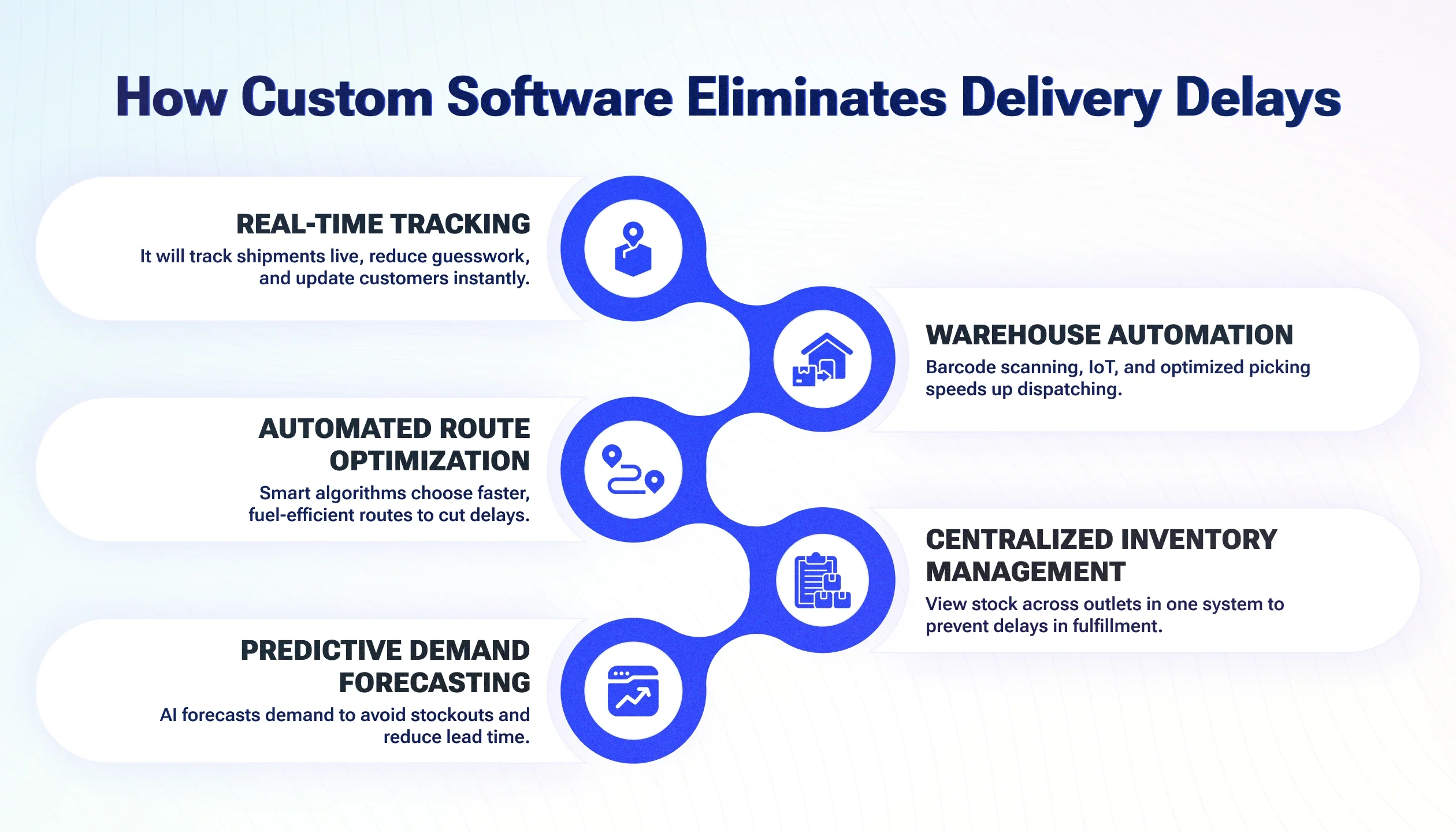
● Real-Time Tracking: Customers receive real-time tracking of their shipments as they happen.
● Automated Route Optimisation: Algorithms to optimise routing based on the fastest and most fuel-efficient routes to provide minimum delivery time and delay.
● Predictive Demand Forecasting: AI technologies predict future demand trends and help prevent stockouts and reduce lead times.
● Warehouse Automation: Employs technologies such as scanners, IoT devices, and consistent optimisation of picking to increase the speed of processing items for shipment.
● Centralised Inventory Management: Provides a comprehensive view of all items across multiple locations to eliminate delays in fulfilment.Choosing to use specialised logistics Software Development Services enables businesses to go from the management of figuring out what went wrong with deliveries (reactive problem-solving) to ensuring that problems don’t occur in the first place via planning for them (proactive management).
Conclusion
Successful operations will be implemented via customised software in both the fields of Logistics and Digital Marketing; the future expects immediate, efficient service! Therefore, in terms of Logistics and Supply Chain, customised Software Solutions are vital for an organised, efficient system that maximises efficiency through accurate Route Planning, Automation & Asset Management (Reliable, On-Time Delivery).
Suave Creators are proficient in designing outstanding, optimised websites to improve online presence and increase revenue streams. When an organisation requires Custom Excellence rather than Off-The-Shelf (Generic) Setups to accomplish success within complex environments, the most viable path for achieving continuous commercial success is through Customisation.