





 +91 88949 00142
 +1 (307) 435-9605
Suave Creators builds custom CRMs and offers Suave CRM. We include a custom option in this list and note when an off-the-shelf tool is the better choice. Prices are vendors' published list prices, checked in early 2027.
Your best rep just lost a shipper to a competitor. Not on price: the follow-up on a quoted lane sat in someone's inbox for three days. Meanwhile, load details live in the TMS, contacts live in a spreadsheet, and the rate history lives in one person's head. A logistics CRM puts customers, lanes, quotes, and loads in one place, so nothing slips. Here are the features that matter and six options worth comparing.
What Is the Best CRM for Logistics Companies?
It depends on your systems. Freight brokers already on Salesforce often choose Revenova, a Salesforce-native TMS with CRM built in. Forwarders on Magaya can add Magaya CRM. Small brokers and 3PLs that mainly need sales tools usually start with HubSpot or Zoho. Companies with unusual workflows build a custom logistics CRM.
Key takeaways
- A general CRM tracks people and deals. A logistics CRM also tracks lanes, quotes, loads, and carriers.
- The most important feature is a two-way sync with your TMS.
- Logistics-specific tools cost more but fit better. General CRMs are cheaper but need setup.
- A custom CRM makes sense when your quote-to-load process is your competitive edge.
What Is a Logistics CRM?
A logistics CRM is customer relationship management software built for, or adapted to, freight brokers, 3PLs, carriers, and forwarders. As well as contacts and deals, it stores each customer's lanes, quote history, load volume, margins, and service issues, and it shares data with the transportation management system (TMS) that runs operations. Sales sees what operations is doing, and operations sees what sales promised.
What Features Should a Logistics CRM Have?
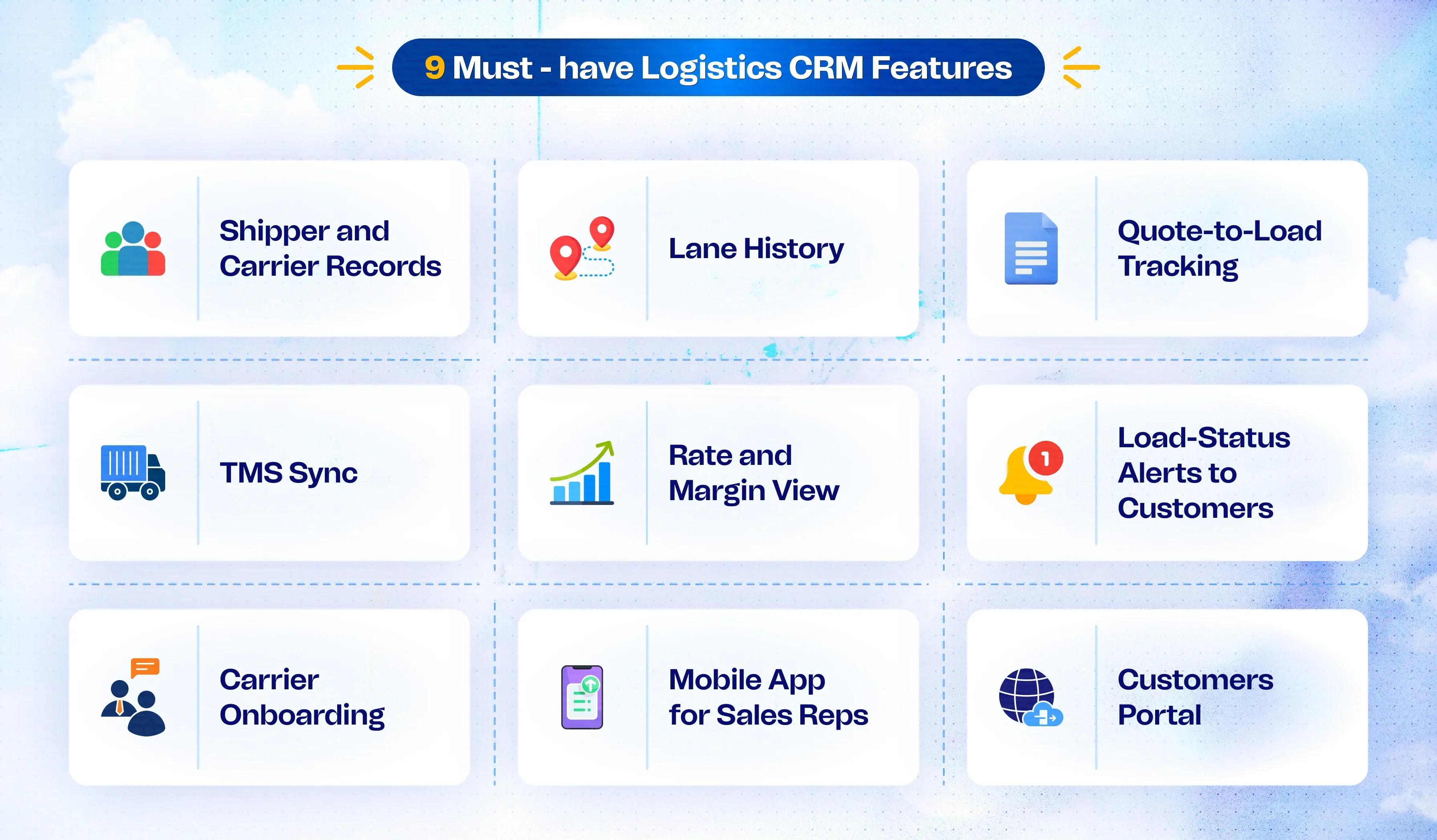
- Shipper and carrier records in one place, with contacts, credit terms, and documents
- Lane history: origin and destination pairs, volumes, and rates by customer
- Quote-to-load tracking: see which quotes became loads, and why others were lost
- TMS integration: loads, status, and invoices sync both ways
- Margin visibility: revenue, carrier cost, and margin per customer and lane
- Automatic customer updates: pickup, delivery, and delay alerts by email or text
- Carrier onboarding and compliance: insurance, authority, and safety documents with expiry alerts
- Mobile app for sales reps on the road
- Customer portal for quotes, tracking, and documents
The 6 Best CRMs for Logistics Companies Compared
| CRM | Type | Best for | Starting price (USD) | Connects to a TMS? |
|---|---|---|---|---|
| HubSpot Sales Hub | General CRM | Small brokers and 3PLs focused on sales and marketing | Free plan; Starter $20 per user/month | Through integrations or API |
| Salesforce Sales Cloud | General CRM, highly customizable | Mid-size and large logistics firms with admin support | Starter $25 per user/month | Through AppExchange apps or API |
| Zoho CRM | General CRM | Budget-conscious teams that want CRM plus accounting | Standard $14 per user/month | Through integrations or API |
| Revenova | Salesforce-native TMS with CRM | Freight brokers and 3PLs that want TMS and CRM in one platform | From $2,500 per company/month, plus Salesforce licenses | It is the TMS |
| Magaya CRM | Add-on for Magaya Supply Chain | Freight forwarders already using Magaya | Quote-based | Syncs with Magaya Supply Chain |
| Custom logistics CRM (Suave Creators) | Built for your workflow | Companies with unusual quoting, pricing, or customer processes | Typically $15,000–$40,000 for a first version; no per-seat fees | Built to sync with your TMS |
Prices: GoFreight, April 2026 (HubSpot, Salesforce, Zoho); RFP.wiki, citing Revenova's Salesforce AppExchange listing. Check current pricing on each vendor's site before buying.
1. HubSpot Sales Hub
Best for: small brokers and 3PLs that need strong email, sequences, and marketing.
HubSpot is easy to learn and has a free plan, so many small logistics teams start here. It has no freight data model, so you add custom properties for lanes and loads, or you sync from your TMS through an integration.
Pros: fast setup, a free plan, strong marketing tools. Cons: freight fields need custom setup, and costs rise quickly on the Professional tier. Price: free; Starter from USD 20 per user/month.
2. Salesforce Sales Cloud
Best for: mid-size and larger logistics companies with an admin or partner to customize it.
Salesforce can model almost any logistics process, and the AppExchange has logistics apps, including Revenova. The trade-off is complexity: most logistics companies need a Salesforce partner to set it up well.
Pros: very flexible, large ecosystem, strong reporting. Cons: setup cost and admin effort; add-ons increase the price. Price: Starter from USD 25 per user/month; higher tiers cost more.
3. Zoho CRM
Best for: cost-conscious brokers and carriers that also want Zoho Books and Zoho Desk.
Zoho offers a lot for its price, and Deluge scripting lets you add custom logic. Like HubSpot, it needs custom modules for lanes and loads.
Pros: low price, wide suite, customizable. Cons: the interface takes time to learn; it needs a freight-specific setup. Price: Standard from USD 14 per user/month.
4. Revenova
Best for: freight brokers, 3PLs, and shippers that want TMS and CRM on one Salesforce platform.
Revenova is a transportation management system that runs natively on Salesforce. It covers load planning, tendering, carrier and rate management, and freight billing and settlement, with Salesforce CRM workflows built in. Sales and operations share one database.
Pros: TMS and CRM in one system; the Salesforce ecosystem. Cons: you need Salesforce licenses as well, and implementation takes planning. Price: from USD 2,500 per company/month on AppExchange, plus Salesforce licenses; full pricing by quote.
5. Magaya CRM
Best for: freight forwarders and logistics service providers already running Magaya Supply Chain.
Magaya CRM is an extension of Magaya Supply Chain. It manages leads, accounts, pipeline, and quote history, with built-in dashboards, and syncs automatically with the quotes and accounts in Magaya.
Pros: no integration work for Magaya users; forwarding-focused. Cons: limited value if you don't use Magaya. Price: quote-based.
6. Custom Logistics CRM (Suave Creators)
Best for: companies whose quoting, pricing, or customer service process sets them apart, or whose TMS doesn't connect well to off-the-shelf CRMs.
A custom CRM is built around your lanes, quote rules, and approval steps, and syncs with your TMS, accounting system, and load boards. You own the code and pay no per-seat fees, which matters as your sales team grows. Read more about custom CRM development, or see our work on logistics and supply chain apps.
Pros: fits your exact workflow, no seat fees, full ownership. Cons: a higher upfront cost and a build time of 8–12 weeks. Price: typically USD 15,000–40,000 for a first version.
Also worth a look: Pipedrive (from USD 14 per user/month) for very small sales teams that want a simple pipeline. Just starting out? Try Suave CRM, which is free.
CRM vs TMS: Do Logistics Companies Need Both?
Usually, yes. A TMS runs operations: loads, carriers, tracking, and billing. A CRM runs revenue: leads, quotes, follow-ups, and account growth. The problems start when the two don't talk to each other. Choose one of three setups:
| Setup | How it works | Suits |
|---|---|---|
| TMS with CRM built in | One platform, e.g. Revenova or Magaya with Magaya CRM | Teams that want a single system |
| Separate TMS and CRM, integrated | Sync through an API or iPaaS | Teams happy with their current TMS |
| Custom CRM on top of your TMS | Built around your workflow, synced with your TMS | Teams with unique processes |
For connecting systems cleanly, see CRM integration.
How to Choose a Logistics CRM in 5 Steps
- List your systems. TMS, accounting, load boards, email. The CRM must connect to them.
- Map your quote-to-load process. Note where deals stall or data gets typed twice.
- Count users over three years. Per-seat pricing at 10 users looks very different at 40.
- Test with real data. Run a two-week trial with your own lanes and customers.
- Compare total cost. Include licenses, setup, integrations, and admin time, not just the monthly price. See what logistics software costs.
Get a CRM Built Around Your Lanes, Not Someone Else's
Tell us about your operation. We'll recommend the right CRM, off-the-shelf or custom, and if custom fits, we'll give you a fixed USD quote. Related: logistics software development.