





 +91 88949 00142
 +1 (307) 435-9605
Businesses have spent years automating repetitive tasks through workflows and rule-based software. In 2026, the next stage of automation is emerging: AI agents that can understand goals, analyze information, make decisions, interact with business systems, and complete multi-step tasks with limited human intervention.
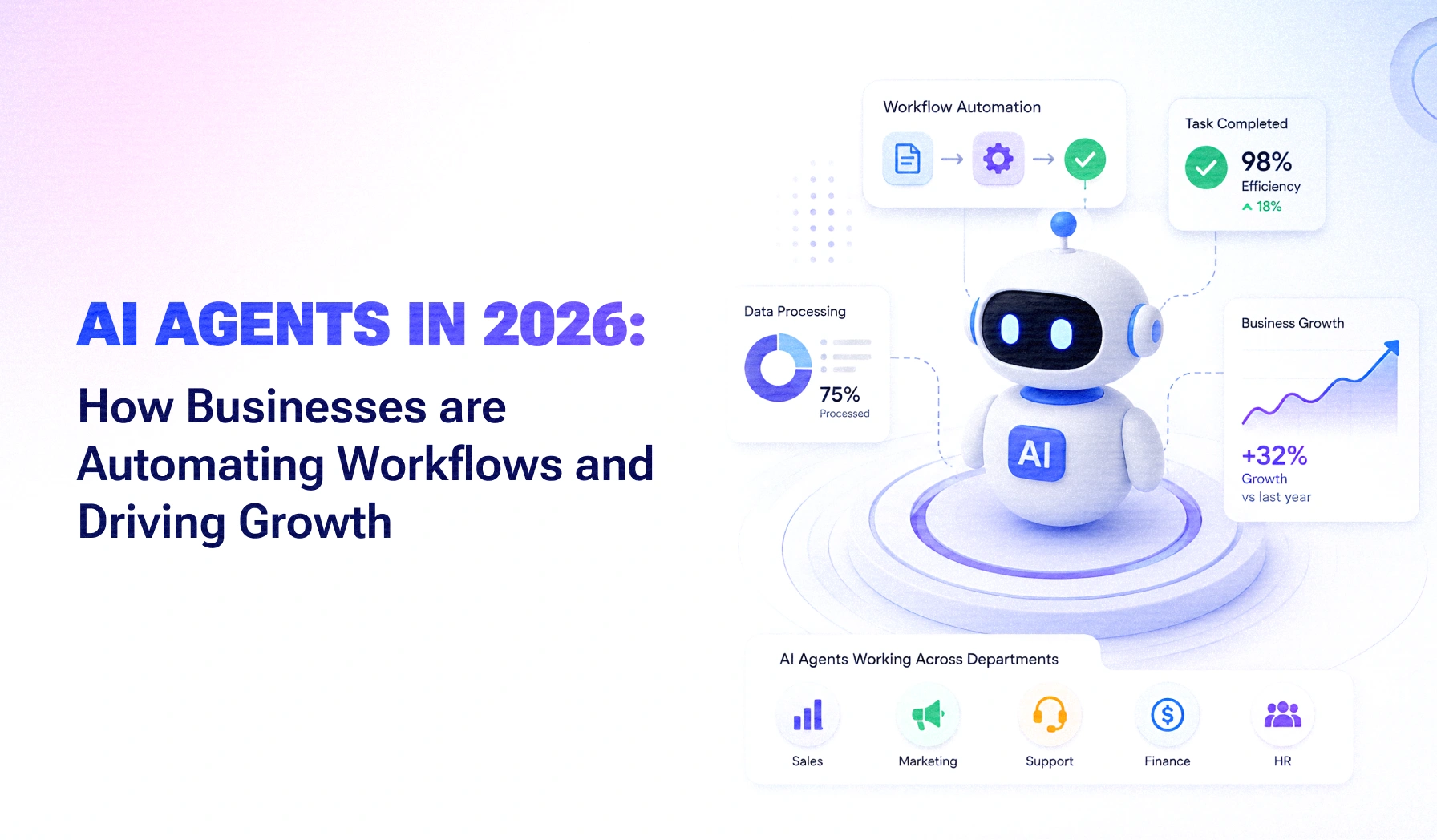
AI agents are transforming business workflows in 2026 by automating tasks, improving efficiency, supporting smarter decisions, and enhancing customer experiences.
What Are AI Agents?🔗
AI agents are intelligent software systems designed to understand goals, analyze information, make decisions, and take actions with limited human intervention. Unlike traditional automation, which follows predefined rules, AI agents can interpret context, determine the next steps, interact with business tools and systems, and complete multi-step tasks. While a chatbot is primarily designed to communicate with users and answer questions, an AI agent can go further by taking action on a user's behalf. For example, a chatbot might tell a customer their order status, while an AI agent could check the order management system, identify a delay, notify the customer, update the relevant record, and create a support ticket if needed. AI agents can also connect with CRM platforms, databases, APIs, email systems, and other business applications to retrieve information and execute tasks. A sales AI agent, for instance, could receive a new lead, analyze its information, check the CRM, research the company, assign a lead score, update the customer record, draft a personalized follow-up email, and notify the sales representative. This ability to understand an objective, decide what actions are required, use connected tools, and complete multiple steps makes AI agents significantly more flexible than traditional automation.
Why AI Agents Matter for Businesses in 2026🔗
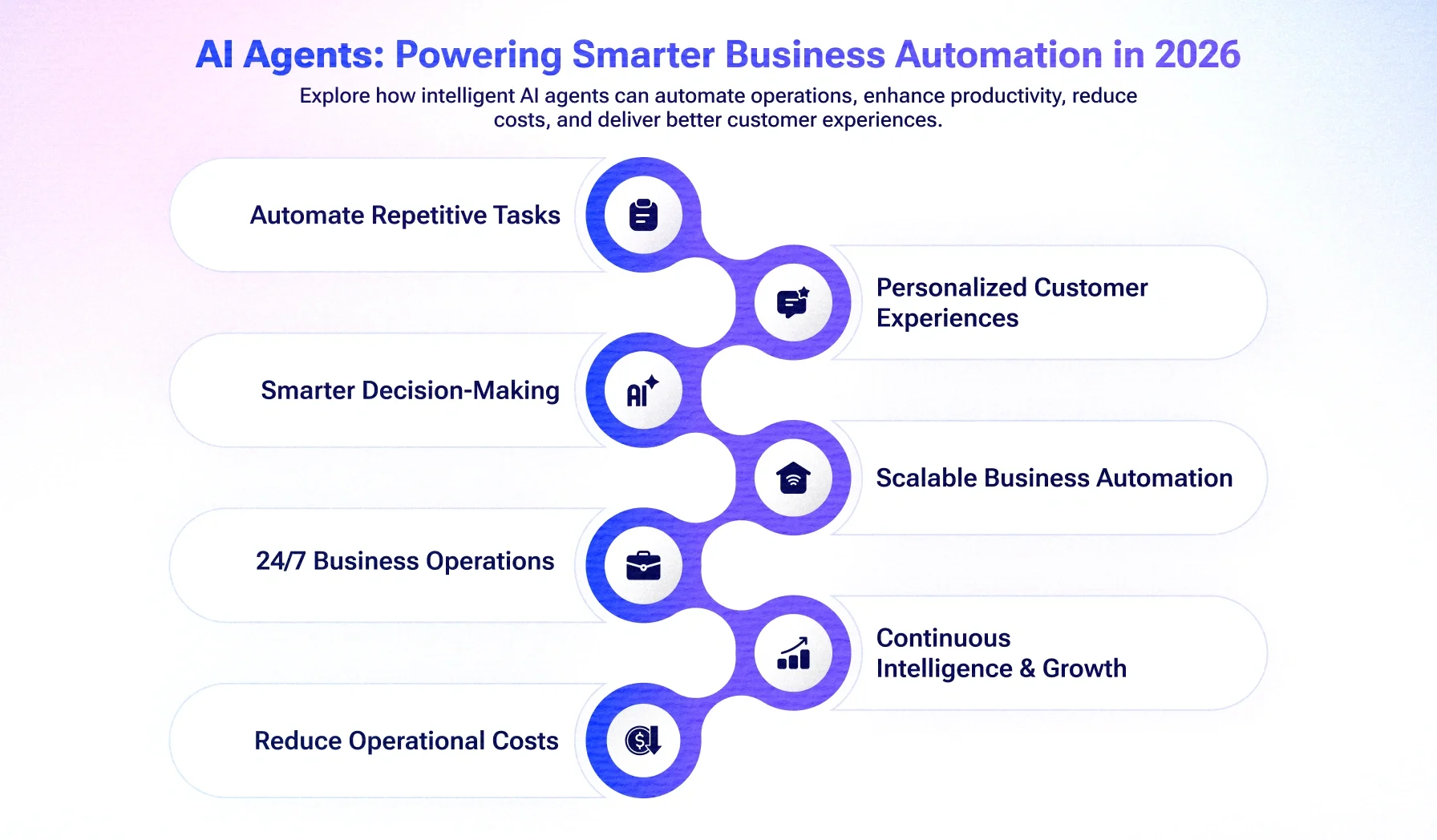
As businesses handle increasing amounts of data, customer interactions, and operational tasks, traditional workflows can become time-consuming and difficult to scale. AI agents are becoming an important part of modern business operations because they can automate repetitive processes, analyze information, support decision-making, and work across multiple systems. By taking care of routine and time-intensive tasks, AI agents allow employees to spend more time on strategic work that requires creativity, expertise, and human judgment.
AI agents can also help businesses improve efficiency and reduce operational costs by completing tasks faster and minimizing avoidable errors. Their ability to process large volumes of information can provide teams with timely insights and recommendations, helping them make better-informed decisions. At the same time, AI agents can improve customer experiences by providing faster responses, personalized assistance, and continuous support across channels. As businesses look for ways to become more agile, productive, and customer-focused in 2026, AI agents can serve as a practical layer of intelligent automation across everyday workflows.
How AI Agents Work
AI agents work by combining artificial intelligence, business data, connected tools, and defined instructions to achieve a specific goal. Instead of simply following a fixed sequence of commands, an AI agent can understand the objective, determine the steps required, take action, and adjust its approach based on the results. A typical AI agent workflow involves the following stages:
- Understand the Goal: The agent first interprets the user's request or business objective and determines what needs to be accomplished.
- Collect Relevant Information: It gathers the necessary information from sources such as databases, CRM systems, documents, APIs, websites, or other connected business applications.
- Reason and Make Decisions: The agent analyzes the available information, identifies the appropriate next steps, and makes decisions based on the instructions, business rules, and context provided.
- Use Business Tools: Through integrations and APIs, the agent can interact with tools such as CRM platforms, email systems, project management software, databases, and customer support systems.
- Execute Actions: Once the required actions are determined, the agent carries them out—for example, updating a record, sending an email, creating a task, generating a report, or notifying an employee.
- Evaluate the Result: The agent checks whether the action achieved the intended outcome. If something changes or the result is incomplete, it can determine the next appropriate step.
- Escalate to Humans When Necessary: AI agents should not handle every decision independently. When a situation is sensitive, complex, uncertain, or requires human judgment, the agent can hand the task over to an employee for review or approval.
For example, consider an AI agent handling a customer support request. It can understand the customer's issue, retrieve their account and order information, determine the appropriate response, update the support system, and respond to the customer. If the issue involves a refund, complaint, or situation outside its defined permissions, it can escalate the case to a human support representative.
Business Benefits of Adopting AI Agents🔗
Adopting AI agents can help businesses improve productivity, streamline operations, and deliver more consistent experiences as they grow. By automating routine and time-consuming tasks, AI agents can support teams without requiring every process to scale through additional manual effort. They can also operate around the clock, making them useful for customer support, monitoring, data processing, and other workflows that require continuous availability.
Another major benefit is personalization. AI agents can use relevant customer and business data to provide more tailored interactions, recommendations, and responses. They can also analyze large volumes of information to identify patterns, trends, and opportunities that may be difficult to detect manually. When implemented with appropriate data controls and human oversight, these capabilities can help businesses make faster, more informed decisions while creating workflows that are more efficient, scalable, and responsive.
Challenges and Best Practices
While AI agents can significantly improve business workflows, successful implementation requires careful planning. Businesses need to consider how these systems will interact with existing processes, data, employees, and security requirements. Addressing these challenges early can help organizations achieve better results and reduce the risks associated with AI adoption.
Integration is one of the first challenges businesses may face. Connecting an AI agent with existing CRM platforms, databases, communication tools, or other business applications can require careful planning and technical expertise. Before implementation, businesses should identify the workflows that need improvement and determine which systems the AI agent needs to access.
Data quality and security are equally important. AI agents depend on accurate and relevant information to produce reliable results. Incomplete, outdated, or inconsistent data can lead to incorrect recommendations or actions. Businesses should establish proper data management, access controls, privacy measures, and security practices to ensure that AI agents work with trusted information.
User adoption and human oversight are also essential for long-term success. Employees may be hesitant to adopt AI if they do not understand how it affects their roles or how the technology benefits their work. Providing proper training, clearly defining responsibilities, and keeping humans involved in important decisions can help build confidence and encourage effective collaboration between employees and AI agents.
Common Implementation Mistakes to Avoid
Implementing AI agents without a clear strategy can limit their effectiveness and create unnecessary challenges. Businesses should avoid treating AI adoption as a one-time technology upgrade and instead focus on continuous improvement, employee involvement, and measurable business outcomes.
One common mistake is neglecting user training. Employees need to understand how AI agents work, what tasks they can handle, how to review their outputs, and when human intervention is required. Proper training helps teams use AI more confidently and effectively.
Another mistake is overlooking scalability. An AI agent may work well for a small workflow but become difficult to manage as business requirements increase. Organizations should consider future workloads, additional users, new integrations, and expanding use cases before choosing an AI solution.
Businesses should also avoid ignoring user feedback. Employees and customers who interact with AI systems can provide valuable insights into what is working and where improvements are needed. Regularly reviewing feedback, performance data, errors, and workflow outcomes allows businesses to refine AI agents over time.
Finally, businesses should avoid automating the wrong processes. Not every workflow needs an AI agent. Organizations should first identify repetitive, time-consuming, and well-defined processes where AI can deliver measurable value. Starting with a focused use case and expanding gradually can lead to a more successful AI implementation.
Future Outlook for AI Agents
The future of AI agents is moving toward more capable, connected, and autonomous business systems. As AI models become better at understanding context, reasoning through complex tasks, and working with different software tools, businesses will be able to use agents for more than simple automation. AI agents are expected to support increasingly complex workflows across areas such as sales, customer service, marketing, finance, operations, and internal business processes.
Businesses are also likely to move toward multi-agent workflows, where multiple specialized AI agents work together to complete larger tasks. For example, one agent could analyze customer information, another could prepare a recommendation, and a third could update business systems or communicate the results to a team member. At the same time, human oversight, security, privacy, and governance will remain important as AI agents take on greater responsibilities.
As these technologies mature, the focus will shift from simply asking "What can AI automate?" to "Which business processes can AI agents improve safely and effectively?" Organizations that identify the right use cases, establish appropriate human oversight, and integrate AI into their existing workflows will be better positioned to improve efficiency, adapt to changing demands, and create new opportunities for growth.
Practical Checklist for Implementing AI Agents
Implementing AI agents successfully requires more than simply selecting an AI tool. Businesses should take a structured approach that connects the technology to specific business objectives and measurable outcomes. Start by assessing existing workflows and identifying repetitive, time-consuming, or error-prone processes where AI can provide meaningful value. Once a suitable use case is identified, define clear goals and success metrics before selecting an AI agent solution that fits the organization's requirements.
Next, ensure that the AI agent has access to accurate, relevant, and secure data, with appropriate permissions and safeguards in place. Businesses should then integrate the agent with the necessary tools and systems, such as CRM platforms, databases, communication tools, or internal applications. Employees should receive proper training and guidance so they understand how to work with the AI agent, review its outputs, and know when human intervention is required.
Finally, monitor the agent's performance continuously by tracking accuracy, task completion, time savings, errors, and business outcomes. Collect feedback from employees and customers, identify areas for improvement, and refine the workflow over time. Starting with a focused use case, measuring its impact, and gradually expanding successful implementations can help businesses adopt AI agents more effectively and responsibly.
How Suave Creators Can Help
At Suave Creators, we help businesses turn AI opportunities into practical, scalable solutions that improve everyday workflows. Our team can help identify processes where AI agents can deliver meaningful value, design customized AI-powered workflows, and integrate intelligent automation with existing business systems.
From AI agent development and workflow automation to API integrations, CRM solutions, and custom software development, we focus on building solutions around your specific business requirements rather than applying a one-size-fits-all approach. We can also help businesses establish appropriate human oversight, optimize workflows, and continuously improve AI solutions based on real-world performance.
Whether you are exploring your first AI-powered workflow or looking to expand an existing automation strategy, Suave Creators can help you plan, build, integrate, and scale AI solutions that support your business goals.
Bottom Line
AI agents are moving beyond the idea of future technology and becoming a practical part of modern business operations. By automating repetitive tasks, analyzing information, supporting decision-making, and working across business systems, they can help organizations improve efficiency, reduce operational workload, and deliver more responsive customer experiences.
However, successful AI adoption is not simply about automating as many tasks as possible. Businesses need to identify the right workflows, use reliable data, maintain appropriate security and human oversight, and continuously measure results. Organizations that take a thoughtful and strategic approach to AI agents can build more efficient, scalable, and adaptable operations while creating new opportunities for growth and innovation.