





 +91 88949 00142
 +1 (307) 435-9605
Let me be direct about something: healthcare software is one of the hardest categories of software to build well. Not because of the code itself - but because of what's riding on it.
Build secure, HIPAA-compliant healthcare software. Learn encryption, compliance frameworks, and architecture for reliable medical apps.
A billing error in an e-commerce app? Annoying. A data breach in a hospital system? Patients get hurt, careers end, and the organization spends years trying to recover its reputation. I've watched teams underestimate this and pay for it badly.
So this guide isn't about covering the basics quickly. It's about the real stuff - the architecture calls, the compliance traps, the performance decisions that actually matter when you're building software that clinicians and patients depend on every day.
Whether you're a small team building your first EHR module or an engineering org modernizing systems that haven't been touched in a decade, this is worth reading before you write a single line of production code.
Why Healthcare Is a Different Beast Entirely
Every software project comes with constraints. Healthcare just comes with more of them - and the consequences of ignoring them are more severe.
Think about what you're actually working with:
Regulations that differ by country - HIPAA in the US, GDPR in Europe, India's DPDP Act - and all of them have teeth
Data that ranges from demographic details to radiology images, each type carrying different sensitivity and storage requirements
Legacy systems at hospitals that were never designed to talk to modern APIs but still must
Availability expectations that are basically 99.99% - a patient management system going down during a night shift isn't a minor inconvenience
Full audit trails for everything, because regulators and lawyers will ask for them
Mess any of this up and you're not dealing with a bad review or a churn spike. You're dealing with regulatory fines, potential lawsuits, and the kind of press coverage no company wants.
Getting Your Head Around Compliance - Before You Start Building
Here's where most teams make their first mistake: they treat compliance like something to sort out later, once the product is taking shape. That's backwards. The compliance requirements should shape your architecture - not get retrofitted into it.
These are the frameworks you'll most likely need to know:
HIPAA - Still the Big One for US Healthcare
If you're touching US patient data, HIPAA is your baseline. Full stop. The law breaks down into two parts most dev teams need to care about: the Privacy Rule (who gets to see PHI and under what circumstances) and the Security Rule (the technical controls you need to protect electronic PHI).
Fines go from $100 to $50,000 per violation. The "we didn't know" defence doesn't hold up. Build it in from day one.
GDPR - Stricter Than Most People Realize for Health Data
Health data sits in GDPR's "special category" - which means it gets extra protections beyond regular personal data. If any of your users are EU residents, GDPR applies to you regardless of where your servers are or where your company is registered. Data minimization, explicit consent, and the right to deletion aren't optional features. They need to be in your data model from the beginning.
HL7 and FHIR - The Data Language of Modern Healthcare
These aren't legal frameworks - they're how healthcare systems actually talk to each other. HL7 v2 is the old standard (still everywhere in hospitals). FHIR is the modern replacement, built on REST APIs and JSON, and it's now mandated by US regulators for certain use cases. If your software needs to talk to any EHR platform, lab system, or insurance payer, learn FHIR. It'll save you enormous pain.
SOC 2 - The Ticket Into Enterprise Healthcare Deals
If you're building a healthcare SaaS product and you want hospital systems as customers, they will ask for your SOC 2 Type II report. Not a Type I - the Type II, which shows your controls actually worked over time, not just that they existed on paper during an audit. Budget 9-12 months for your first one and start earlier than you think you need to.
What Security-First Architecture Actually Means in Practice
"Security by design" is one of those phrases that gets thrown around a lot and means very different things to different people. Let me make it concrete.
Encryption - Don't Argue About This One
I've seen teams push back on encryption requirements because of performance concerns. In almost every case, those concerns are overblown. The non-negotiables:
AES-256 for data at rest - databases, backups, file storage
TLS 1.2 minimum (TLS 1.3 preferred) for everything in transit - no exceptions
Backups encrypted separately, not just the live database
Key management through a dedicated service like AWS KMS or Azure Key Vault - not hand-rolled key storage
The performance hit is real but minimal. The cost of a breach is not.
Access Control - The Part Teams Usually Rush
Who gets to see what? This sounds simple until you start mapping out a real hospital environment with dozens of roles - physicians, nurses, residents, billing staff, lab techs, administrators, and on and on. A billing clerk doesn't need to see surgical notes. An on-call doctor shouldn't be pulling payroll data.
RBAC (role-based access control) works well for most cases. For more complex scenarios - like access that depends on the patient-provider relationship - look at ABAC (attribute-based access control). Either way, map out every role and every permission before your first database migration. Changing access control models later is painful and risky.
MFA - Not Optional Anymore
Require multi-factor authentication for every user. Yes, every user. Clinicians find it annoying at first - until you explain that a stolen password is the most common way hospitals get ransomwared. Adaptive MFA that only triggers on suspicious behaviour (new device, unusual hours, new location) tends to reduce friction while keeping the security benefit.
Zero Trust - The Model You Should Be Designing Around
The old approach assumed that if you were inside the corporate network, you could be trusted. That broke down a long time ago - and healthcare environments make it even worse. Remote staff, personal devices, third-party vendors with network access, cloud services... the perimeter is essentially gone. Zero Trust means every request gets verified. Every time. No free passes for being on the internal network.
Audit Logs - Build Them Like a Lawyer Will Read Them
Because someday, one will. HIPAA mandates audit trails. But even beyond compliance, logs are how you figure out what happened when something goes wrong - and something always goes wrong eventually. Log every read and write on patient data. Store logs somewhere tamper-proof and separate from your main system. Alert on anything unusual in real time. Don't batch-process audit events overnight - that's how small incidents become big ones.
Performance and Compliance: You Don't Have to Choose
A lot of developers assume that HIPAA compliance and fast software are in tension. They're not, really. The performance problems I've seen in healthcare systems almost never come from encryption overhead or access control checks. They come from bad database design, synchronous processing of things that should be async, and not planning for scale until the system is already struggling.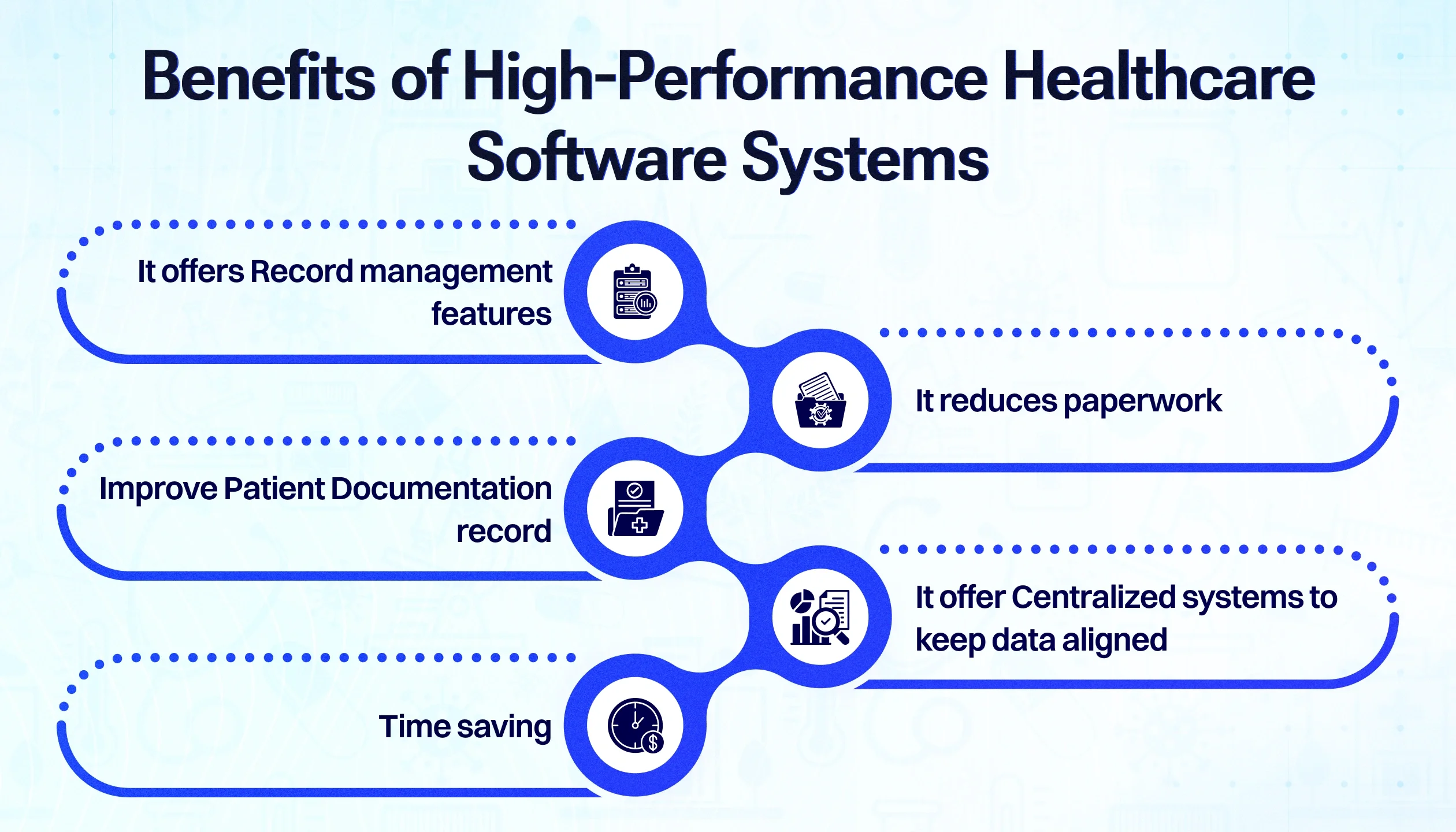
Build to Scale From the Start - Even If You're Small Now
Healthcare adoption curves can be steep, especially post-COVID. A telehealth platform that had 50 daily users in 2019 might be handling 5,000 today. Build stateless services that scale horizontally. A few other things that pay off early:
Database connection pooling - hospital shift changes create instant concurrency spikes
Read replicas for analytics and reporting - keep that load off your primary database
Cache non-sensitive reference data (drug lists, ICD codes, appointment types) - this data changes rarely and gets queried constantly
Pick Your Database Based on What the Data Actually Is
Patient records are deeply relational. A single patient touches dozens of data types - demographics, diagnoses, prescriptions, lab results, imaging orders, appointment history, insurance details. PostgreSQL handles this well and has solid support for the encryption and row-level security features you'll need. For medical imaging and unstructured documents, object storage (S3 with proper encryption and access policies) is the right tool. For fast search across records, Elasticsearch as a secondary read index works well - just make sure you're not storing PHI there without proper controls.
Push Heavy Work to the Background
Generating a 200-page clinical summary report, processing a DICOM imaging file, or running an insurance eligibility batch - none of these should be happening synchronously in your API layer. Use a message queue (RabbitMQ, Amazon SQS) and let background workers handle the heavy lifting. Your API stays fast, your clinical staff stays happy, and you're not hitting resource ceilings every time someone runs a large report.
High Availability Isn't a Nice-to-Have
When a hospital's system goes down during an overnight shift, people work around it with paper and memory. Errors happen. Sometimes patients get hurt. Your uptime standards need to reflect that. At minimum:
Multi-AZ deployments - a single data center failure shouldn't take you down
Automated failover for your database layer
Tested restore procedures for backups (not just backups - tested restores)
Documented RTOs and RPOs that your clinical stakeholders have actually agreed to
Scheduled disaster recovery tests - at least twice a year, run the actual failover
Integrations: Where Security Usually Falls Apart
No healthcare system is an island. You'll integrate with EHRs, lab systems, insurance payers, pharmacy platforms, government databases. Each integration is a potential security gap if you treat it carelessly.
A few rules that will save you:
Use FHIR R4 for clinical data exchange wherever you can - it's increasingly the mandated standard, and it makes interoperability dramatically simpler
OAuth 2.0 with proper scoping for all API authentication - don't roll your own auth here
Treat all incoming external data as untrusted until it's been validated and sanitized - yes, even from reputable vendors
For legacy HL7 v2 integrations (and there will be some), use a proper integration engine like Mirth Connect or Azure Health Data Services rather than custom parsing code
Keep a register of every third-party vendor who touches PHI - you need a BAA with each of them, and HIPAA requires you to know who they are
DevSecOps - Security Can't Live in One Team's Backlog
If security only gets reviewed before a release, it'll get deprioritized under deadline pressure. Every time. The only sustainable approach is to make security part of the regular development workflow - automated where possible, with humans reviewing what automation can't catch.
What that looks like in practice:
SAST scanning on every pull request - tools like Snyk or SonarQube catch a lot before code gets merged
Dependency scanning to flag known vulnerabilities in third-party libraries
DAST testing against staging environments before major releases
Annual penetration testing by an independent firm - internal red teams are good, external testers find different things
PHI must never appear in application logs, error messages, or monitoring dashboards - make this a linting rule, not just a policy
Credentials in code is a firing offense - use HashiCorp Vault, AWS Secrets Manager, or equivalent; never .env files committed to repos
Testing Healthcare Software: Standard QA Isn't Enough
I've seen healthcare software that passed every automated test and still failed badly in real clinical environments. The reason is usually that the tests were written by developers who had never spent time in a hospital. Testing in this domain needs to go beyond what typical QA covers.
Clinical workflow testing - sit with actual nurses, physicians, and lab techs and watch them use the software. You'll discover friction points no test script would catch
Data integrity testing - patient records need to remain accurate and consistent across every possible read/write combination. Test the edge cases obsessively
Compliance testing - does the system actually enforce HIPAA access controls in all scenarios, not just the happy path?
Load testing - simulate what happens when 500 staff log in at 7am shift change. Most systems haven't been tested at that concurrency level
Failover testing - don't assume your HA setup works. Take components offline deliberately and verify the behaviour
Mistakes That Come Up Again and Again
These aren't exotic edge cases. I see versions of these on nearly every healthcare project I come across:
Treating HIPAA like a one-time certification - it's not. It requires ongoing monitoring, staff training, and policy updates as systems change
No BAA with cloud vendors - if you're storing PHI on AWS, Azure, or GCP, you need a signed Business Associate Agreement with them. Shockingly common oversight
Using real patient data in dev/test environments - always use synthetic or properly de-identified data outside of production. Always
Collecting more patient data than you need - if your application doesn't need a field, don't store it. Less data means less exposure
Building secure software that clinical staff hate using - frustrated users find workarounds, and workarounds create security holes. UX matters for security, not just usability
Tech Stack: What Works Well in Healthcare Environments
There isn't a single right stack, and anyone who tells you otherwise is probably selling something. But some choices do make the compliance and security work easier:
Backend: Java has the longest track record in enterprise healthcare. Python is increasingly common for data-heavy use cases. Node.js works well for API-heavy systems - just be thoughtful about dependency management
Databases: PostgreSQL for relational clinical data (strong encryption support, row-level security, battle-tested). MongoDB with field-level encryption for flexible document needs. HAPI FHIR Server if you want native FHIR storage
Cloud: AWS, Azure, and GCP all offer HIPAA-eligible services and will sign BAAs. Google Cloud's Healthcare API is worth looking at if FHIR is central to your architecture
API Authorization: SMART on FHIR is the emerging standard for OAuth-based access in healthcare apps. Learn it
Messaging: Kafka for high-throughput event streams. RabbitMQ for simpler queue-based workflows. Either beats synchronous API calls for background processing
A Final Word
I'll be honest - healthcare software is exhausting to build correctly. The compliance requirements are detailed and unforgiving. The integration landscape is a mix of cutting-edge APIs and 30-year-old protocols running side by side. The stakes feel heavy because they are.
But there's something I keep coming back to: when it works, it really matters. A well-built patient records system means a doctor has the information they need at 2 AM in an emergency. A reliable medication management tool means fewer errors on a busy hospital floor. The people who depend on this software are real, and they're counting on it.
Start with the architecture, not the features. Make compliance part of sprint planning, not a final review gate. Test with the people who will actually use it. And build for the day when something goes wrong - because it will - and you need the system to handle it gracefully.
If your team is in the middle of a healthcare software project and you want a second opinion on your architecture, compliance approach, or security posture - we're happy to take a look.