





 +91 88949 00142
 +1 (307) 435-9605
The Indian online shopping industry is not merely growing; it is about to take off. The convergence of widespread adoption of digital devices, especially in smaller towns (tier-II and III), as well as a massive behavioural shift to shopping on mobile phones, has already driven the market to over 150 billion dollars. Experts estimate it is on a path to $345 billion by 2030—a clear, monumental market opportunity for any aspiring online business.
The opportunity presented by e-commerce in India is extraordinary, though it's inherently characterised by scale and diversification of users
Opening an online shop is not the end; it is just the beginning. To succeed in today’s fast-paced, competitive, digital market, an online store has to be strong and entirely customer-centric. In this guide, we have come up with all the essential steps, features, technologies, and expenses to launch a remarkable e-commerce website and mobile app right here in India.
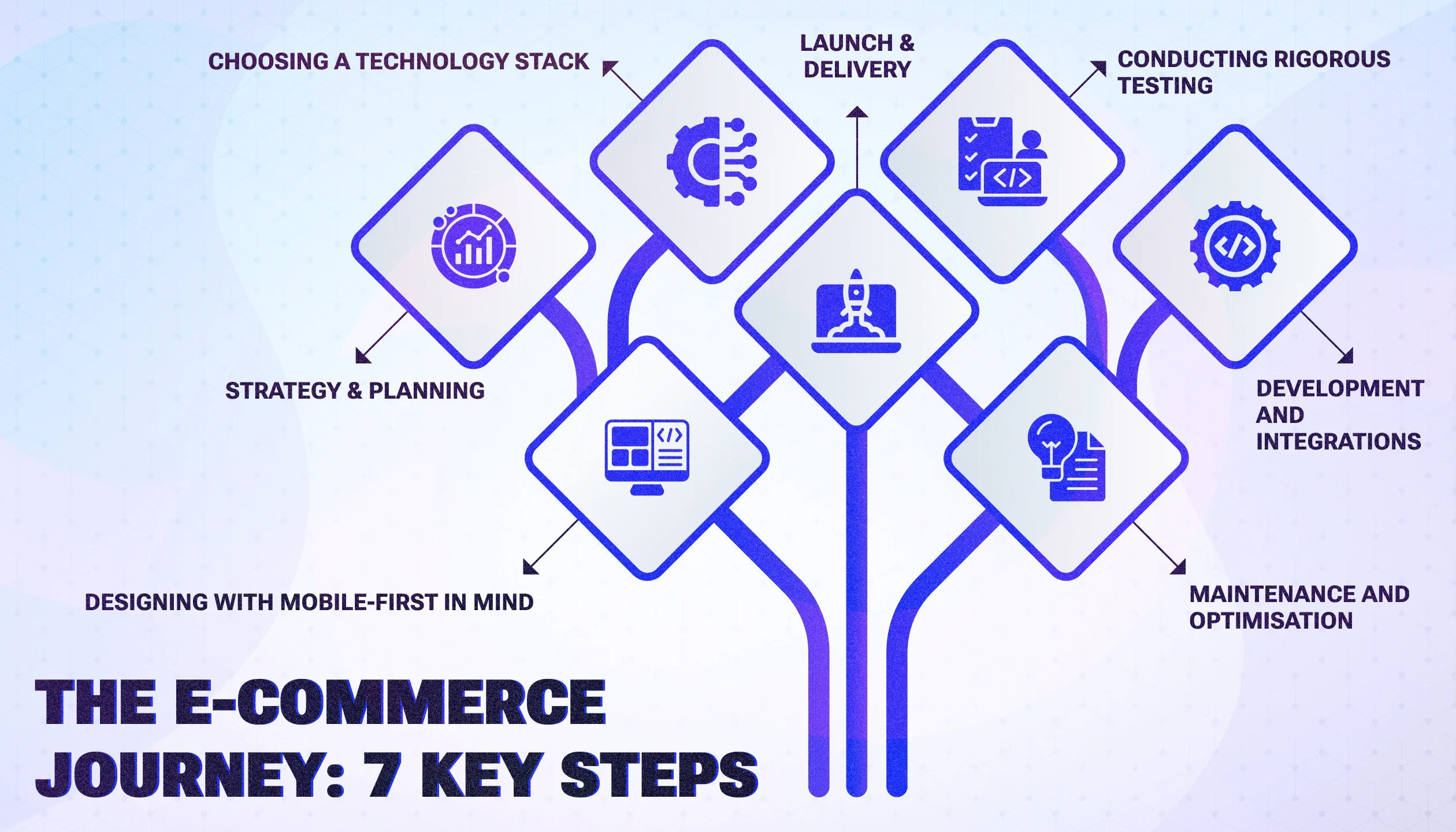
I. The E-commerce Journey: 7 Key Steps
To create a strong, future-proof e-commerce platform, you have to follow a defined, verified process. Bypassing those steps means you are compromising your security, customer experience, or completely jeopardising your possibilities to shine in the future.
Strategy & Planning
You must understand your business’s goals before you launch an app. You have to find out whether your business is B2C, a D2C brand or a multivendor marketplace. Next, undertake a detailed analysis of the Indian market, specifically your target user's behaviour and, importantly, their preference in regional language. Look at your competition (the big names and the niche competition). This whole planning process will emerge with a granular roadmap that addresses features, security, and scalability objectives.
Choosing a Technology Stack
The technology stack is the digital basis of your company that will set the speed, scalability, and maintenance costs. Generally, businesses use frameworks like Node.js or Python (Django) for web applications. If you want to enter the market and want to make a position, consider platforms like Magento or Shopify.
Since mobile is popular in India, your app strategy is important! Choose quick and affordable tools like Flutter or React Native. For best performance, you can use local tools (Swift/Kotlin), as they are budget-friendly too. You should always use a trusted cloud service (AWS/GCP) to prepare for spikes in Diwali traffic.
Designing with Mobile-First in Mind
A fantastic User Experience (UX) is your best tool to beat abandoned carts. With mobile leading the charge, you will want to think mobile-first: large tappable buttons, simple navigation, and loading times under 2 seconds. Your navigation will need to be intuitive for large catalogues. Shoppers can't touch the product, so use high-quality imagery to showcase products or utilise interactive video assets instead.
Development and Integrations
This is where the main coding happens! In addition to incorporating shopping cart logic into your site, the primary work is going to be localising the user experience with integrations:
Payments: Payment integration options must include local, high-volume options such as UPI, Net Banking, and popular e-wallets. Also, cod is mandatory!
Logistics: In addition to optimised delivery for pickups, you must provide integrations with local carriers (Delhivery, Blue Dart) to live track and fulfil local order deliveries throughout geographies in India.
Compliance: Fully integrate GST and Tax Modules to check all "boxes" for local compliance.
Conducting Rigorous Testing
A single bug can cost tens of thousands of sales and trust. Do some intense testing: Functional Testing (features work), Performance Testing (can handle the load), Security Testing (PCI compliance and data handling), and Usability Testing (gate testing and pest fix design problems from real people).
Launch & Delivery
When testing is complete, you can plan for the public release. First priority is the Google Play Store (Android is king), and then the Apple App Store. Finally moving the website to live production.
Maintenance and Optimisation
The launch is only the beginning. To attain endless success, you have to use security patches and keep running OS updates regularly. Don’t forget to check Analytics (Conversion Rates, Cart Abandonment) so you can keep adding new features based on real users' responses and trends in the marketplace.
II. Essential Localised Features for India
In order for your platform to be competitive and build trust with customers in the Indian market, the platform must include unique behaviours around the local market.
Trust & Payments: Cash on Delivery (COD) is still very important for getting access to customers in the rural market. Focus on UPI and Net Banking for a low-friction digital payment experience.
Logistics: A Pincode Serviceability check gives users instant information about whether or not delivery is possible. Trust is contingent on transparent Returns & Exchange Management.
Engagement: Regional Language Capability (initiated with Hindi) to attract the Tier-II and Tier-III economies. Incorporate Voice Search, which is becoming increasingly predominant amongst Indian users. Leveraging Social Logins (Google/Facebook) will provide the capability for easy sign-ups, and use Push Notifications to advertise and inform potential purchases.
Performance: Provide a Progressive Web App (PWA) solution, permitting users to still receive reasonable performance when internet speed is compromised. Make the platform performant across all 4G/5G as they are not all the same bandwidth.
III. Financial Investment: Costs in India
The cost of development can vary greatly depending on the complexity, features and customisation you require.
For a Basic Store, expect to pay approximately ₹50,000 to ₹1,50,000. This is often a template-based platform; either Shopify or WooCommerce often offers basic functionality, usually with limited functionality until around 100 products.
Mid-Level Custom totals generally range from ₹1,50,000 to ₹5,00,000, which will include a custom design, multiple payment and shipping API integrations, along with a base mobile app.
Enterprise/Marketplace pricing starts at approximately ₹10,00,000, and caps off around ₹1 Crore and above. They are fully customised solutions, built for extensibility, multi-vendor capability, and complex AI integrations.
In all fairness, once developed, there are annual recurring costs (hosting, security certificates, and maintenance) that will need to be factored into the budget, which can be anywhere from ₹10,000 and over ₹1,00,000 (based on complexity) annually.
IV. Future Trends to Integrate
To survive till the last in this competitive market, you need to build something that will be the trend setter:
Quick Commerce: Consumers demand essentials like groceries to be delivered in 30 minutes or less. Your application needs to have complex, integrated logistics and enable routing.
Artificial Intelligence (AI) Personalisation: It is crucial to use Machine Learning to automatically recommend products to users - and this will typically lead to a significant increase in conversion.
Social Commerce: Leverage the massive social audience. Build and add the ability for people to buy directly through platforms like Instagram and WhatsApp.
Tier Focus: Incorporate regional language content and promotions tied to local festivals in your plan to capture the emerging Tier-II and Tier-III markets.
Conclusion
The opportunity presented by e-commerce in India is extraordinary, though it's inherently characterised by scale and diversification of users. Promoting a successful digital platform in India is a strategic investment in building a sustainable and scalable business. As e-commerce operators, you will find success in the long-term, will rely on the security of your platform, a real, localised user experience, and the technology capable of handling massive spikes in growth, as well as ongoing changes in consumer expectations. By pursuing this process and adopting trends that exhibit "future-readiness", your e-commerce project will evolve into a thriving economic opportunity in the rapidly growing and changing digital economy of India.