





 +91 88949 00142
 +1 (307) 435-9605
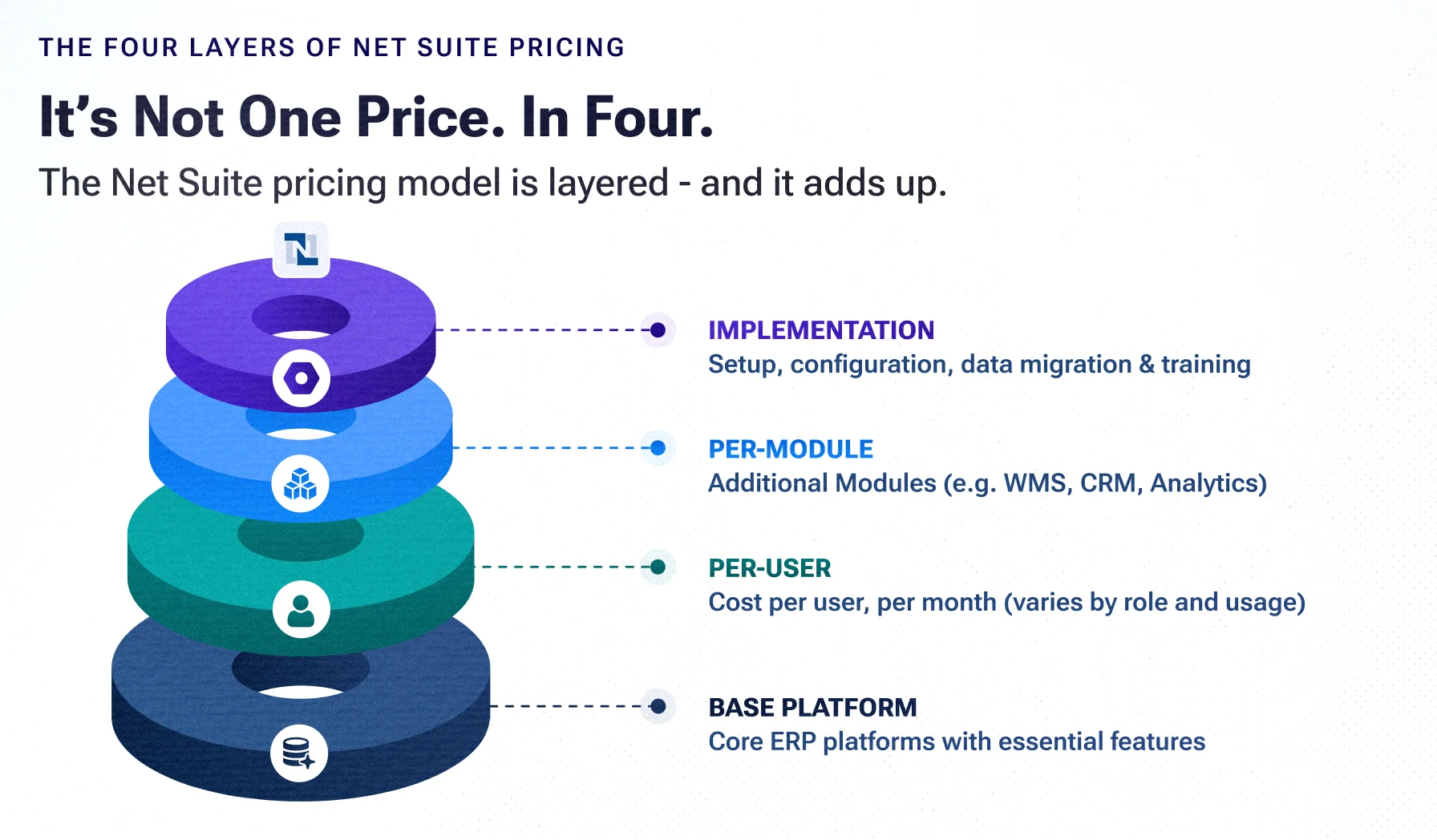
- The Module Trap: NetSuite is not one price — it is four stacked prices. A base platform subscription, per-user licences, per-module subscriptions, and a separate implementation project. Mid-market buyers consistently budget for the first and get invoiced for all four.
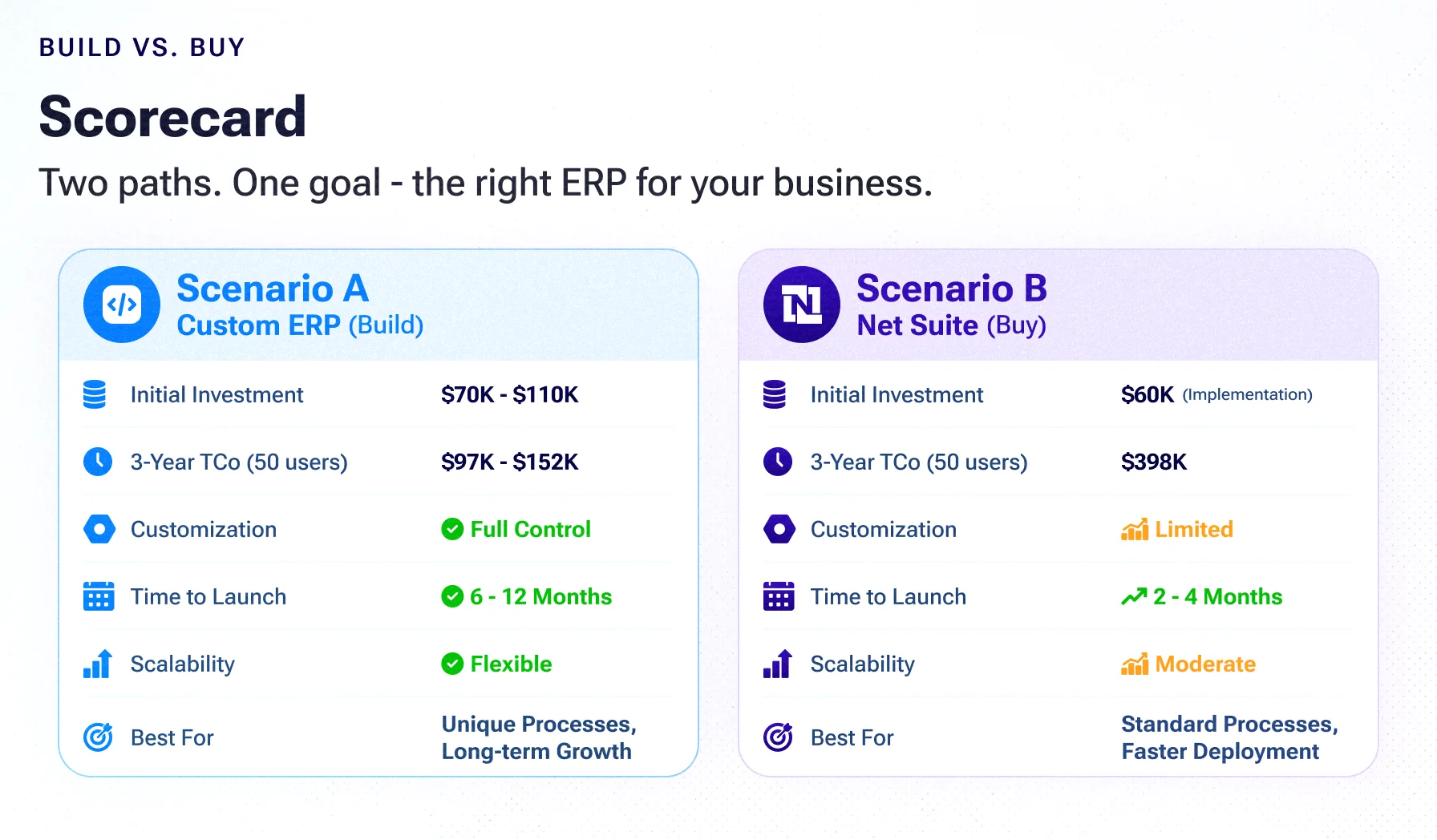
- Real 3-Year Spend: A 50-user distributor running financials, inventory, WMS, and analytics realistically commits $390,000+ over three years — and owns nothing at the end of it.
- The Custom Build Economics: A purpose-built ERP on Laravel/Node + PostgreSQL + React costs $70,000 to $110,000 one time, plus $9,000 to $14,000 per year in dedicated cloud hosting and maintenance. Three-year total: $97,000 to $152,000.
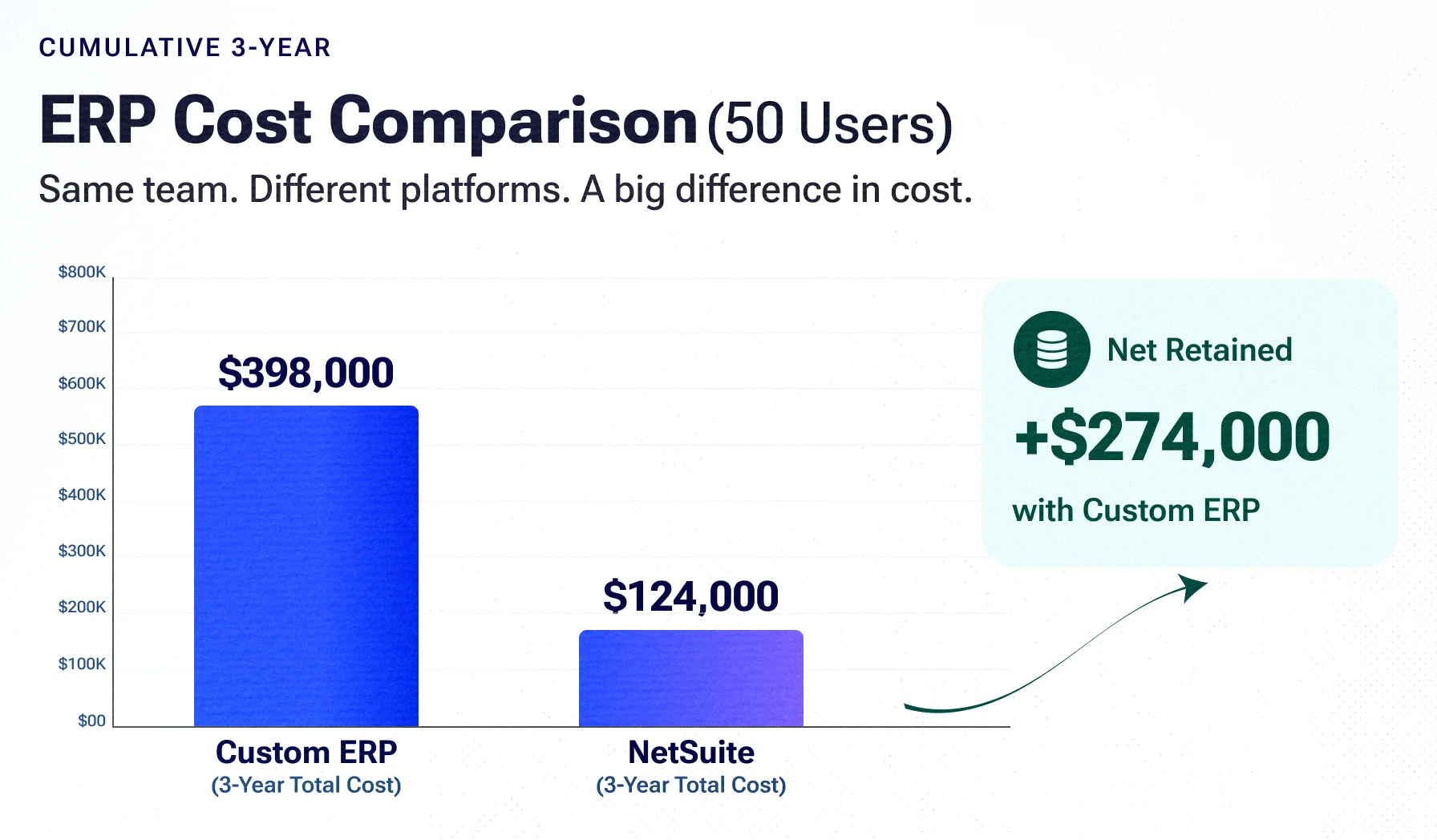
- Net Position: $246,000 to $301,000 retained over three years, zero cost per additional employee, and an ERP that appears on your balance sheet as an owned asset instead of a renewing liability.
- The Real Driver Isn't Price: Mid-market operators switch because their actual process — kitting, job costing, route-based dispatch, consignment inventory, multi-warehouse allocation — does not exist inside a standard ERP object model without six-figure customisation.
The 2026 ERP Problem: You Are Paying Enterprise Prices for a 70% Fit
Every mid-market manufacturer, distributor, and multi-location operator eventually hits the same wall. The finance team wants one system of record. Operations wants their actual workflow. The ERP vendor delivers a rigid object model and a certified partner who bills hourly to bend it.
The result is predictable: a platform that handles general ledger and AP beautifully, and handles your production floor, your quoting logic, or your freight allocation not at all. Teams route around it. Shadow spreadsheets multiply. Within eighteen months you are paying six figures annually for an expensive ledger with a reporting layer bolted on.
Compounding this, the commercial ERP pricing model punishes exactly the growth you are trying to fund. Every warehouse hire, every seasonal picker, every new account manager is another named licence. Every new capability is another module subscription. Renewal quotes rise annually regardless of whether your usage did.
The 3-Year TCO Breakdown: NetSuite vs. Custom Built ERP
Modelled on a US distributor running 50 full-access users with financials, inventory, warehouse management, and analytics.
| Financial & Technical Dimension | NetSuite (50 Full Users) | Suave Creators Custom ERP (Client-Owned) |
|---|---|---|
| Base Platform Licence (Year 1) | $12,000 ($999/month) | $0 |
| Full-Access User Licences (Year 1) | $69,000 (50 users @ $115/user/month) | $0 (Unlimited named users) |
| Add-On Modules (Inventory, WMS, Analytics) | $18,000+/year, billed per module | $0 (Modules built into the core application) |
| One-Time Implementation / Build | $60,000 (Certified partner configuration & migration) | $70,000 – $110,000 (Discovery, UI/UX, full production build) |
|
Year 1 Total
|
$159,000
|
$79,000 – $119,000
|
|
Year 2 Subscription (5% renewal uplift)
|
$103,950
|
$0 |
|
Year 2 Support / Infrastructure
|
$12,000 (Partner retainer, optimisation)
|
$9,000 – $14,000 (Dedicated AWS/GCP, backups, patching) |
|
Year 3 Subscription (compounded)
|
$109,148
|
$0
|
|
Year 3 Support / Infrastructure
|
$14,000
|
$9,000 – $14,000
|
|
3-Year Cumulative Spend
|
$398,000 (pure operating expense)
|
$97,000 – $152,000 (capitalised company asset)
|
|
Net 3-Year Capital Retained
|
Baseline
|
$246,000 – $301,000 (62–75% saving)
|
|
Cost Per Additional Hire
|
+$1,188 – $1,548 / year / user
|
$0 / year
|
|
Change Request Economics
|
Partner change order, hourly
|
Internal sprint, owned backlog
|
|
Data & Schema Ownership
|
Vendor-hosted, proprietary object model
|
100% client sovereignty, open PostgreSQL schema
|
5 Operational Breaking Points: When a Custom ERP Becomes the Correct Decision
Price is the trigger conversation. These are the actual reasons operations leaders make the call.
1. Your Process Has No Native Object in Standard ERP
Kitting and light assembly, consignment stock, split-shipment allocation, job-level costing, broker margins, multi-UOM conversions on the same SKU. When your business logic requires stacking three custom fields and a scripted workflow onto a standard sales order, you are already paying to build custom software — you are just paying to build it inside someone else's rented container.
2. Your Licence Population Is Mostly Low-Touch
Warehouse scanners, shop-floor operators, field technicians, and seasonal staff do not need full ERP access — they need to scan, confirm, and close. Commercial vendors monetise this population with tiered licences that still carry real annual cost. A custom ERP gives you unlimited role-based access, with a warehouse operator seeing a single scan screen and a controller seeing the full ledger.
3. Integration Is Your Core Requirement, Not an Afterthought
Shopify or a custom storefront, Stripe, QuickBooks or Xero, 3PL APIs, EDI partners, carrier rate APIs, and shop-floor IoT telemetry. Commercial platforms meter API calls and gate connectors behind additional subscriptions. A custom ERP exposes unrestricted internal queries and purpose-built REST/GraphQL endpoints with no per-call ceiling.
4. Reporting Latency Is Costing You Working Capital
If your buyers cannot see true available-to-promise inventory in real time, you over-order. If your controller waits on a nightly batch for margin by customer, you under-price. A normalised PostgreSQL schema with a Redis cache layer returns operational dashboards in under a second on millions of rows — without a separate analytics module subscription.
5. You Want AI Embedded in Operations, Not Sold Back to You as a Copilot
Demand forecasting on your own sales history, automated PO suggestions from reorder velocity, anomaly detection on supplier lead times, and document extraction from inbound invoices and packing slips. Built into a custom ERP, these run against your private data with no per-seat or per-token vendor surcharge. Our AI Solutions team ships these as native modules, not add-ons.
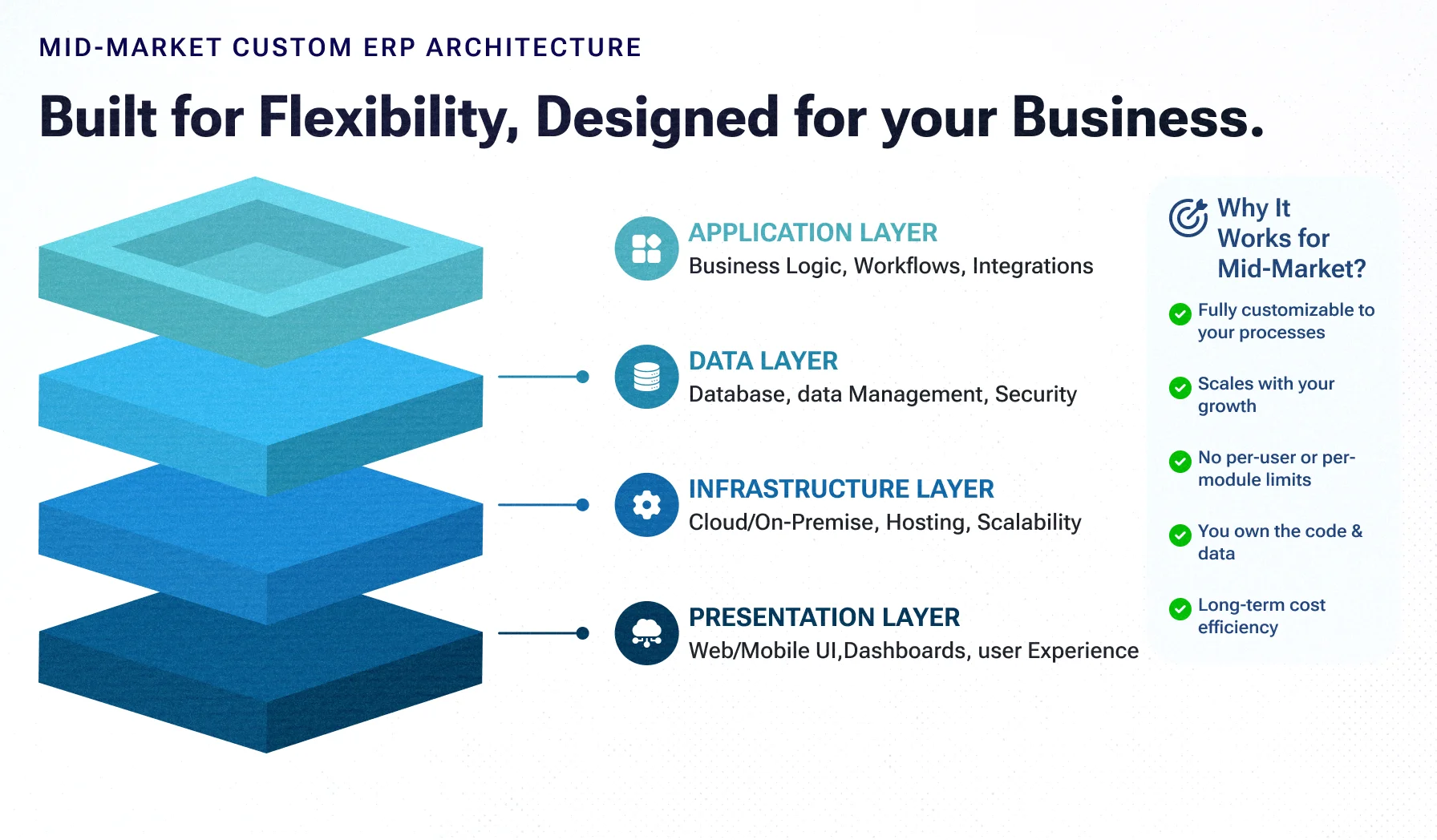
Technical Architecture: How a Mid-Market Custom ERP Is Built in 2026
Building a custom ERP in 2026 does not mean writing a general ledger from first principles. It means assembling proven, battle-tested frameworks around your operational schema. Typical production delivery: 12 to 20 weeks.
The ERP Migration Playbook: Moving Off NetSuite, SAP B1, or Spreadsheets Without Stopping Operations
|
The question every CFO asks first is: "What happens to eleven years of transaction history, and what happens to shipping on cutover week?"
|
|---|
|
Phase 1 — Operational Discovery & Schema Design. We map the real process, including the spreadsheets people actually use. Your operational model drives the database design, not the reverse.
|
| Phase 2 — Master Data Extraction & Sanitisation. Items, BOMs, customers, vendors, price lists, open POs and SOs, and inventory positions are extracted, deduplicated, and normalised. Dead SKUs and obsolete custom fields are retired before they pollute the new system. |
| Phase 3 — Financial Reconciliation. Trial balance, AR and AP ageing, and inventory valuation are reconciled line-for-line against the legacy system and signed off by your controller before cutover is scheduled. |
| Phase 4 — Parallel Run. Two to four weeks of dual entry on live transactions. Operations validates picks, ships, invoices, and month-end close in the new system while the legacy platform remains authoritative. |
|
Phase 5 — Delta Sync & Cutover. A scheduled low-volume window (typically a weekend or a plant shutdown), a differential script for transactions created during parallel run, and a go/no-go checklist.
|
|
Phase 6 — Hypercare. Two weeks of embedded engineering support on-site or on-call, followed by transition to a maintenance retainer.
|
Real-World Proof: Custom Operational Software in Production
Suave Creators builds operational systems that commercial platforms could not accommodate.
In our logistics engineering engagement documented in the Turbo Trans Corporation Case Study , we delivered real-time dispatch coordination and automated quote calculation logic that standard off-the-shelf transport software could not support — replacing manual coordination with a single operational source of truth.
In our AI-powered task and workflow engagement , we consolidated fragmented operational tracking into one accountable system, removing the spreadsheet layer that sits alongside most mid-market ERPs.
The pattern in both: the software was shaped to the operation, not the operation to the software.
Stop Renting the System Your Business Runs On
An ERP is the operational backbone of your company. It should be engineered around how you actually work, and it should belong to you.
- Explore Our Engineering Capabilities: Visit our Enterprise Software Solutions hub.
- Model Your Own Numbers: Schedule a free ERP discovery consultation with a senior software architect.